
In Black Bahr, maneuvering your ship is built around three core elements: the wind, the sails, and the ship’s wheel. To move the ship, you must position the sails according to the wind direction in the world. To steer the ship, you rely on the Ship’s Wheel.
Sails can be adjusted into three distinct configurations:
1- Fully Furled (Fully Closed) – The sails are rolled up and inactive. They won’t catch the wind.
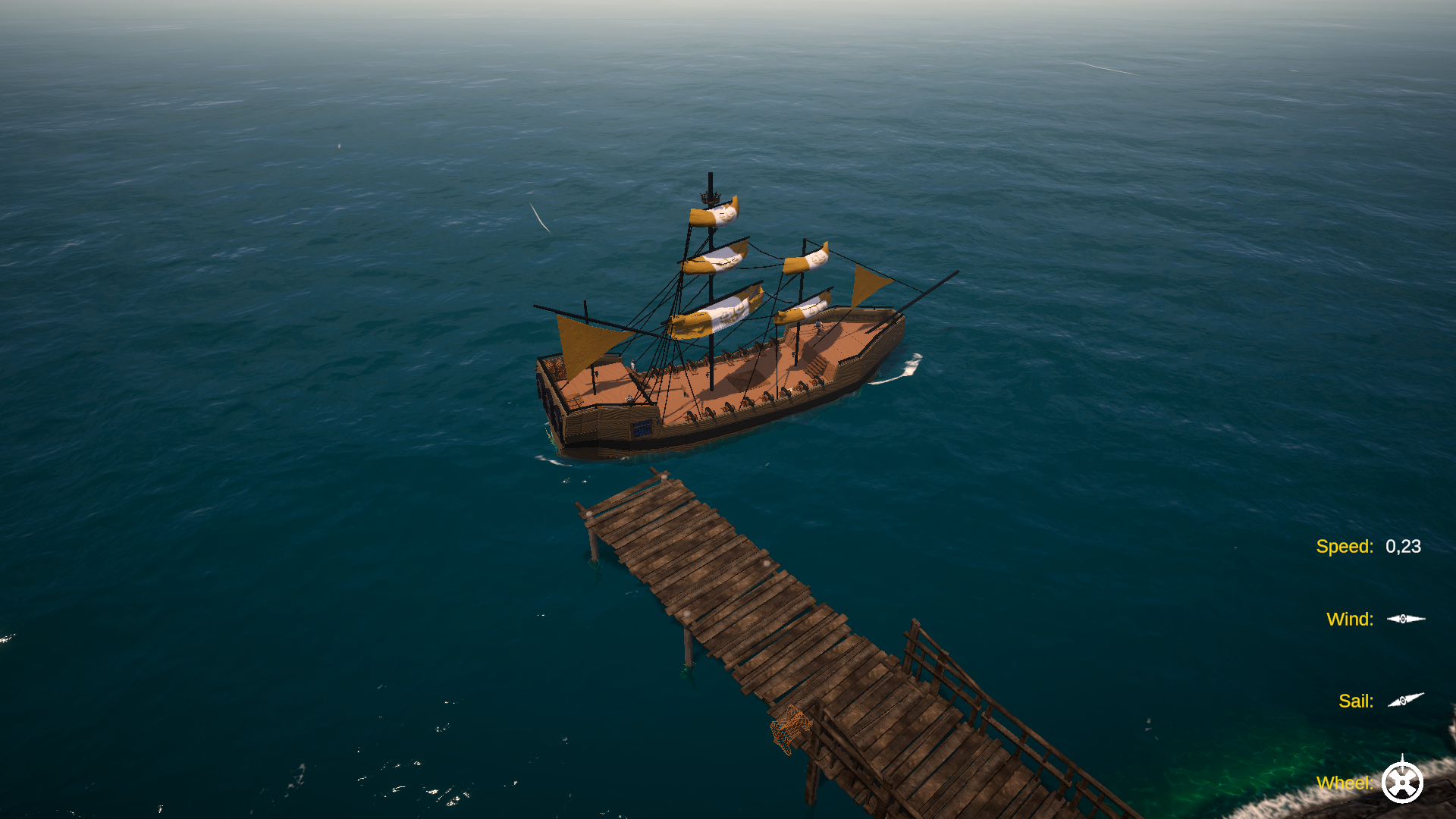
When the sails are fully furled, they cannot catch any wind and the ship cannot move (unless the anchor is up—in that case the ship might drift slightly).
2- Reefed (Partially Opened) – The sails are partially deployed to reduce wind impact.
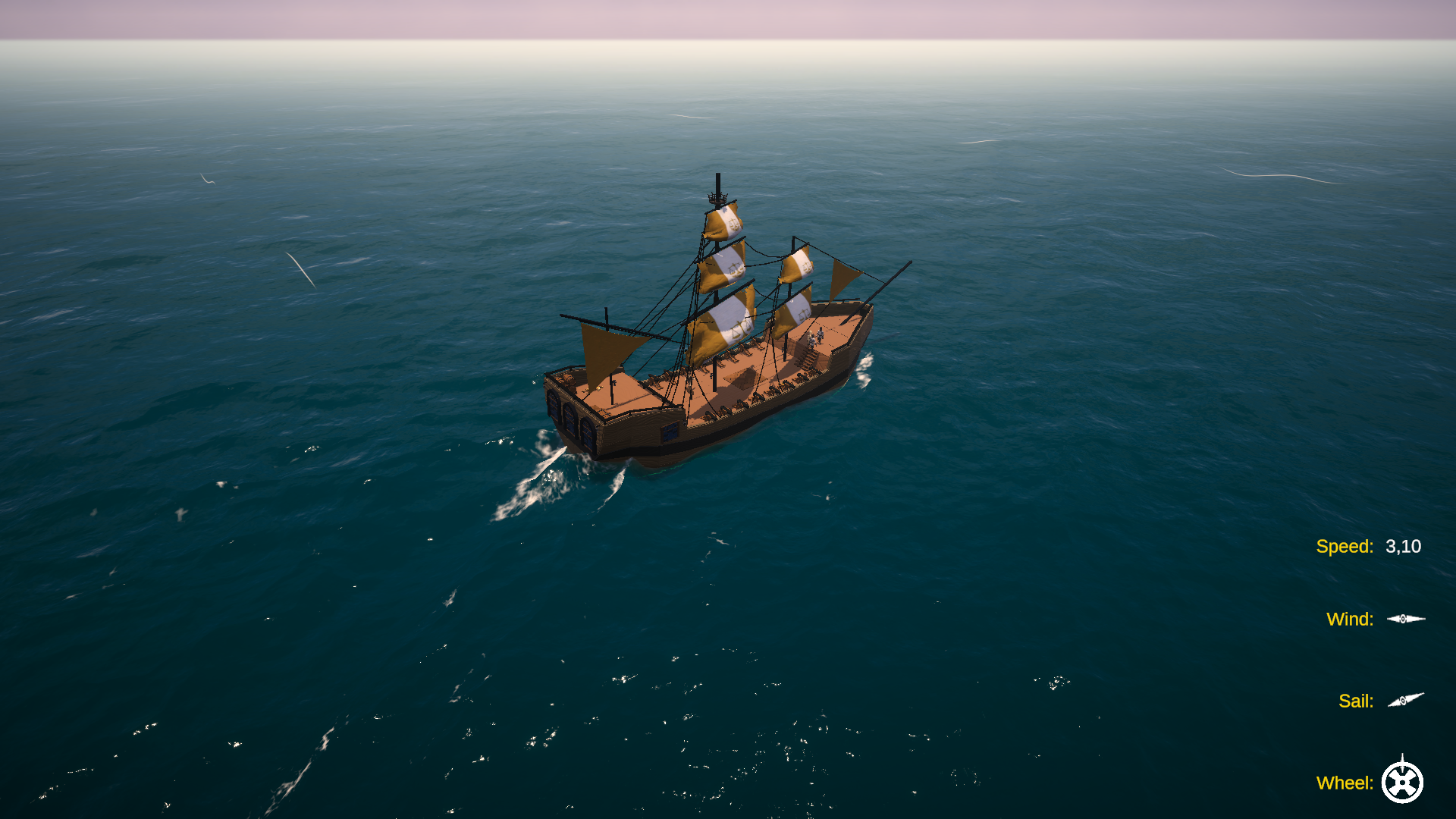
In reefed mode, only about 60% of the full propulsion is applied. (This ratio may be adjusted later.)
3- Fully Unfurled (Fully Opened) – The sails are completely deployed to harness the wind’s full force.
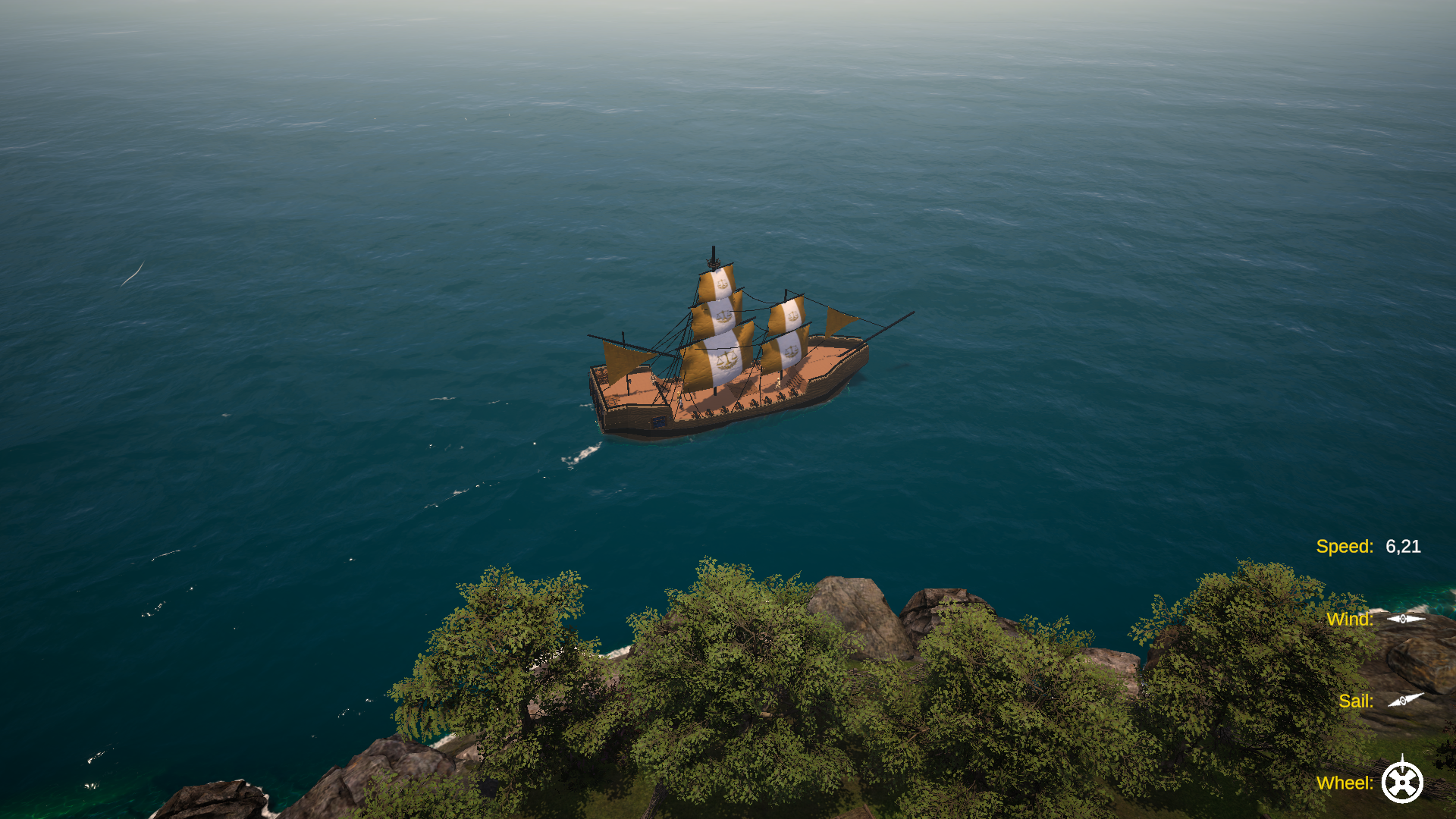
When the sails are fully unfurled, they capture wind and generate movement. The ship’s speed depends on several factors, such as:
-Wind strength
-Ship weight (including cargo)
-Sail quality
-The alignment of the sails with the wind
In addition, the game includes anchoring and rowing systems. While both mechanics are functional in-game, their corresponding animations have not yet been added.
Rowing: Used for small adjustments, such as docking maneuvers or moving against the wind. It’s especially helpful when the wind is calm or blowing in the opposite direction. Rowing is slower and unsustainable in the long run, as it can lower crew morale.
Anchoring: Besides keeping the ship stationary, anchors can also be used tactically for sharp turns or emergency stops.
Demonstration Videos
1- Raising and lowering the sails
2- Rotating the sails to set their direction relative to the wind and initiate movement.
3- How sail states affects speed (with favorable wind)
4- Steering the ship using the Ship’s Wheel
These demonstrations feature a medium-sized vessel belonging to the Kingdom of Hinud, offering a preview of one of the game’s factions.
Why was the Kingdom of Hinud chosen for the introduction?
Because the Kingdom of Hinud is intentionally familiar and archetypal, showing it won’t spoil any major surprises.
The Kingdom of Hinud is a peaceful, trade-focused nation. They have little interest (or skill) in warfare, and tend to favor diplomacy and negotiation. Their national colors are white and yellow, and their banner bears a set of scales and an olive branch.
People from Hinud embody their kingdom’s nature. When recruited as crew members, they provide bonuses to trade and production, but come with penalties to combat effectiveness. They dislike pirates and bandits, and may cause conflict if forced to serve alongside them. They also have historical grievances against the former imperial factions, avoiding trade with them, though they will tolerate sharing a crew if necessary.
What’s Next?
I’m currently focusing on naval combat systems. Just like with ship movement, my goal is to provide players with meaningful variables and controls in battle. Once the core combat mechanics are more defined, I’ll share another devlog update.
I'm developing Black Bahr completely solo, so the majority of my time goes into building the game itself. I know I can't always post updates as often as I'd like, but I aim to keep you informed with meaningful milestone-based updates like this one.
Rest assured, any message sent via the website, email, or Steam will be read.
Black Bahr – Vision & Goals
My goal is to create a dynamic sandbox colony simulation game set in an oceanic open world filled with various kingdoms, clans, and factions. This universe aims to function autonomously, featuring unpredictable diplomatic movements among power centers, constantly evolving trade routes and products, and independent pirates, raiders, and other groups adapting to these changes.
The player starts in this intricate world without any favoritism or guidance, placed in the middle of the ocean with absolute freedom to choose their path. Initially controlling a small boat, players will progress and upgrade their vessels based on their playstyle and decisions. This is where the colony simulation aspect comes into play: the crew serves as your colony, whose needs and desires must be managed. Resources must be strategically used, and following production trees will yield profits or powerful equipment. Core gameplay centers around naval battles and coastal raids. The game is neither an FPS nor a TPS. Players do not control individual characters directly. Instead, battles and boarding use an RTS-style command system, with the player acting as a captain and tactician.
World Systems
-Races and factions interact with each other and the player in dynamic, evolving ways.
-Diplomacy, war, and trade develop based on ongoing world events.
-The game world includes dangerous, high-reward areas with rare loot and randomized events.
-Neutral waters exist outside any kingdom’s control, ideal for exploration or building your own legacy.
Racial Traits, Crew Dynamics, and Social Tension
-Each race has its own personality, bonuses, and rivalries.
-Politics aren’t just about alliances or war. They involve complex social dynamics.
-You can join factions or create your own once certain conditions are met.
-Your reputation influences how special NPCs and kingdoms respond to you.
-Triggering a bounty causes bounty hunters to track you across kingdom waters.
Crew System Highlights:
-Diverse racial composition affects crew performance and morale.
-Mixing incompatible races can lead to conflict and mutiny.
-Crew can be recruited from ports, prisoner rescues, or converted enemies.
-Crew members consume wages and food.
-Slaves perform tasks at lower cost, but pose risks if they outnumber the loyal crew.
-Crew members gain experience over time, improving their combat, repair, and operational skills.
Trade, Piracy, and Combat
-Trade features dynamic prices, black-market goods, and illegal trades like slavery.
-Some factions forbid such practices, others profit from them.
-Pirates prey on traders, forcing players to balance defense and cargo capacity.
-Players can interact with pirate networks and black-market economies.
Naval Combat Mechanics Include:
-Seven ship sizes, each with unique stats and upgrade potential.
-Damage affects specific ship parts (masts, cannons, rudder, etc.).
-Ships require wood, tools, and supplies to repair.
-Tactics include stealth attacks (lights off) or broadside assaults.
-Entering combat mode (e.g., opening cannon ports) alerts nearby vessels.
-Discarding cargo can boost speed in emergencies.
-Some ships call reinforcements with flares, act quickly or risk escalation.
-Multiple cannon and ammo types (explosive, incendiary, etc.), tiered by quality.
-Ammunition can be bought or crafted, depending on your economy.
The game is not limited to these systems. Black Bahr will continue to evolve with your feedback. Your thoughts, ideas, and feature requests are always welcome.