
Time Invested
How many hours have we worked on Groovity so far?
This is a somewhat complex metric to measure, but luckily Jira comes to the rescue when needed. In the production of the demo, we have completed 670 tasks to date. And in each one, we distinguish the effort involved (L, M, or S) in executing them. Although they are not a metric of hours, we can make an approximation of the hours that each type of task may take. With 102 L tasks, 290 M tasks, and 278 S tasks, in the 23 weeks that we have been working on the project, we have an estimated 5,880 hours of effort. By the end of the project, we will reach that golden figure of >6,000 hours with complete certainty!
How many days/weeks/months has development taken since the first prototype?
From the start of the ideation process to the first Proof of Concept, 86 days passed, or 12 weeks, or almost 3 months.
How many hours of internal meetings, testing, and planning have we recorded?
Between sprint planning, weeklies, mentoring, and follow-up meetings, the team has an average of 15 meetings per week. And this excludes all the ad-hoc work sessions that arise organically when working as a team. Considering that of those 23 weeks of production, only one was free of meetings, we reach the magic number of 330 meetings. But if we count Monday's meetings, we reach 333. Not even on purpose.
How many people have worked on the game (programmers, artists, marketing, VFX, production, musicians, etc.)?
During the project, 24 people have collaborated, with people from the disciplines of Art, Technical Artist, Animation, Design, Marketing, Programming, Production, and Sound.
Created Content
How many levels does Groovity have?
In total, the demo will have 4 levels, in which the player will go through two free-form levels and 2 more surprising levels that we can't reveal much about yet...
How many original music tracks does the game contain?
It has 4 original pieces. That may seem like a small number, but in Groovity we use a dynamic music system. In this system, we use a series of layers that make the music evolve at the same pace as the player progresses through the levels, giving us a total of 21 different pieces!
Testing and Feedback
How many times has the game been tested in playtests?
Externally, we have conducted 4 days of playtesting with a total of 96 different people. Internally, we have also had 4 days of playtesting, sometimes repeating with team members and other times inviting people from outside the project. With these sessions, 22 different people have participated, for a total of 36 play sessions.
In other words, the game has been tested “formally” 132 times. As a result, it has taken a great deal of effort to digest all the information and make it actionable!
How many bugs have been fixed so far?
Fewer than we thought at the beginning of the project, thanks to the code review dynamics we have avoided many bugs. But even so, we have encountered 58 bugs in the project, more than 2 per week. The goal is to leave no bugs behind when we launch on the 11th!
What was the most curious or difficult bug we encountered?
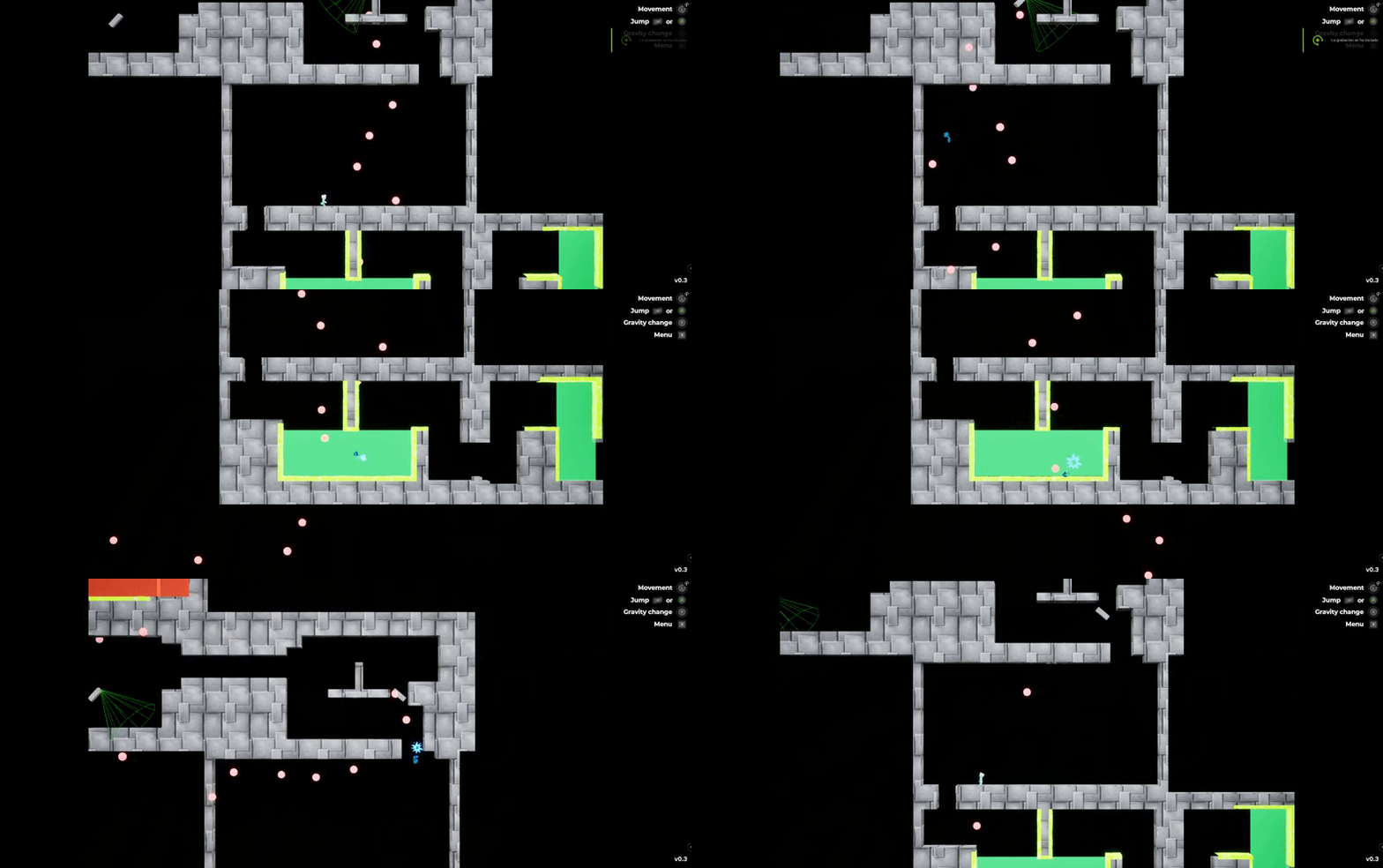
For several weeks, one of our enemies, a flying guy who shoots projectiles at the player, started firing a relentless rain of fire at the player. This bug, which we called “meatball rain,” was the source of much laughter and back-and-forth during several debugging sessions with the programming team.
Project Evolution
How many tools have we used?
Between game development and cross-functional support tasks, we have used at least 13: Unreal, 3DS MAX, Maya, Blender, Jira, Excel, Word, DaVinci, InDesign, Illustrator, etc. Making video games requires tackling many fronts, each with its own particularities and specific demands.