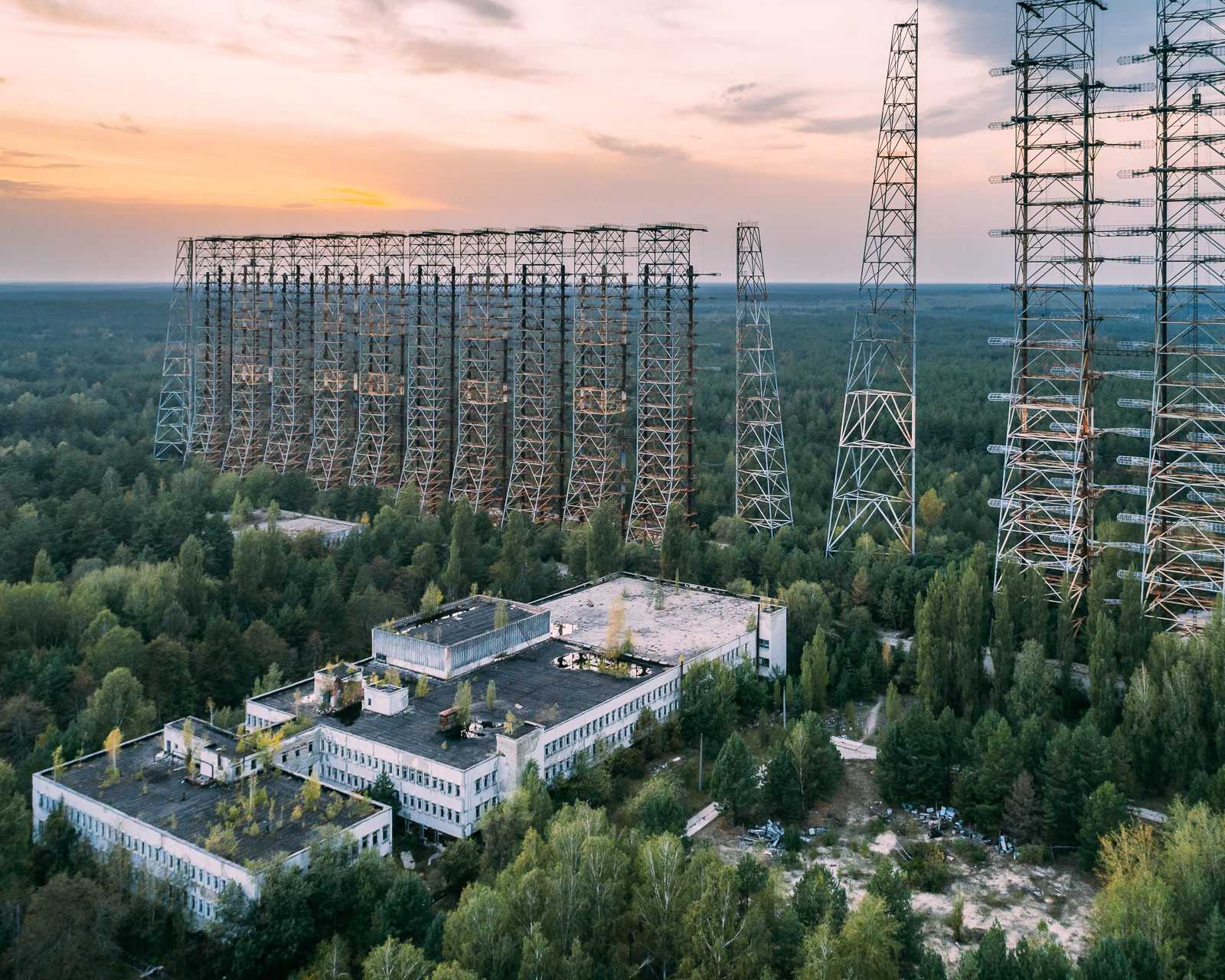
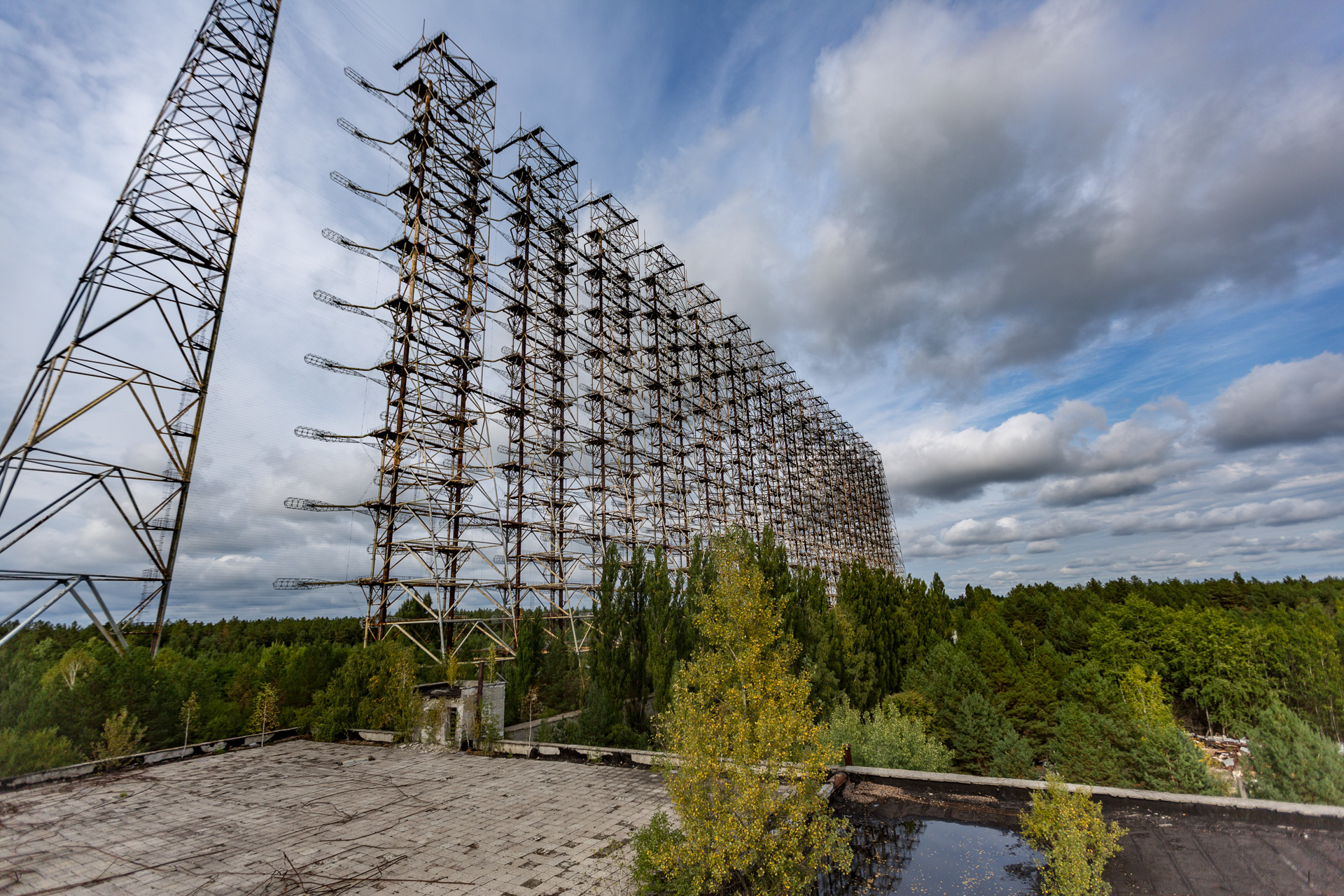
While development of update continues and we will share more information with you as soon as possible. But today we want to tell you a little about some new content for the game. In the next major update we will add some freshness to the world of Survarium by introducing the new Duga Radar location.

Duga (Russian: Дуга́) was a Soviet over-the-horizon radar (OTH) system used as part of the Soviet missile defense early-warning radar network. The system operated from July 1976 to December 1989. Two operational Duga radars were deployed, one near Chernobyl and Chernihiv in the Ukrainian SSR (present-day Ukraine), the other in eastern Siberia.
The Duga systems were extremely powerful, over 10 MW in some cases, and broadcast in the shortwave radio bands. They appeared without warning, sounding like a sharp, repetitive tapping noise at 10 Hz,[1] which led to it being nicknamed by shortwave listeners the Russian Woodpecker. The random frequency hops disrupted legitimate broadcasts, amateur radio operations, oceanic commercial aviation communications, and utility transmissions, resulting in thousands of complaints by many countries worldwide. The signal became such a nuisance that some receivers such as amateur radios and televisions actually began including 'Woodpecker Blankers' in their circuit designs in an effort to filter out the interference.

The unclaimed signal was a source for much speculation, giving rise to theories such as Soviet mind control and weather control experiments. However, because of its distinctive transmission pattern, many experts and amateur radio hobbyists quickly realized it to be an over-the-horizon radar system. NATO military intelligence had already given it the reporting name STEEL WORK or STEEL YARD. While the amateur radio community was well aware of the system, this theory was not publicly confirmed until after the fall of the Soviet Union.
The Soviets had been working on early warning radar for their anti-ballistic missile systems through the 1960s, but most of these had been line-of-sight systems that were useful for rapid analysis and interception only. None of these systems had the capability to provide early warning of a launch, within seconds or minutes of a launch, which would give the defenses time to study the attack and plan a response. At the time, the Soviet early-warning satellite network was not well developed, and there were questions about their ability to operate in a hostile environment including anti-satellite efforts. An over-the-horizon radar sited in the USSR would not have any of these problems, and work on such a system for this associated role started in the late 1960s.
The first experimental system, Duga, was built outside Mykolaiv in Ukraine, successfully detecting rocket launches from Baikonur Cosmodrome at 2,500 kilometers. This was followed by the prototype Duga, built on the same site, which was able to track launches from the far east and submarines in the Pacific Ocean as the missiles flew towards Novaya Zemlya. Both of these radar systems were aimed east and were fairly low power, but with the concept proven, work began on an operational system. The new Duga-1 systems used a transmitter and receiver separated by about 60 km.
Read more about the famous "Russian Woodpecker" at Wikipedia: https://en.wikipedia.org/wiki/Duga_radar