
Hey Vibers,
We’ve been hard at work trying to answer one of the toughest game design questions in Future Vibe Check since starting: How do you make music, something subjective, work inside an automation game, something built around objective outputs?
Automation games are built around quantitative pressure. Items per minute. Belt throughput. Jammed outputs. Power usage. Layout efficiency. Players look at a system, find the bottleneck, rebuild it, and make the number go up.
Music is not like that. A great song can be dense, simple, strange, aggressive, soft, repetitive, or chaotic. If we just tell players “make good music,” there is nothing concrete to optimize. If we force players to copy exact songs or solve a specific puzzle, we lose the feeling of creative freedom that is core to what makes making music fun. How do we make the music feel like your own but the factory you make feel like it is optimized for it?
The Vibe Check system is our answer.
It turns music into a performance objective without turning creativity into homework.
The Draft: Pick The Vibe Before You Build It
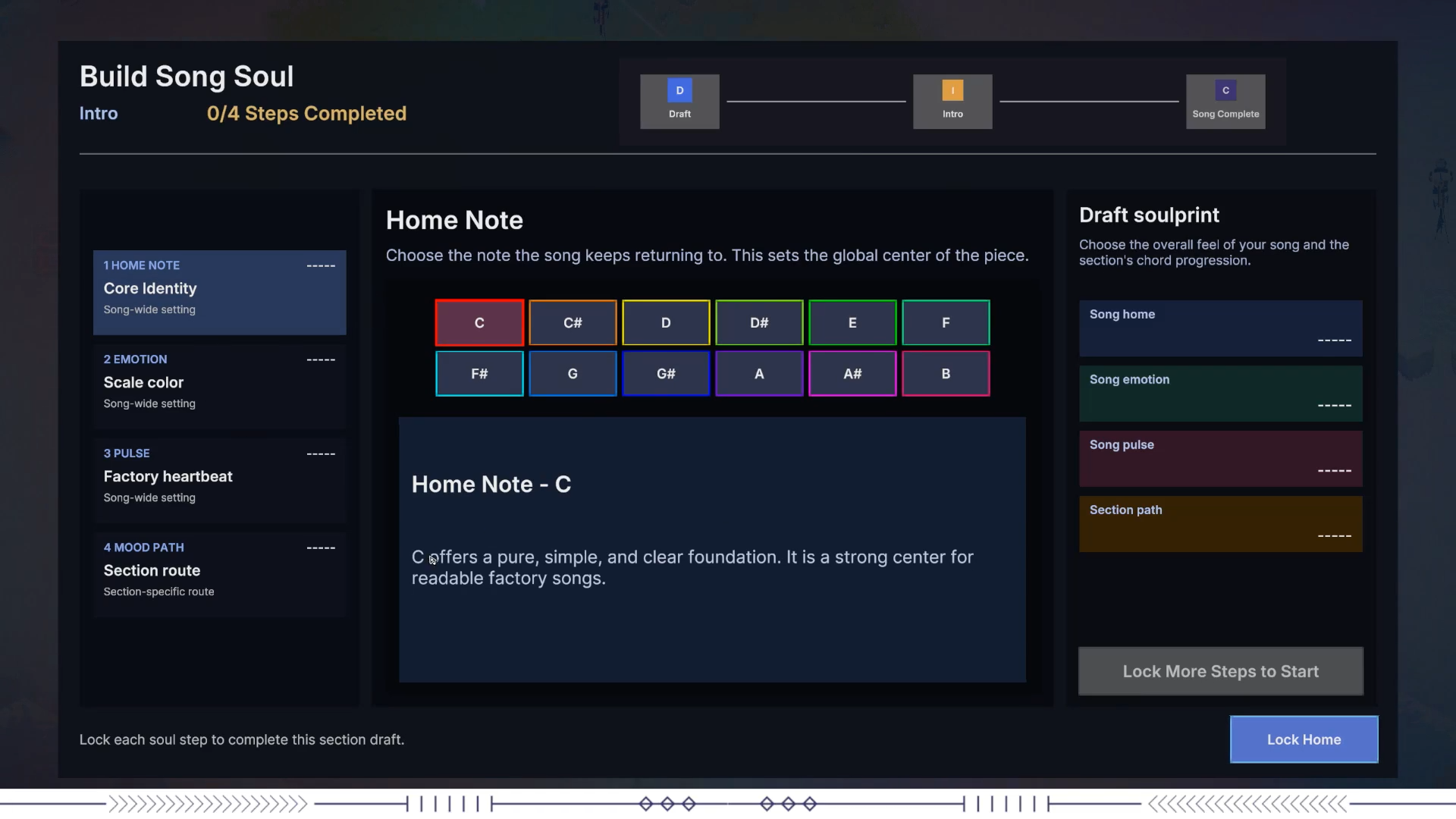
Before a song section begins, players can draft the musical direction they want to aim for. That draft can shape the section’s key, scale, mode, tempo, chord progression, and contract objective.
This matters because we do not want the game to say, “Here is the correct song. Recreate it.”
Instead, we want the game to say, “Here is the kind of musical problem you are solving. Now build your own answer.”
A draft might push you toward a verse with rising melodic motion, a chorus with call-and-response hooks, a strong bass-focused section, a rock intro, a jazz groove, or a branching network shape that creates a larger musical phrase. The player still decides how to route signals, which nodes to use, how dense the arrangement becomes, and how the performance actually sounds.
The draft is the creative brief. Your factory is the composition.
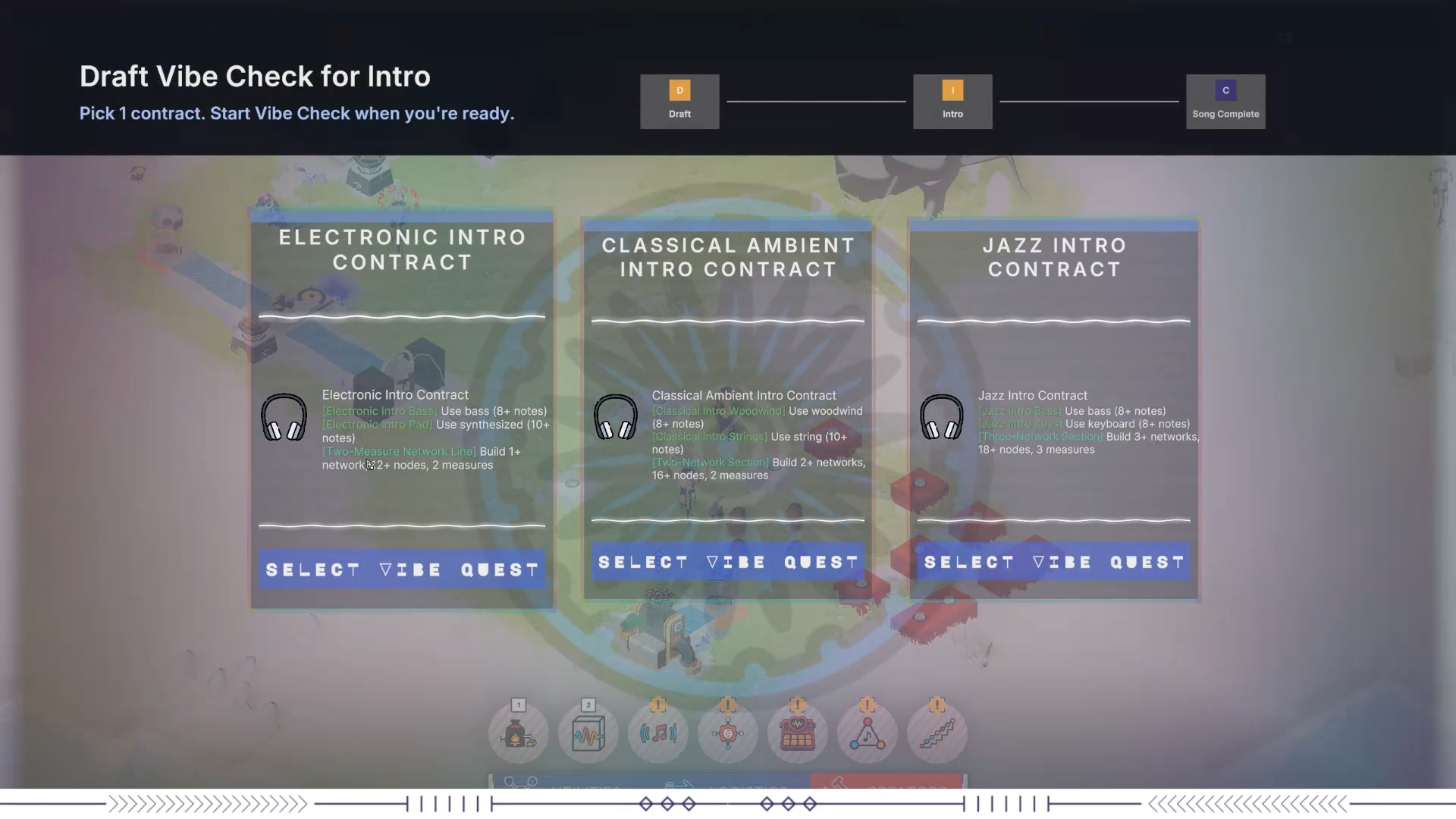
The Vibe Check: A Score You Can Optimize Around
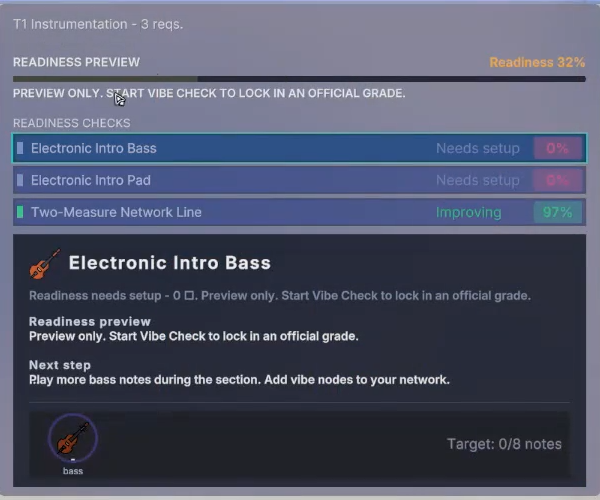
Once you have built the section, you can start a Vibe Check. Finally the name of the game is tied to a real mechanic :) ! When you choose to start a Vibe Check, the game scores a live pass of what music you are making with your factory.
That distinction is important. The system is not judging a static menu choice. It is listening to what your factory actually performs in time.
At runtime, the music contract system evaluates notes as they happen, measure by measure, against the current musical context: tempo, key, mode, scale, chord progression, section, and timing. Some requirements care about every measure. Some accumulate across the full contract. Some reset with the chord progression. Network requirements can also score the physical shape of the audio network itself.
What Can A Vibe Check Measure?
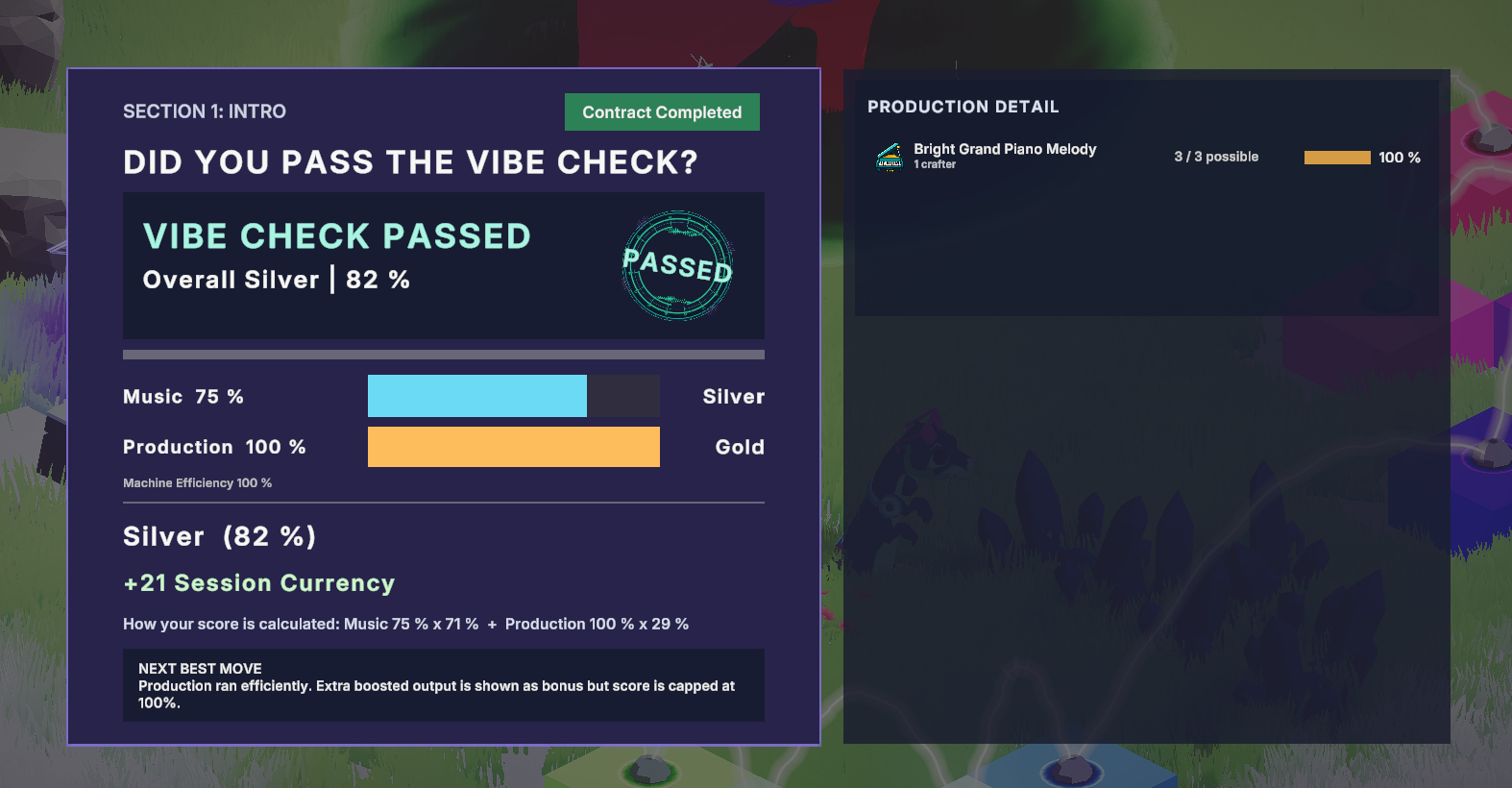
This is where the system gets interesting. A Vibe Check is not one generic “song quality” meter. It is a modular contract made from multiple music requirements. We have built a way to quantify the “structure” of music in a way to make objectives flexible and procedural.
Examples include:
Rhythm Check: Require kicks, snares, hi-hats, or other instrument categories on specific sixteenth-note steps. A contract can allow loose timing, demand exact timing, or punish extra notes.
Density Check: Ask for a sparse phrase, a dense phrase, a minimum number of notes, notes per beat, or enough unique step coverage to keep the pattern moving.
Instrumentation Check: Require bass, drums, keys, leads, or multiple instrument categories. The system can ask for “bass every measure” or “use at least three instrument types across the progression to make a certain genre.”
Tonality Check: Check key, mode, scale, crafted tonal settings, or specific chord progression behavior.
Tempo Check: Score against BPM ranges or traditional tempo markings.
Composer Check: This is where the procedural music brain becomes scoreable. Requirements can look for roles like Bass, Melody, Harmony, Lead, or Rhythm. They can check melodic contours, harmonic focus, voicing styles, tension tolerance, resolution urgency, voice leading, anticipation, octave range, density, and dynamics.
Network Check: Since Future Vibe Check is built on spatial music routing, the system can also score the physical composition network. It can require a certain number of audio networks, downstream nodes, signal path length, branch points, terminal sound nodes, unique path lengths, or exact edge spacing. A requirement can even say: build a long route, but avoid one-cell jumps.
That means a music contract can ask for something like:
Build a chorus with call-and-response contour, chord or color-tone focus, and a branching audio network with multiple terminal sound nodes.
That is not just “play more notes.” That is a musical and logistical design challenge.
Why This Fits The Genre
The goal is not to make music less subjective. The goal is to make musical intention measurable.
In an automation game, a good objective should create a readable problem. If a belt is starved, you add supply. If an output is jammed, you fix routing. If your Vibe Check score is low, you can inspect why.
Not enough bass notes? Route more signals through bass-focused nodes.
Rhythm missing the backbeat? Move the node spacing so notes land on the right sixteenth steps.
Density too low? Add another source, split a signal, or increase note generation.
Network score failing? Extend the route, add branches, or clean up one-cell jumps.
Tonality missing? Craft stronger key, scale, and mode control into the signal.
That is the loop we want: listen, diagnose, rebuild, improve.
The music becomes something you can feel and optimize.
The Bigger Design Goal
Future Vibe Check is trying to bridge two player motivations that usually fight each other.
The first is the expression: “I want to make something that sounds like me.”
The second is mastery: “I want the system to give me a hard target, then let me solve it better.”
The draft gives players creative direction. The Vibe Check gives players objective feedback. Together, they let us bring music into the automation/base-building genre without flattening it into a simple puzzle.
You are not just making a factory that produces items.
You are building a machine that performs.
And when you pass the Vibe Check, it should feel like your layout choices and your ear clicked into place.
The biggest challenge we have now is onboarding players to this system, improving the UI/UX, tuning the requirements, balancing the scoring, and ensuring the mechanics around it are simplified for this to come to life. I’m excited for players to pass some Vibe Checks in the game soon as we polish this system and its place in the game.
Peace and Love,
Unwise