
Transparency is one of the most complex aspects of rendering. Particles, smoke, magic effects, and glass don’t follow the usual lighting rules. Making them look natural is a challenge — even for large studios.
In TSAREVNA, we use a system called Translucency Lighting Volume (TLV) — it allows light to interact correctly with translucent materials without turning the GPU into an oven.
The Transparency Problem
Most modern games use Deferred Rendering.
In the first stage, the engine builds a G-Buffer — a set of textures that store information about the scene’s geometry: normals, depth, materials, albedo, and so on. Lighting isn’t calculated yet; it’s applied later, all at once, to the finished buffer.
This approach works perfectly for opaque surfaces — but not for transparent ones.
The reason is simple: transparent materials can’t be properly written to the G-Buffer because the background is visible behind them. That means they have to be drawn on top of an already lit scene, without participating in the main lighting system.
The Solution: Translucency Lighting Volume
To make transparent objects look natural, we use Translucency Lighting Volume (TLV).
The engine creates an invisible 3D grid around the camera. Each cell in this grid stores lighting information — direction, intensity, color, and reflected light sources (for example, the red glow of a torch or the blue shimmer of a magical portal).
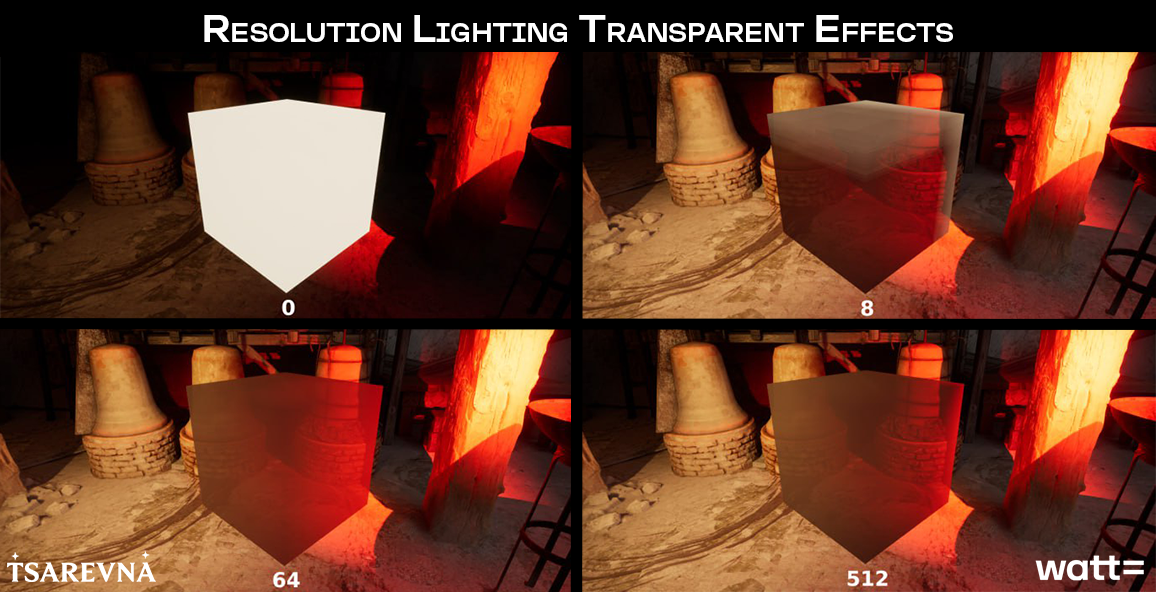
When a transparent object is rendered, it doesn’t calculate lighting from scratch.
Instead, it simply samples the nearest TLV cell and uses the precomputed lighting data.
This greatly reduces GPU load, especially in scenes filled with particles, smoke, magic effects, and post-processing.
Quality Settings
The resolution of the TLV directly affects the quality of transparent lighting:
High resolution — used in cutscenes and cinematic moments for maximum precision and light depth.
Medium / Low resolution — used in combat and gameplay for better performance without noticeable visual loss.
In TSAREVNA, this system powers the glow of spells, scattered magical light, and semi-transparent materials — from ethereal fog to shimmering enchantments.
We’ll continue introducing similar technical improvements as development goes on.
Stay tuned for more dev diaries — there’s plenty of visual magic ahead