
One of the most lasting lessons from AAA is that iteration is everything. If you want to make something good, you have to be able to keep making it. So for MoteMancer, it was never just about building the final game, it was about building the game in a way that was enjoyable and fast to iterate on.
From day one, I asked:
“How can I make this game easy and fun to make?”
Before I wrote a single system, I blocked out the core data I’d need, and how I'd want to edit it. This image is many years old, well before a single line of code was written, just exploring how I'd want to edit the game:
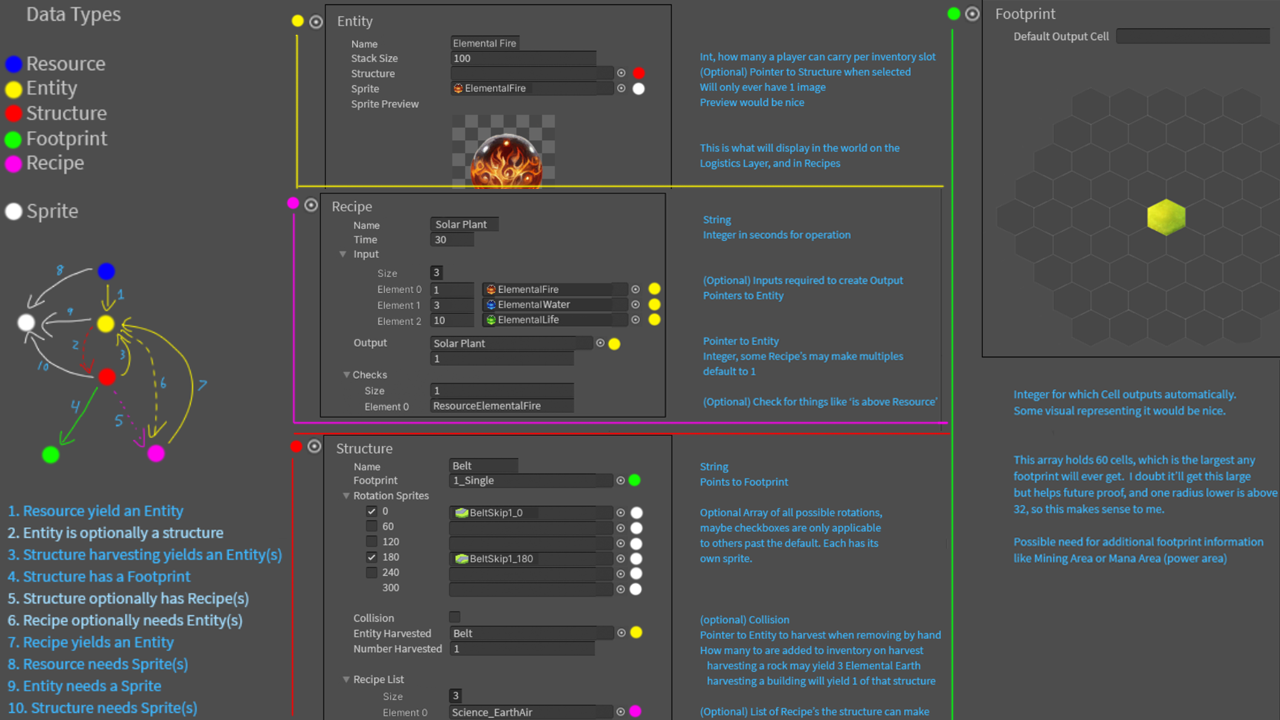
- Entity – A thing you carry or transport around
- Structure – A thing you place and interact with
- Footprint – The shape a Structure occupies
- Recipe – How inputs become outputs
- Resource – What exists in the world (now “Mote Fields”)
These interfaces have evolved greatly over the course of development, but it's important to show how unrefined early games truly are. These concepts are still the beating heart of the game, and they’re the reason bugs are fast to fix and iteration is fun. A wise mentor once told me "Game Dev = Bugs." Never a truer equation was uttered. Thus, setting myself up for future success became ever-present mindset.
Designing for Future-You
If a task isn’t trivial, I spend time first making it trivial. Not with bulletproof systems, just with directional tools. I ask: “Is there a future pain point I can reduce right now?”
That principle doesn’t just apply to gamedev. It applies to cooking, leatherworking - any craft where your skill improves by improving your process. Half the joy is in making the next attempt smoother than the last. When your tools are not getting in your way you spend more time in flow state, perfecting the craft itself.

My Favorite Button in the World
Most of MoteMancer’s tuning data doesn’t live in-engine. It lives in a spreadsheet, where I can balance everything side-by-side. Recipes, research, and localization all gets pushed into Unity with one click.
That one-click philosophy scales up, too:
- Import tuning from Excel
- Import multi-language localization
- Build every platform - Demo, Full, (soon to include Linux and Mac)
- Push to Steam

All from one button.
These individually took about a day each to build. They’ve repaid themselves a hundred times over - not just in time saved, but in flow protected. When you’re not interrupted by tedium, your focus is easier to maintain, which also pays for itself in spades.
My Guiding Rule
Here’s the guiding principle that’s kept me sane:
If it’s not trivial, spend 30–60 minutes making it more trivial. Then do the thing.
Don’t overbuild. Don’t chase the perfect editor. Make the main things trivial, medium things easier, and everything else sane.
This is likely not the first time you've seen or heard advice like this. In my experience, sometimes you just need to hear it from another perspective to remember that your time is worth investing in. Hopefully this sparks something for your own project. I'm certain the time I've spent writing this and you've spent reading this will likewise pay for itself many times over :)
—
Stay savvy, MoteMancers.
~CyanAvatar