
Stealth is not the only reason submarines are said to be the most powerful. Modern torpedoes have unparalleled power on the battlefield.
Since the advent of the self-guided torpedo, all kinds of decoys have been developed to fool it. However, it is now known that many of them do not work well enough. The torpedo's search algorithm is designed to either ignore the decoy or return and attack again even if it misses the enemy. In other words, it is very advantageous to the attacker.
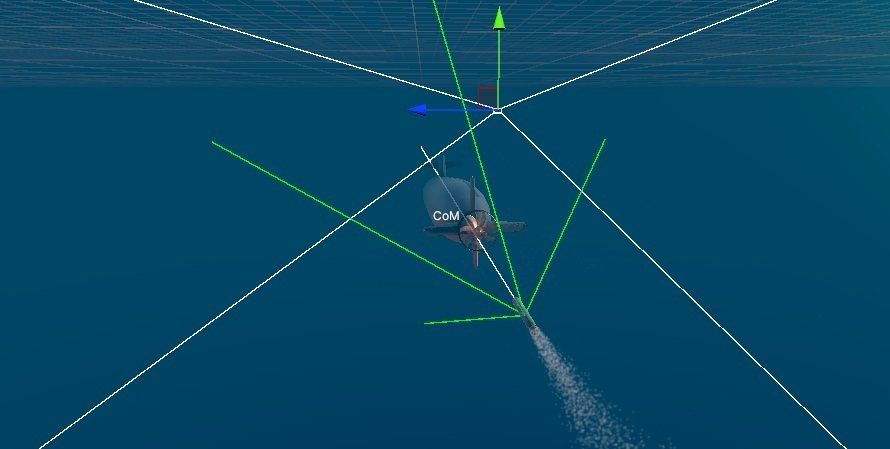
Asymmetries like this are also a bit tricky to create games. Looking back at other games, it is clear that unbalanced weapons ruin the battlefield.
Therefore, I have established these policies.
- Avoid making the torpedo’s search algorithm more advanced.
Simplifying maneuver patterns during re-attacks allows defenders to avoid them. It also does not have advanced target identification capabilities such as image recognition. However, it can be guided manually as long as the wire is connected. This means that torpedo guidance performance is dependent on player skill.
- Adjust torpedo’s range, speed and turning performance in moderation.
The range of some torpedoes can reach 50 km. On the other hand, a typical game map is 100 km square, so if a battle occurs in the center of the map, the torpedoes will chase you even if you escape to the limits of the play area. It may seem a little too strong. Therefore, the torpedo's key performance parameters will be adjusted through test play to achieve the right balance.
This is a typical search pattern of the torpedo.
- A wire is connected to the torpedo that has just been fired and the manual control mode is enabled.
- When the torpedo reaches the wire length limit, it switches to the self-search mode. In this mode, it searches for targets in a straight line, S-shape, or circular pattern.
- When the torpedo finds the target, it switches to tracking mode and begins its approach to the target.
- If the torpedo loses the contact, it will again enter search mode, but this time it will execute a circle search pattern in the direction in which it had detected the signal just before missed the target. If the torpedo finds the target while searching in a circle, it will attempt to approach again.
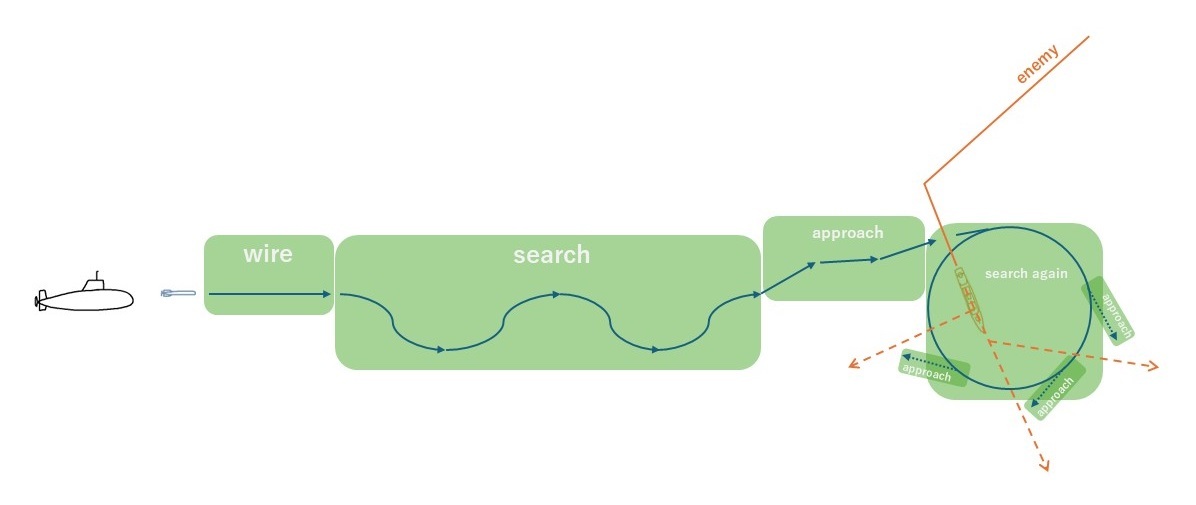
This is a simplified figure for illustrative purposes; the actual developed version is a bit more complex. In addition, torpedoes have passive and active sensors, each of which has different search capabilities. They also move a little differently in tracking mode and hit different positions of the ship.
We wanna implement various other types of torpedoes. For example, a rocket torpedo that uses supercavitation.
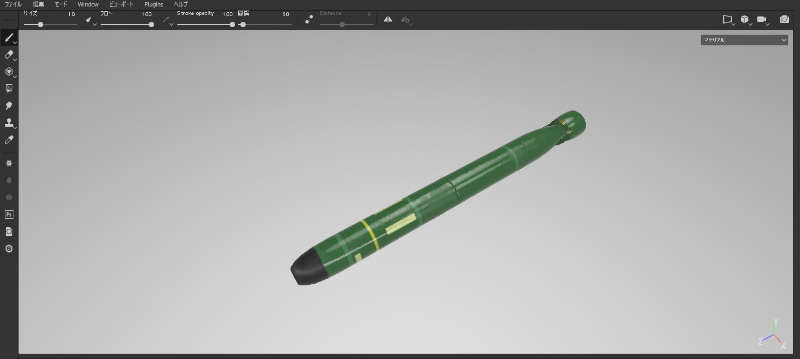
However, first I have to make a 3D model. Since I am coding and modeling all by myself at the same time (and going to university during the day), the process takes a bit more time. So I ask my friends to help me with modeling and coding. Please be looking forward to updating while watching pigeons in the park or solving the P≠NP forecast!