In this devblog, our Lead Artist Tim Ludwig answers a few questions about the building system in Lost Legions.
Can you briefly introduce yourself?
Tim: Gladly! My name is Tim, I am the Lead Artist at Tarock Interactive and in Lost Legions, I am mainly responsible for environment graphics, lighting, and even the user interface design. We are a small team, and many people wear multiple hats. Currently, I am working intensively on our modular building system, which allows players to create their own structures and buildings.

What is the significance of building in Lost Legions?
Tim: Our game is mainly based on the mechanics of the open-world survival and crafting genre. Building structures and buildings is an essential part of the gameplay because it fulfills several key functions. When a village is taken over by the players, it can be transformed into a Roman camp through construction measures. With a good defensive structure, an enemy attack can be held off, and a well-developed field camp can accommodate more workstations and house more powerful NPC allies. Lastly, by having a solid building system, we also fulfill the fantasy of being in a believable ancient world and feeling like real Roman legionaries.
What is the current state of the building system?
Tim: So far, we have been satisfied with a genre-typical, but honestly, somewhat generic implementation of the building system. The basic principle is surely familiar to survival players: you build foundations to level out the unevenness of the terrain, and then you can place wall elements on top and finish them with a roof structure. We reached this stage early on, and for the pure mechanics, it was sufficient so far. Now the game has evolved, and this area can be taken to the next level. My task is to transform and expand the system so that we can create authentic-looking Roman and Germanic structures and buildings.
How do you approach this?
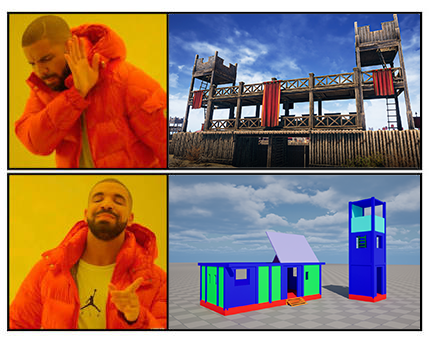
Tim: Funnily enough, this often means taking a step back. I am working with colorful blocks again to determine exactly which parts we need and how they need to fit together to replicate the models from our reference collection. Working with these blockouts allows me to try different approaches quickly and get closer to the desired result. Only when this works reliably will the placeholders be replaced with detailed elements.
How is the building system organized?
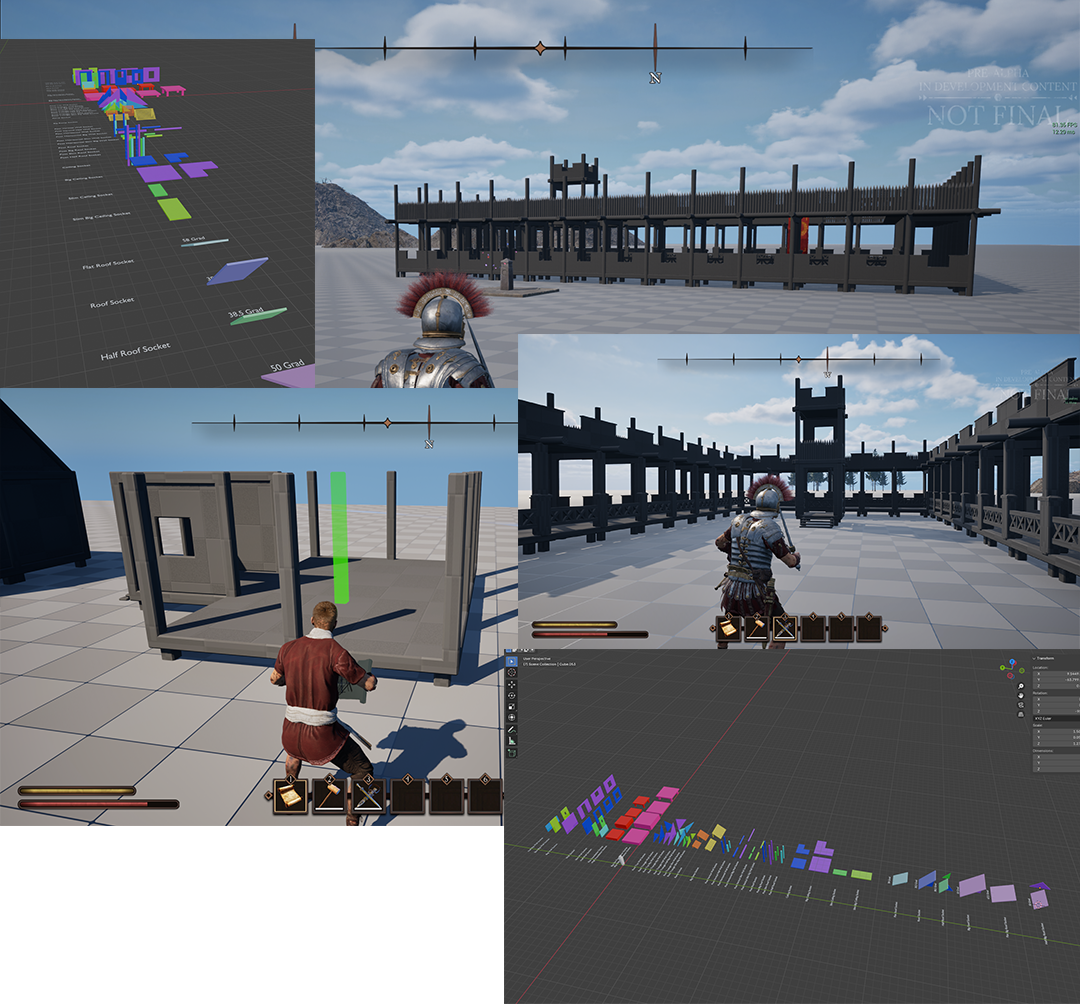
Tim: The modular system is divided into themed sets. Players will be able to equip different expandable blueprints as items to access these sets. This division helps with clarity. There are several categories of structures that can be placed. There are the typical defensive structures like barriers, traps, and palisades. These can be placed freely. The core is certainly the blueprints with modular building parts to construct fortified structures that always stand on a foundation. With these, towers, platforms, and classic buildings can be created. These parts snap together magnetically based on a set of rules. Additionally, we have a category with predefined non-modular elements, such as tents and especially workbenches and workstations. Finally, there will be at least one blueprint offering elements for detailing and decorating.
What unique aspects have you noticed while working on the building system?
Tim: Modular systems have many advantages in games, but they tend to become visually repetitive. My goal is for players to be able to build in a way that these repetitions don’t become negatively noticeable and a believable, organic overall picture can emerge. I am very confident that we will succeed. Just by expanding with beams and half-wall elements, you can break the monotony wonderfully. At the same time, the building kit must not become too granular to ensure it remains easy and quick to use. The challenge is to find a good balance so that “efficiency players” and “creative builders” can equally enjoy the game.
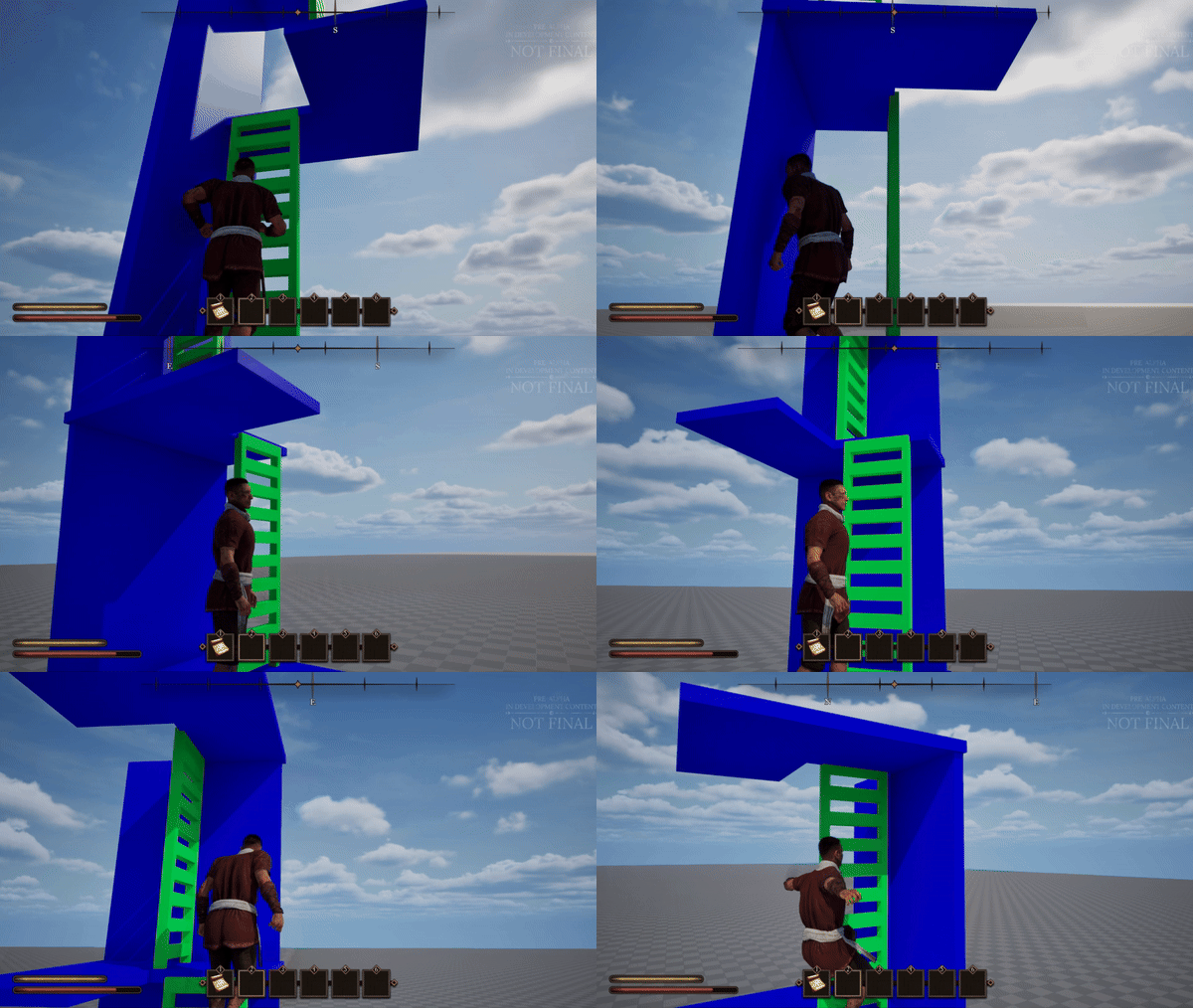
Another challenge is ladders! As a player, you might not give them much thought, except that they are often not so easy to use. From a developer’s perspective, ladders are not trivial, especially in a multiplayer game. We will need ladders to climb towers, platforms, and elevated walkways. Currently, we are solving this problem with a somewhat clumsy elevator method, which looks a bit odd but serves the purpose. We can continue with this approach for now, and the final iteration will come later after more critical elements are implemented.
What else do you have planned for the building system in the future?
Tim: The modular system allows you to build your own constructions. We can’t prevent players from creating nonsense or structures that don’t fit the historical period. That’s just part of the freedom that the genre offers. For players who care about making their camps look as historically accurate as possible, we have the idea of offering historically credible buildings according to the rules of our building sets. These buildings are pre-designed and can be placed directly. They could serve as collectible items.
Throughout the game, several technological advancements will take place. The building elements can then be visibly upgraded and will have improved properties. Enemies will not remain idle and will present players with a suitable challenge depending on their progress.
Finally, I would like to reveal an idea I am personally very fond of: peaceful building in the starting zone. In most building areas in the game, Roman marching camps are built. Sometimes larger, sometimes smaller, but essentially functional military installations that can be smashed into pieces by Germanic raiders at any time. To mitigate the frustration of losing camps and to provide a proverbial playground for “creative builders” and Roman fans, we plan a large building area that cannot be attacked, where a few special rules apply, and players can use our building system to create a farmstead with a manor.
Thank you, Tim, for your insights, and thank you for your attention to our Devblog XX! As always, we are happy if you want to continue discussing the topics mentioned with us here in the comments or on our Discord channel.
If you want to support us even more, you can do so by following our Kickstarter announcement: