“The highest ambition of our magistrates and generals was to defend our provinces and allies with justice and honour. And so our government could be called more accurately a protectorate of the world than a dominion.”
Cicero, De Officiis, 2.27

Hi, Lucas here! In this diary I will talk about war and how I'm expecting to represent it in Historia Realis. Hope you enjoy!
Today I'll focus more on war & conquest in general, but it's worth sharing a few points on how I expect you might be able to interact with war:
You can be a junior officer doing smaller duties in an army.
You can be a legate doing more important duties for a commander.
You can be the commander yourself (usually a Consul or Praetor, or a promagistrate).
You can be a Senator who voted "yes" to start the war, but never took part in it.
You can be a Senator who begins a vote to recall a commander who is doing poorly, or who prosecutes a returning commander for their unjust war, or rewards them with a Triumph.
And you can be all of those things at different stages of your life. There's no linear progression; it all emerges from the simulation.
That said, I will not be focusing here on what the player can do, but on war more broadly.
War in Games
Ah, war. One of the most well-trodden aspects of history in games.
This is both good and bad. Good, because we have tried many things, and so I can look at what has worked and hasn’t, and build upon the foundation. Bad, because we’ve established conventions that have no grounding in history or reality, and breaking free from these long-standing traditions will probably cause some weirdness, even if it’s accurate.
For example, in war games we are used to building bigger and bigger armies. You expand, you get more income, and now you can afford bigger armies. So you increase your army size. Makes sense, right? That’s how history worked, right?
Well, no. It really wasn’t. Let’s look at the number of legions Rome had at its service from 200 to 95 BC, a period of great expansion of Roman power in the Mediterranean:
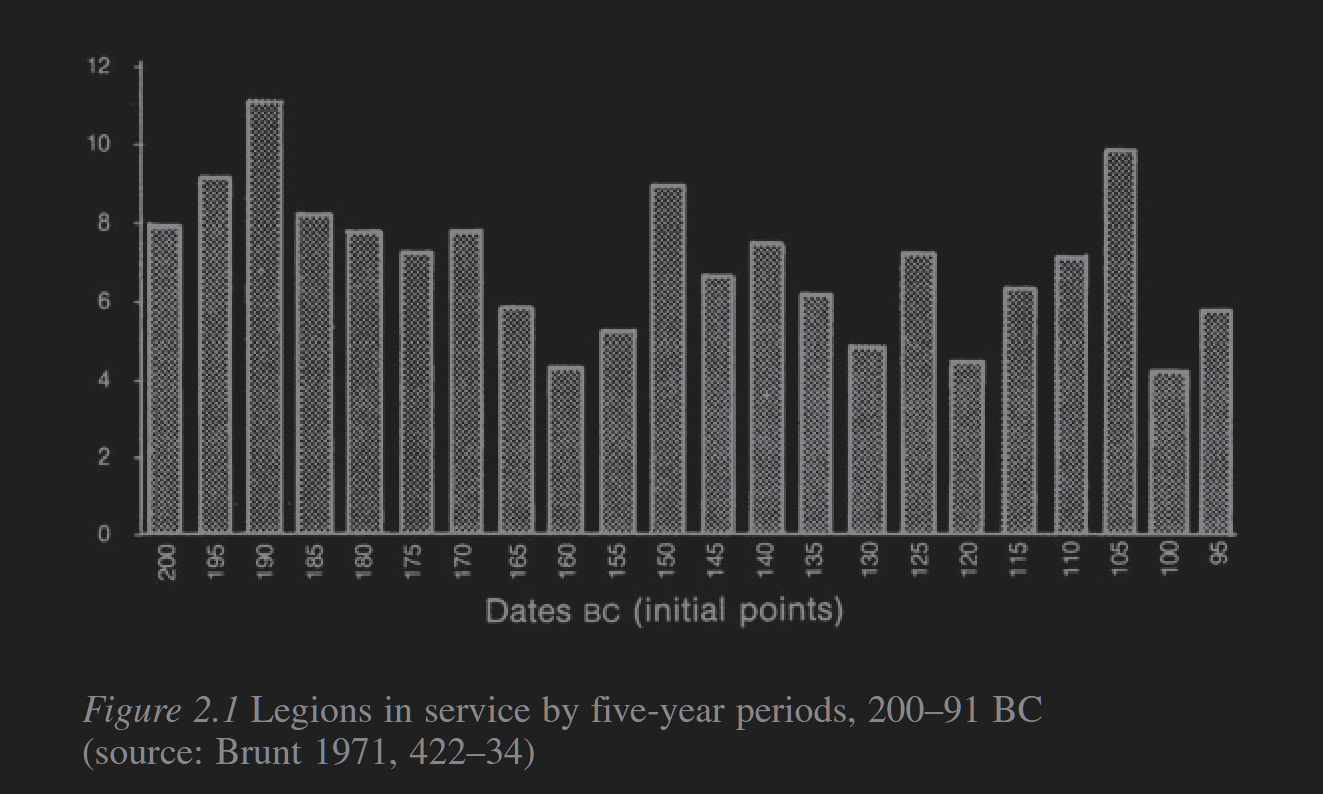 (From: War and society in the Roman world, John Rich and Graham Shipley, 1993, 2002 edition)
We see a few spikes, but also valleys, and, on average, a reduction in the number of legions over the 2nd century BC. If this graph were to extend backwards and forwards a bit, we would see another interesting thing: two huge spikes, one at the beginning due to the 2nd Punic War, and one at the end due to the Social War.
What we definitely don’t see is steady growth, or even a trend towards growth, which is how games often do things. But games just do that to make you feel like you’re making progress and getting stronger, not to accurately portray history.
And that’s not the only aspect that needs some serious looking into. Let’s compare how games often represent war versus how the Romans during the Republic actually did war:
Games | Actual History of Republican Rome |
|---|---|
More and more armies over time, so you can get a feeling of growth and improvement. | Number of armies depended on the needs of the moment. |
You recruit different “unit types” and experiment with your army composition. | Army composition was mostly stable. There were changes, but they happened over centuries. |
Conquest means annexation, territorial occupation, direct rule, “Romanization” and “cultural conversion”. | Conquest meant alliances with locals, hands-off administration, indirect rule. Not territorial control. |
You start most wars, either from a “casus belli” or simply to expand. | The Romans started wars in response to contingencies, and the term “casus belli”, even though it is in Latin, did not exist; it is a later, Modern creation that appears in the 17th century. |
You control all aspects of war, from recruitment to movement to tactics. | The commander was often given an army instead of recruiting it, and delegated much of its activities to subordinates. |
Some people don’t mind these inaccuracies; they just want to play a fun game loosely based in history. But I mind. Sure, I also want to make a fun game. But I want to make it historically authentic. I want the mechanics to be truly representative of history, as much as possible.
My Framing
In order to get more clarity, I’m framing the concept of “war” as a few distinct things:
War: has multiple campaigns in it.
Campaign: has multiple battles in it.
Battle: has multiple little things people do, I guess.
This diary focuses on just the first of those (war itself), not campaigns nor battles. I have some ideas for campaigns and battles, but I’ll leave those for future diaries.
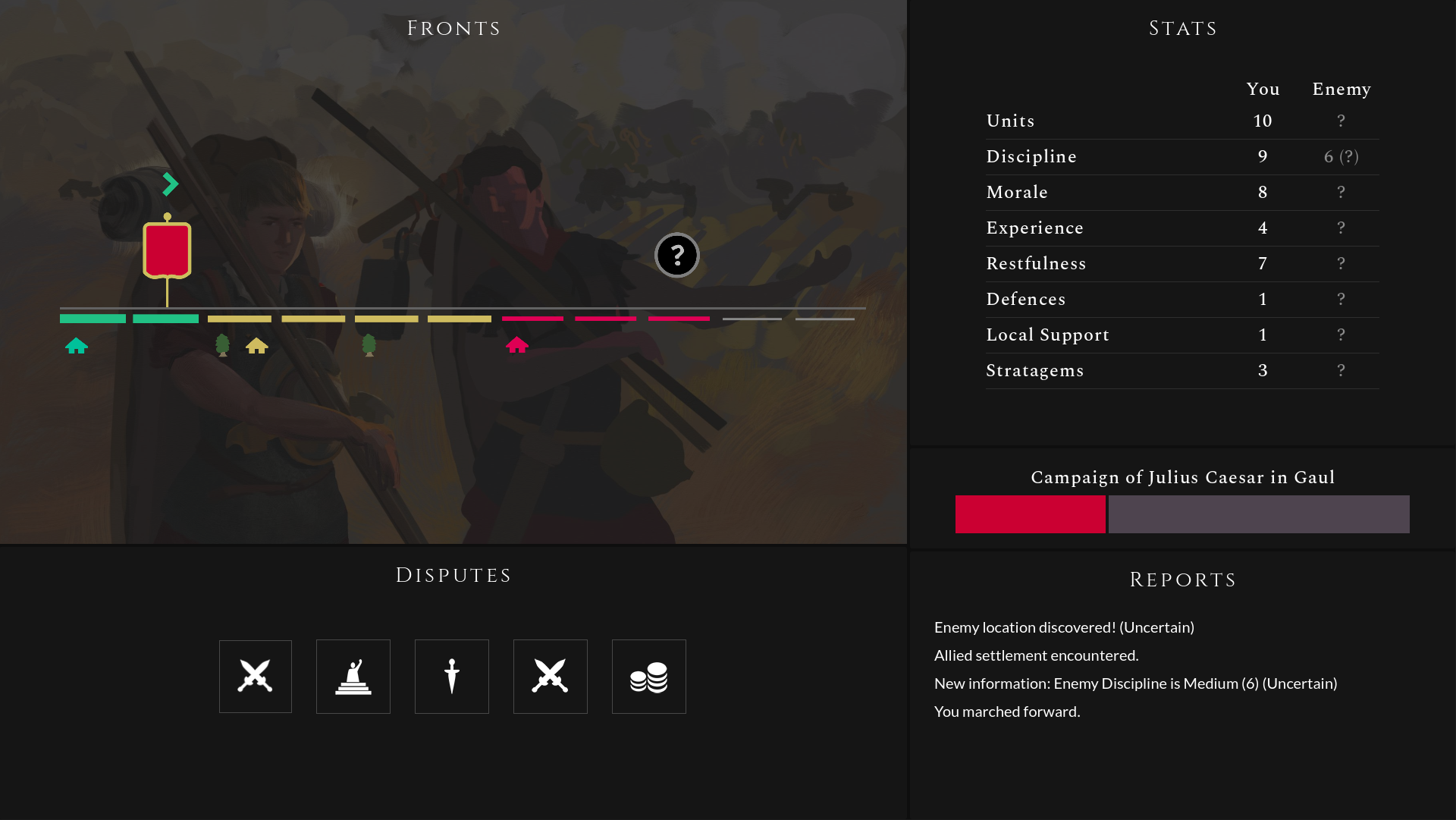 (This was a mockup for a military campaign screen that I posted on our Discord to see if there was approval or rejection of the concept. The result was 6 very positive reactions, 8 positive and 1 negative)
Mechanics of War
There was a very recent Reddit topic about a player being unsatisfied with warfare in new Paradox games. I am too, and I commented there.
However, most of my ideas to address the problems pointed out in that post are within the “Campaign” component I mentioned above, so I will not go into them here.
As for my design solutions for the “War” component, I will leave specifics for the next diary and the prototype itself. The next diary will talk about the geopolitics of Roman war; how wars started, ended, and the general trend of Roman expansion.

I'm working on a map that shows Roman expansion. The map isn't the primary way of interaction in Historia Realis, this is not a "map game", but the map is still useful to visualize the situation of Roman expansion.
Who Is The Player?
We have to remember that, in Historia Realis, the player is just another character in the simulation. You don’t play as Rome or as the Senate. You might be another senator among 300, or you might be just another dude trying to get into it. So you don’t make all the decisions.
This means that player interaction with war will be "here and there", in specific parts of the system, rather than one big thing. And you're certainly not directing everything.
Simulating Roman War
I want to set a few intentions for the war system. I also did this when I wrote Provincial Administration, Part I: High Concept, which was followed by Part II: Prototype.
These intentions allow me to then see if I’ve hit the points that I care about when implementing things.
I usually set my intentions around how I want the player to feel and what the core tensions are. By this I mean what are the things that you might want, but that are opposed to each other, and so would force you to choose between them. I find this makes for good gameplay.
There are some specific cases we can look at. For example, if you’re a governor, you might start a war without the authorization of the Senate. But this could open a chance for you to be prosecuted later on, especially if you’re defeated. That’s a good tension: you want military glory, but you don’t want to be exiled or fined, or lose standing.
However, since the player will be at the “outskirts” of the system, I will start by prototyping the simulation as a whole rather than grow that out from the player’s main interaction. This means I’ll be doing things in reverse order from what I normally do. Hopefully that goes well.
Player Experiences
This is how I generally want things to go:
You feel like you’re marginal to the war system, not the center of it. But you’re still (potentially) a part of it. You might lobby for a war in the Senate, or participate as a junior officer, even win a Triumph as a commander. But wars are bigger than you, and you don’t control the whole process.
The system supports the historical expansion of Rome, as well as plausible variations (alternate history). Eventually, you should be able to adjust the settings for how historical you want Rome’s expansion to be (more railroaded or more procedural, or somewhere inbetween).
The system creates some interesting stories and situations, at least some of the time.
I can later compare the prototype to these intentions.
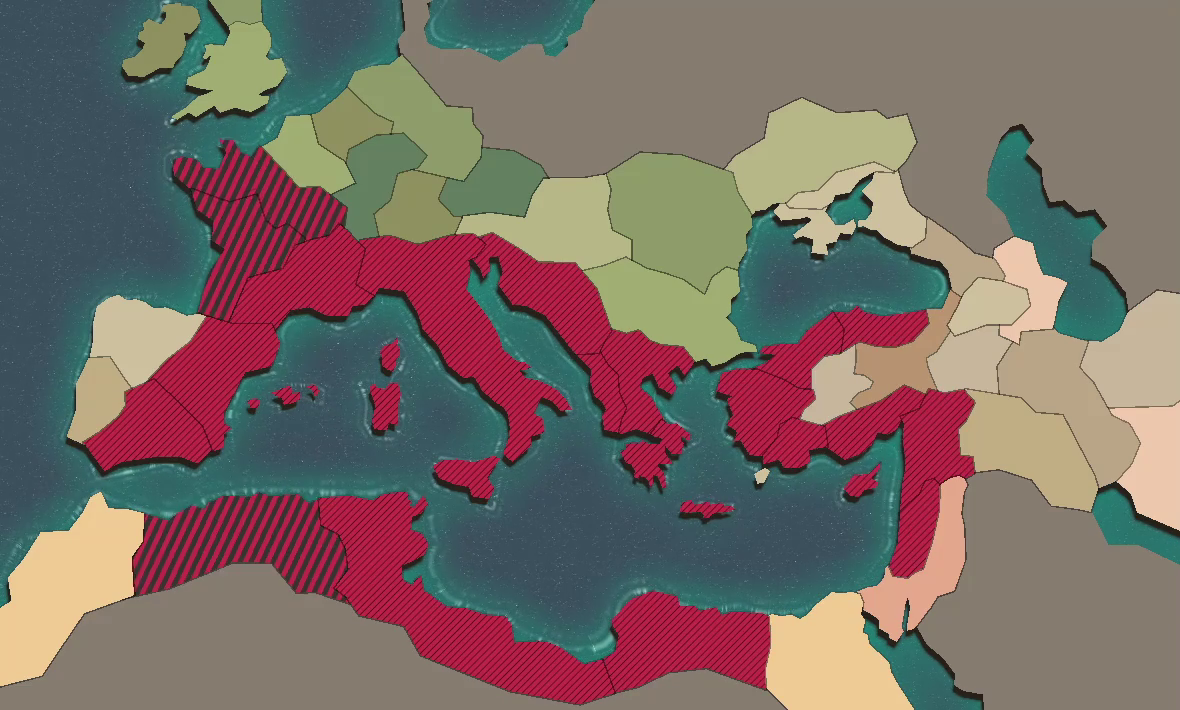 A slightly different take on the map, with outlines and less saturated colors. These are still works in progress.
Intentional Omissions
As always, I have to choose what to leave out. You might be surprised to see some important things in this list, things that might seem crucial or impossible to make a war system without:
Number of legions assigned to a province or campaign
Manpower
Wear weariness
Logistical preparations before war
Foreign empires
However, I believe those aspects are not crucial right now, and I have solutions on how to simulate things without them. I might revisit them later, and they are interesting, but I think I can make the core simulation without them, and leave space to work them in later on (if necessary or fun).
It's wild, I know, but I think I know what I'm doing!
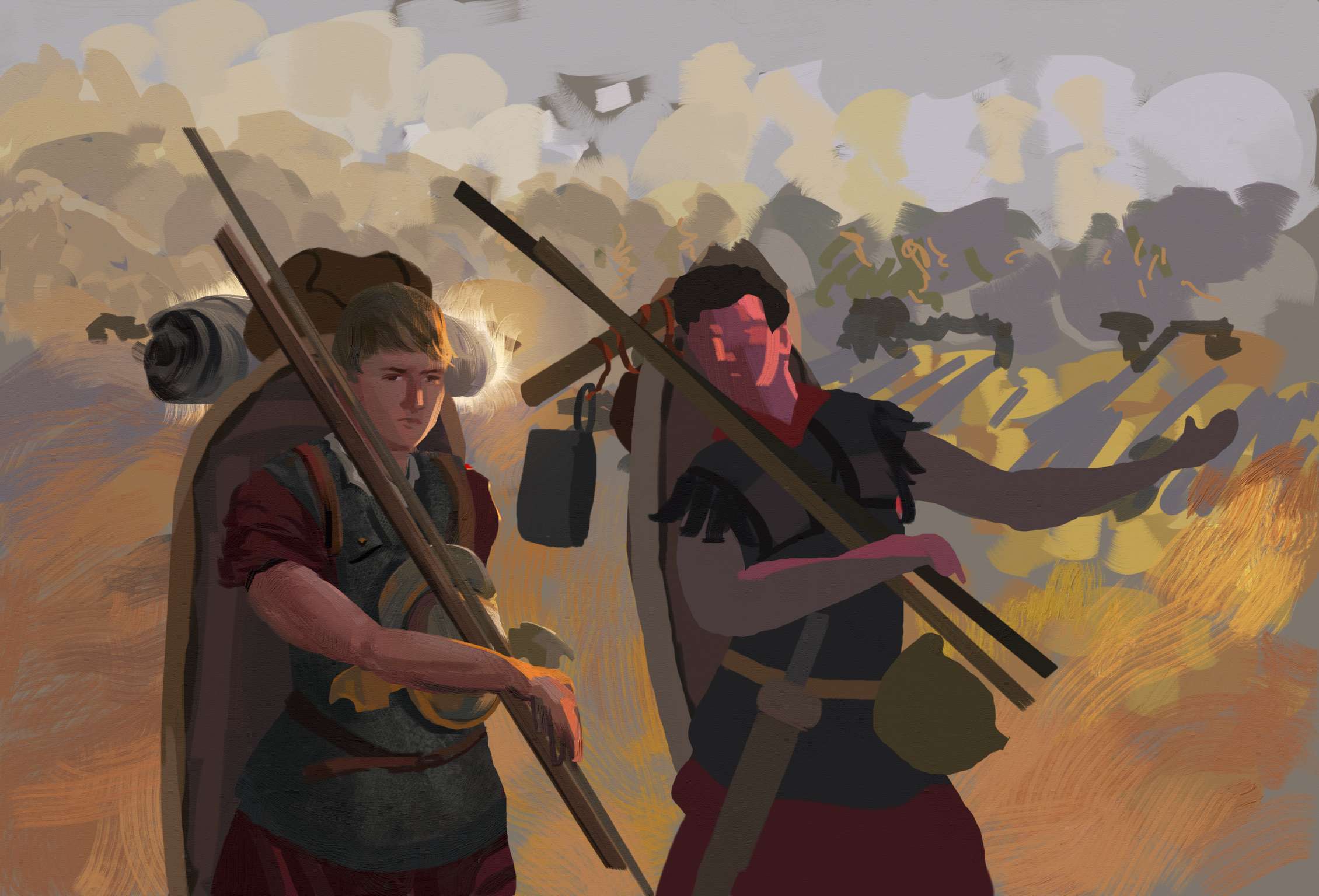 Still unfinished painting of two legionaries marching. These guys knew what they were doing!
References
These two books do a review of the historiography of Roman conquest, and I highly recommend them:
Roman Imperialism by Paul J. Burton (2019)
War and Society in the Roman World, edited by John Rich and Graham Shipley (first published in 1993).
I also read many others, but you can find all those references in the bibliography of those two. Perhaps a more "pop history" alternative is Adrian Goldsworthy's Pax Romana (2016).
Thank you!
Join our Discord to stay in touch! I'm there, you can ask me questions or give me suggestions!
If you want to support the project further, you can join our Substack.
Thank you very much.
— Lucas
Remember to wishlist Historia Realis! Oh, and follow it too! Then you get cool diaries like this delivered to you!