Today we’ll take a look at the province administration prototype. I decided to create it separately from the main game in order to get player feedback more quickly.
This prototype is playable right now, but available exclusively to Substack supporters as a way to thank them for their support. It will be available for free for everyone soon, as I will need more playtesters. Join our Discord and sign up to the mailing list to be notified! Or, if you can’t wait, you can become a Substack paid supporter to gain access now:
Please note that it’s a prototype, so it’s not representative of the final game. Also, there’s currently no in-game tutorial, as the mechanics will change considerably. So I made a video tutorial, where you can watch me do a playthrough:
(Above is a 20min video of me explaining this prototype of province administration)
A quick note on visuals
This prototype is ugly. I believe I’m able to make pretty graphics, but right now I’m focusing purely on gameplay. It didn’t seem worth it to me to work on the visuals yet, so it looks very barebones, like this:
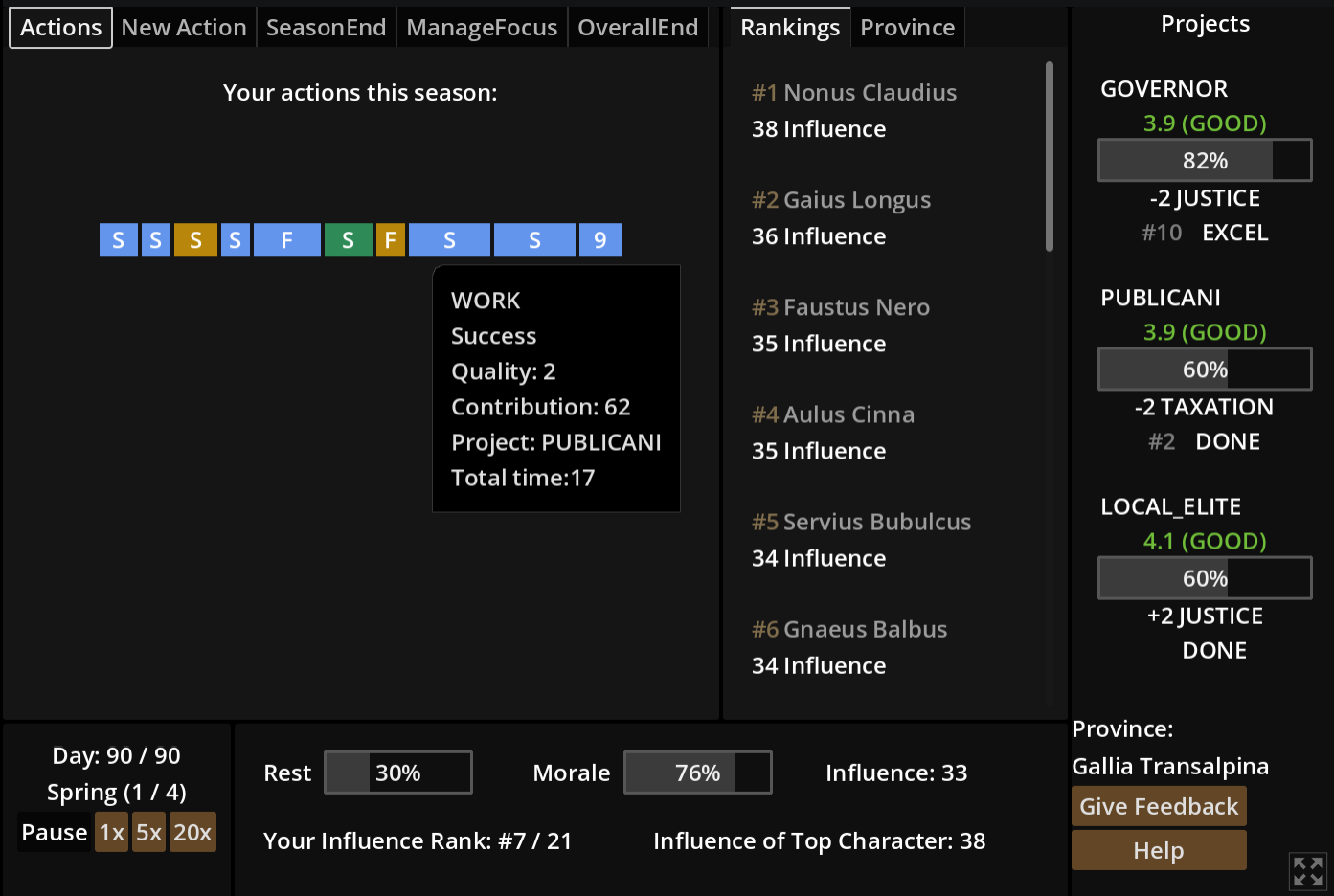
It’s not pretty but hey, it works.
Here’s an image of the current build of the full game that shows some nice visuals (even though it’s not done either):
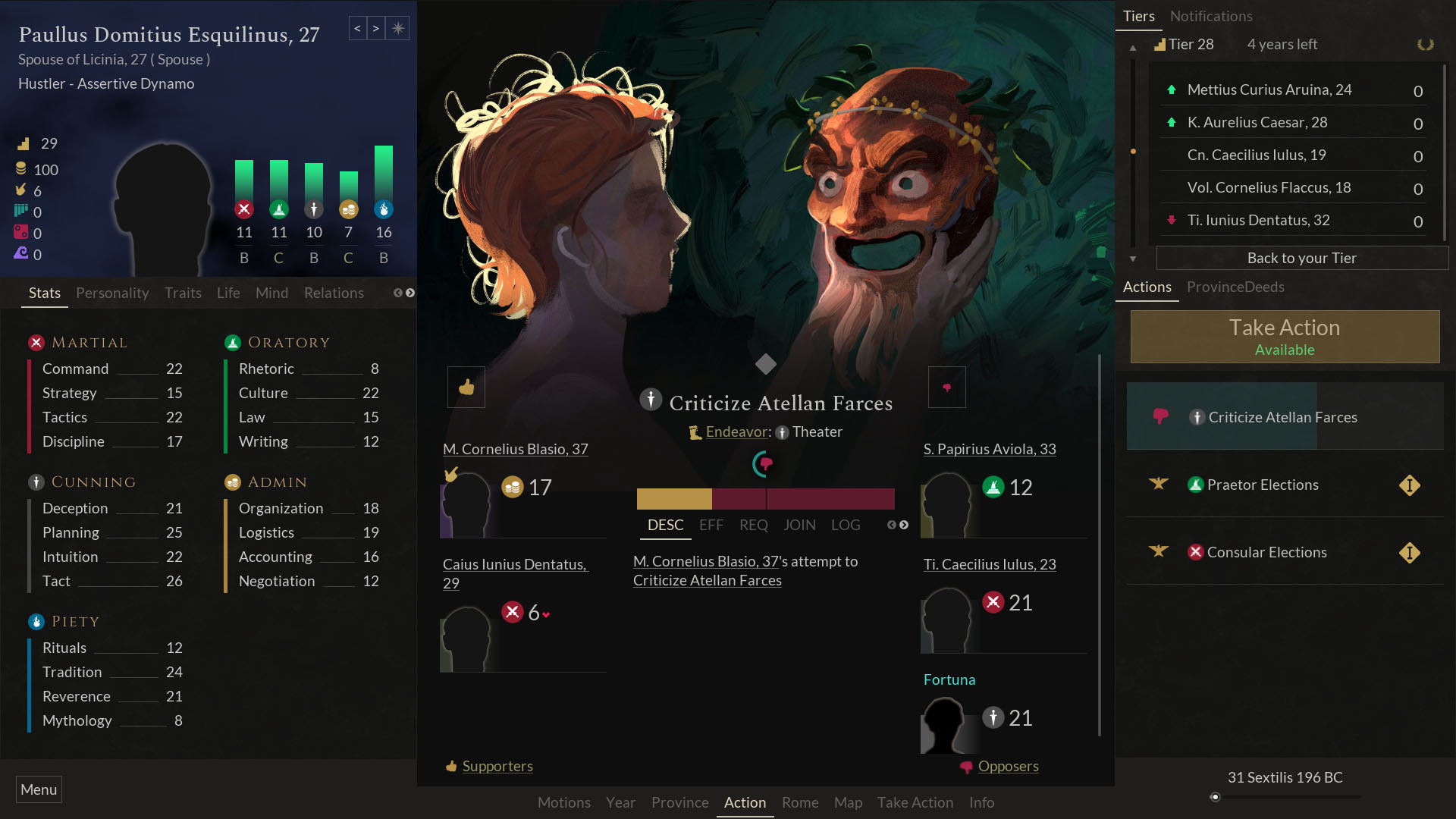
So you can expect province administration to look a lot better in the future. With that disclaimer out of the way, let’s get into the diary itself, and talk about mechanics and game design!
“Work” as the basis of provincial administration
But most of his time he spent in judicial business, settling the disputes of cities and kings, and for those to which he himself could not attend, sending his friends.
Plutarch, Life of Pompey. 39.1
The above quote is about Pompey’s work as a governor of Asia. When Plutarch says “his friends”, he’s talking about the Roman concept of friends: amici, the people that a governor would surround himself with and take to the provinces as his staff. Men, old and young, that would do the work of administrating the province with the governor. These men went out to the provinces and worked there.
From high concept to low-level implementation
Last time, I wrote about the high concept for this prototype. But a high concept doesn’t account for the low-level needs that arise. There are so many little questions that a prototype must answer. How exactly do the mechanics work, what are the elements and moving pieces? When you start implementing, you realize how much is left unanswered (or I do, at least!).
The most interesting thing I discovered, and was a bit surprised by, was the need to bring in an element that was completely absent from the high concept: work.
Administrating a province was work. And so I drew from the concept of work to answer lot of the design questions that came up.
Teamwork and the Division of Labor
We don’t know exactly how the Romans worked in a governor’s staff and in the provinces in general. There are no in-depth sources about the day-to-day of a governor and his staff. Or at least I didn’t find them — if you know any, please let me know!
But, to some extent, work is work! So I was able to draw from my own experiences with working, making stuff and collaborating with others. We all have some experience with work, even if it’s school work or house chores. We all know what it’s like to do stuff and work together as a group, and the difficulties that arise there.
Historically, we do have some sources on work in the legions during campaign, and we know that the Roman army was extremely organized in its division of labor. For provincial work, I decided to split the staff’s work in the following way:
Governor:
Makes high-level decisions, setting a project’s overall direction. Do we want to improve taxation? Improve security? Improve justice? The governor chooses the direction.
Legates:
They manage the project to make sure it’s completed and well executed, and get people together to do the work well. They also represent the governor in places where he can't be.
Prefects:
They do the day-to-day work, the specific tasks to get projects done.
Projects and Tasks
With the division above, the basic elements of interaction I came up with were projects and tasks.
Each season, the interest groups in the province each start a new project. These groups are the Governor, the Publicani and the Local Elite. See more about them in the previous diary.
Projects are always trying to accomplish some change in the province, such as increasing Taxation, or lowering it. They require tasks to be completed in order to get done.
Tasks are done by individuals: the governor’s staff. They take actions and contribute to different projects.
Rest and Leisure Tasks
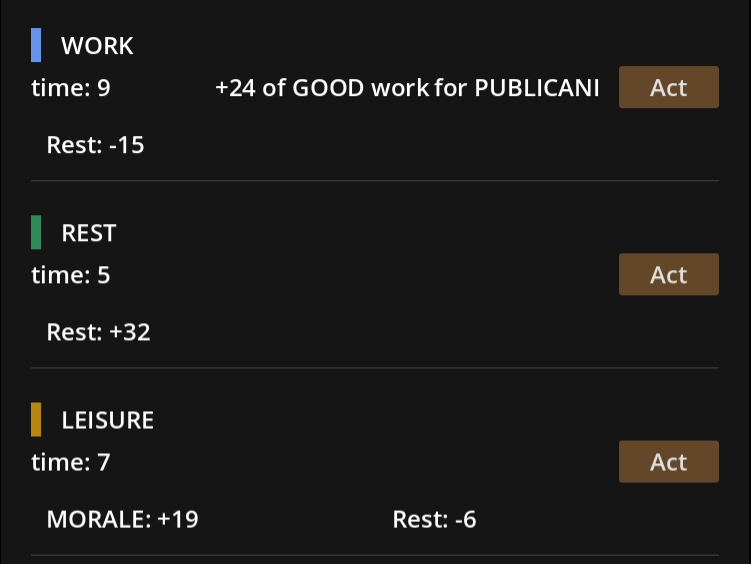
Work spends a character’s Restfulness stat, so they have to take Rest actions to recover. Leisure is another action type which can increase a character’s morale.
Rest and Leisure tasks are not linked to projects, unlike work.
Player Interaction
Pick Task
One of the biggest problems in grand strategy games is the sheer number of buttons. Sometimes the system isn't even that complicated, but there are so many ways to interact with it that it becomes overwhelming. Sliders, menus within menus, buttons that you have to hunt for in the UI… Doing anything takes 10+ clicks — if you can even find the right button.
I wanted to simplify: one click. The choices show right there in your face. That’s it.
For this, I used the “pick 1 of these 3 choices” trope, common nowadays in roguelites. It’s a trope that’s getting more popular because it works, I think. Picking 1 of 3 is enough to give you options, but not too many, and you can make your choice quickly and enjoy the game.
But isn’t that too simple? Perhaps. But there’s still depth. The 3 things presented can be different every time, wildly different, thus supporting a deep system.
With this, I can introduce a near-infinite amount of new action choices without increasing the complexity of player interaction at all, since you always pick between 3, whatever those options are.
In other words, we can have both simplicity and depth. Both ease of interaction and a complex system working under it. Hopefully.
Set Focus
Every design choice has its drawbacks. One problem I noticed was that having 3 random choices can be frustrating when you want to do something specific, but the RNG keeps giving you something else. To mitigate this randomness, I introduced the ability to set your Focus.
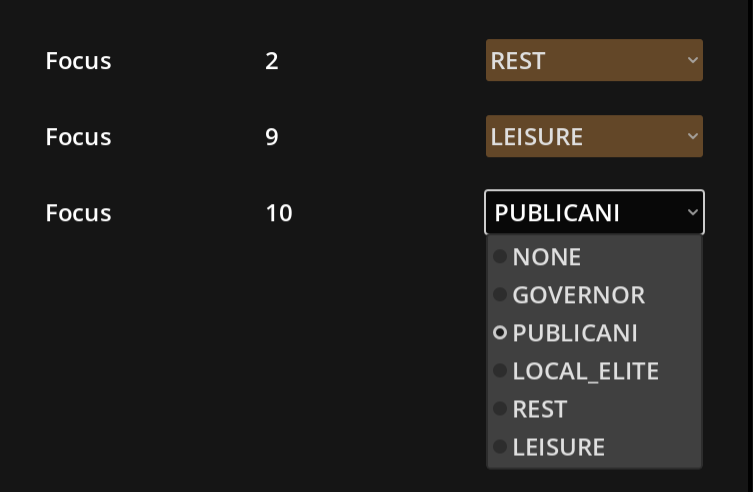
You can focus on a specific group, such as the Publicani, and you will get more tasks in your choice pool that allow you to do work for the Publicani. You can focus on Rest and that will give you more Rest actions. Etc.
This part of the prototype is still very much up for change, but I explain it in the tutorial video at 12:47.
Other Interactions
For the initial prototype, I limited the interactions to basically those two (pick task and set focus). This kept the system tight and clean, and the number of buttons small (yes, I care very much about having few buttons).
But there are a few mechanics not yet implemented that will likely require special interactions. One such case is Stances, which you will set at the beginning of your assignment to the province. A Stance is where you choose if you want to be corrupt, or honest, or a slacker.
This is fine because it only happens once. Another interaction (that will happen more often) is creating projects and assigning leaders, but that’s only for the governor and legates. Those roles are not implemented yet, so I’ll see about them when I get there.
UI/UX
There are a couple of important metrics to me, when it comes to evaluating the UX (user experience):
LESS BUTTONS: The fewer buttons, the better. As long as you’re still making meaningful choices!
LESS CLICKS: The fewer clicks to accomplish an action, the better. I also try to have shorter mouse travel distances in the flow of interactions, but this can be trickier.
The UI in this prototype is obviously ugly, as I am focusing on just making it functional for now.
Micro vs Automation
Personally, I don’t like micro-managing things. I like to make high-impact choices and see how they play out. There was this Reddit thread recently about “two types of GSG players”, and people seem divided on micro vs automation.
I understand the micro lovers, because I do like to play optimally and make sure I’m squeezing the most out of the game’s system. But automation is particularly important because province administration will be running alongside other systems in the full game. If you want to interact with those instead, and ignore this part of the game, you can.
So in this prototype, there’s both micro and automation. And you can switch between those modes seamlessly. There’s a simple “Automate” button that you can turn on and off.
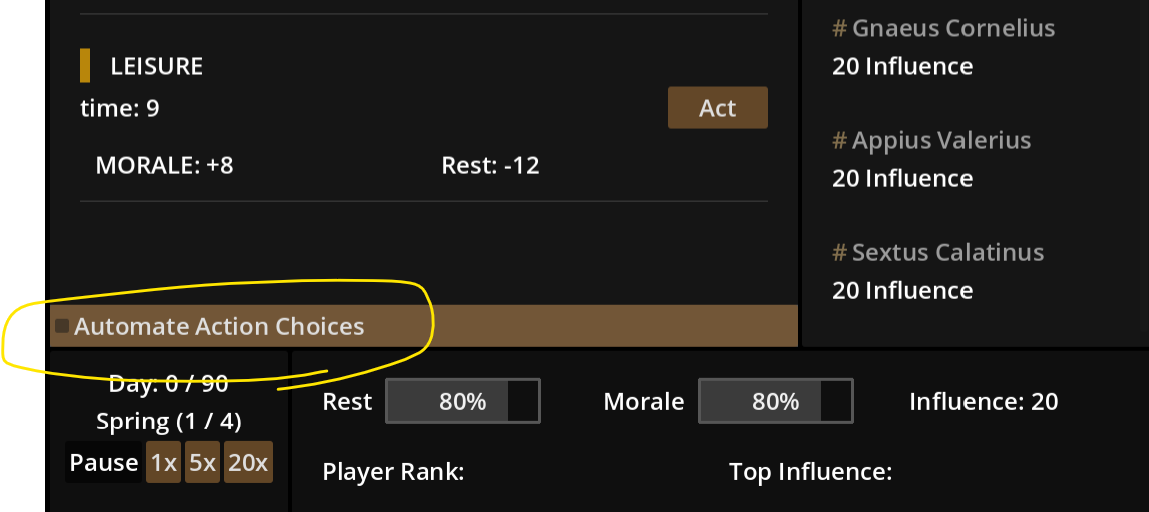
I have more ideas for automation that will be implemented later on.
What’s Next
Am I happy with this prototype? Certainly not! I’m always critical of my work, and I know there’s a lot more to do for this to become a good, fun sub-system.
Also, this prototype suffers greatly from being detached from the bigger game. It’s a prototype for a sub-system, but, without it being integrated into the larger system, it will always feel like something is missing. Because something is indeed missing, the rest of the game!
Without integration into the bigger game, I have to use my imagination to evaluate whether this integration is possible and will enhance the experience. For others looking from outside, this evaluation is even harder, so I’m putting myself into a pickle by collecting external feedback while knowing that people don’t have the full picture. But I think I think it’s worth it, as I can use whatever feedback is given to improve the mechanics that are present. And I also want to develop closer to the players, so this is a good step towards that closeness between me and players.
Before integrating this mechanic into the game, there are still some updates I’d like to make. Below is what might be coming next.
Planned Updates
Progression: Some way to increase your stats, get better over time. Probably through the Focus values, and possibly with character attributes. In other words, a progression system for you to improve your character over time, beyond just gaining Influence.
Opposition: Struggles, Threats, Rumors & Crises. I have some ideas for how these concepts appear and make things harder for the player (and NPCs) and have to be dealt with.
Intel: Corruption, Agendas & Stances. Some characters will be corrupt or lazy, groups will have agendas (even secret agendas), and more.
Legate Gameplay: You will be able to play as legate, with its own unique management mechanics.
Governor Gameplay: Unique interactions if you’re the governor, such as creating projects.
War Variation: My current intention is to use a variation of this sub-system for war. I don’t mean battles, but the experience of being on military campaign over months or years with fellow Romans. This makes sense because the Roman provincial staff was a military-administrative entity that would switch between ‘peace’ and ‘war’ modes according to need.
These planned updates are merely intentions, not set in stone. We’ll see what the future brings!
The Distant Future — Things I won’t get to in this prototype
There are a few limitations in this prototype that I don’t believe I will tackle at all during its development, leaving these for when it is integrated into the full game. The table below shows these limitations and the expected solution to them.
Limitation | Solution |
|---|---|
The province has stats like Security and Taxation, but they do nothing. | Provincial stats like Security and Taxation will matter in the final game. |
There’s no flavor to actions; work is just work, rest is just rest. | Actions will have various types and flavors like “Inspect the Docks” or “See a Play at the Theater”, etc. You’ll be able to gain traits and explore content rather than it all being generic “Work” or “Leisure”. |
The “ending” is a bit unsatisfying: you just get a review of how things went and how much Influence you got, and your rank. | This prototype will tie into the bigger game, and you’ll get rewards and penalties that continue after your provincial posting, and the changes you made in the province, or failed to make, will impact its future. |
These are problems I consider “solved”, or at least problems that I have thought of solutions that will probably work, based on my experience with the full game. So there’s no need (or scope) to prototype solutions to these problems now. They’ll be tackled later on in development.
Prototype Questions
The questions I needed to answer with this initial prototype were:
Does this convey the experience of being a prefect (junior officer) in a Roman province?
I believe it can, yes.
Does this fit into the bigger picture?
I think so, this sub-system seems to be a good fit. It’s a “zoom in” into a specific year (or few years) of your career that allows you to interact with things at a granular level. It potentially slows down the flow in a good way, or you can automate it away if you don’t want to deal with it.
Is it fun, engaging, interesting to play with?
There’s the potential for fun, and I think that’s good enough to move forward. Time will tell if this was correct. Your feedback will help a lot too!
Still Unanswered Questions
Is “Pick 1 of 3 actions” good enough, or too simple?
Can this prototype also support the experience of being a legate and a governor?
Is it expandable, can content and cool stuff be added?
These remain to be seen. Playtesting and further development will help here. If it turns out that this prototype can’t become fun, or doesn’t convey the provincial experience well enough, I can just scrap the whole thing and try something else. We’ll see!
Thanks!
This prototype is available to play right now for paid subscribers of the Historia Realis Substack. This is as a thank you for their amazing support. If you become a paid subscriber, you will get access as well, and my gratitude for believing in this project.
If you don’t have the funds to subscribe, don’t worry! The prototype will be available for free soon, though I don’t know exactly when. Join our Discord to stay tuned! I’ll let everyone know when I decide to expand the number of playtesters.
Thank you all very much.
— Lucas
Oh, and remember to wishlist Historia Realis!