
Welcome to our sixth blog post on the development of Kulebra and the Souls of Limbo. Today we delve into the music and sounds that bring life to the world of Limbo!
We’ll be sharing a lot of audio samples, so be sure to get your headphones or speakers ready to get the most out of this one.

Composers
Before we go any further, first it’s only right to thank the two very talented musicians responsible for the soundtrack and audio of this game: Zach Striefel and Clayton Tapp.
They’re responsible for one of the big pillars that hold this game together. They’re wonderful people and artists! So be sure to check out their other work!
Now let’s have a look (or listen) to the fruits of their efforts.
Music
The main purpose of music in games (and in other media too) is to further convey emotion to what’s actively happening, at least generally speaking. You’ll notice how music for combat situations tends to be fast paced, and slower music is used for more introspective scenarios. Music is incredibly important to help us immerse ourselves in the worlds we see on any screen.
A game’s main theme reflects the story and experience it brings forth into sound. Kulebra and the Souls of Limbo is a game about uncovering mysteries and partaking in a journey to a world unknown to us.
Why don’t we try a brief exercise? Give the main theme a listen and see what words come to your mind.
To me, it radiates a sense of melancholy, but with a tone of hopefulness for things to come. Of course, there’s no right answer here, you might have gotten a completely different vibe from it. But that’s what makes it art.
Now, let’s look at how we use music throughout the game!
Matching the Clock
A core mechanic of Kulebra and the Souls of Limbo is its time and schedule system. An in-game day is divided into “Day”, “Evening”, and “Night.” The clock will advance as you play, and you’ll transition between these 3 stages throughout the day.
Every major area in the game has its own music to invoke a distinct feel to each environment. And to go along with the time mechanic of the game, most environments have different tracks for each time of the day.
Here’s a little sample of how the music changes depending on the time. Have a listen!
A piece for every scenario!
Since Kulebra and the Souls of Limbo is a game about exploration and uncovering mysteries, much of the soundtrack will be on the softer side (It has plenty of good background music tracks to play while working, I can tell you that!). But of course, you can also expect a good variety of different genres of music!
One of our main goals is to make sure each part of the adventure feels unique, and our music plays an important role in doing that. But our music is worth a thousand words, so have a listen to a few unique pieces of the track which are a small taste of what to expect!
Live vs Synthesized Instruments
Most of the game’s music uses live instruments. This means that the music is made from live recordings of instruments, unlike synthesized music which is made digitally.
We felt this aspect helps to give the game a more organic, natural feel through the soundtrack. It’ll be much easier to convey what we mean with a sample, have a listen!
Speech
The world of Limbo is all about its characters, and the way someone talks is a huge part of their personality. We wanted each character to have a unique way of speaking, but how do we achieve that?
Full voice acting was not a practical option for us (it’s a HUGE script after all). Eventually we reached the solution you’ll find in the game: Gibberish-speak!
What did we do?
The gibberish voice you hear is made from smaller voice samples that we play back-to-back quickly based on what the characters are saying. You can think of it as a typewriter that plays a sound every time it types something.
The samples you hear are performed by actual voice actors! We record a huge-bunch of small “syllables” sound that we use to put together the gibberish-speak. This way we can give “character” to the character’s voice; show their personality through the way they talk. The voice actors that helped us did a fantastic job! We’re extremely happy with their work in bringing these characters to life! (And our audio composers did an amazing job coordinating with them and putting the recordings together!)
We record a LOT of “syllables” to make sure we have enough variety so that the speech pattern is not repetitive (We record about 89 voice clips per character). The “syllables” picked are not completely random either: All the sound samples are linked to letters, and when a letter is typed on screen we pick one that has been assigned to that letter.
The gibberish-speak is not meant to be accurate or complex by any means, nor do we use AI to generate any of these sounds, so our fellow voice actors can rest assured that their work is in good hands. More-so, this approach is so that it FEELS like the characters are talking (albeit, in a very weird foreign language). Like I mentioned before, it’s mostly a funny-sounding typewriter.
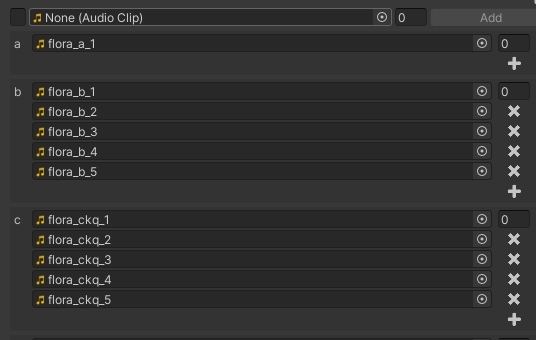
Here’s part of the pool sound for the character Flora. There’s one sound for the letter “a”, and five for “b” and “c” respectively. The letters “c”, “k”, and “q” are similar enough, so they share the same sounds.
Ambience
There’s one final subtle piece of audio design we want to put on the spotlight: Ambience!. It’s generally more difficult to notice since it’s partially covered by the music, but it’s one of those things that makes a huge difference even if we don’t notice them right away.
This not only includes environmental sounds, but also other effects like echoes in big empty spaces, and muffled noises from sounds coming from another room. Listen to a few examples and check which little changes you notice with the sounds!
What do you think?
We hope you enjoyed your time delving into the inner workings of Kulebra’s and the Souls of Limbo’s audio design! Thank you very much for checking it out and we hope to see you here on our next development blog post. Toodle-oo!