Salutations! The focus of today's Dev Diary is the Policies System, narrated by our Content Designer, John!
We have heard your feedback and are posting a VLOG, as usual, and also a text version of the Dev Diary below. Enjoy!
In Gilded Destiny, one of the main ways you can affect how your society functions is through policies: the laws and ordinances that your government puts in place that dictate the running of the country. This Dev Diary explains and shows several of the policies that feature in the game—what they are, how they work, and the kinds of impact they will have.
Policies Overview
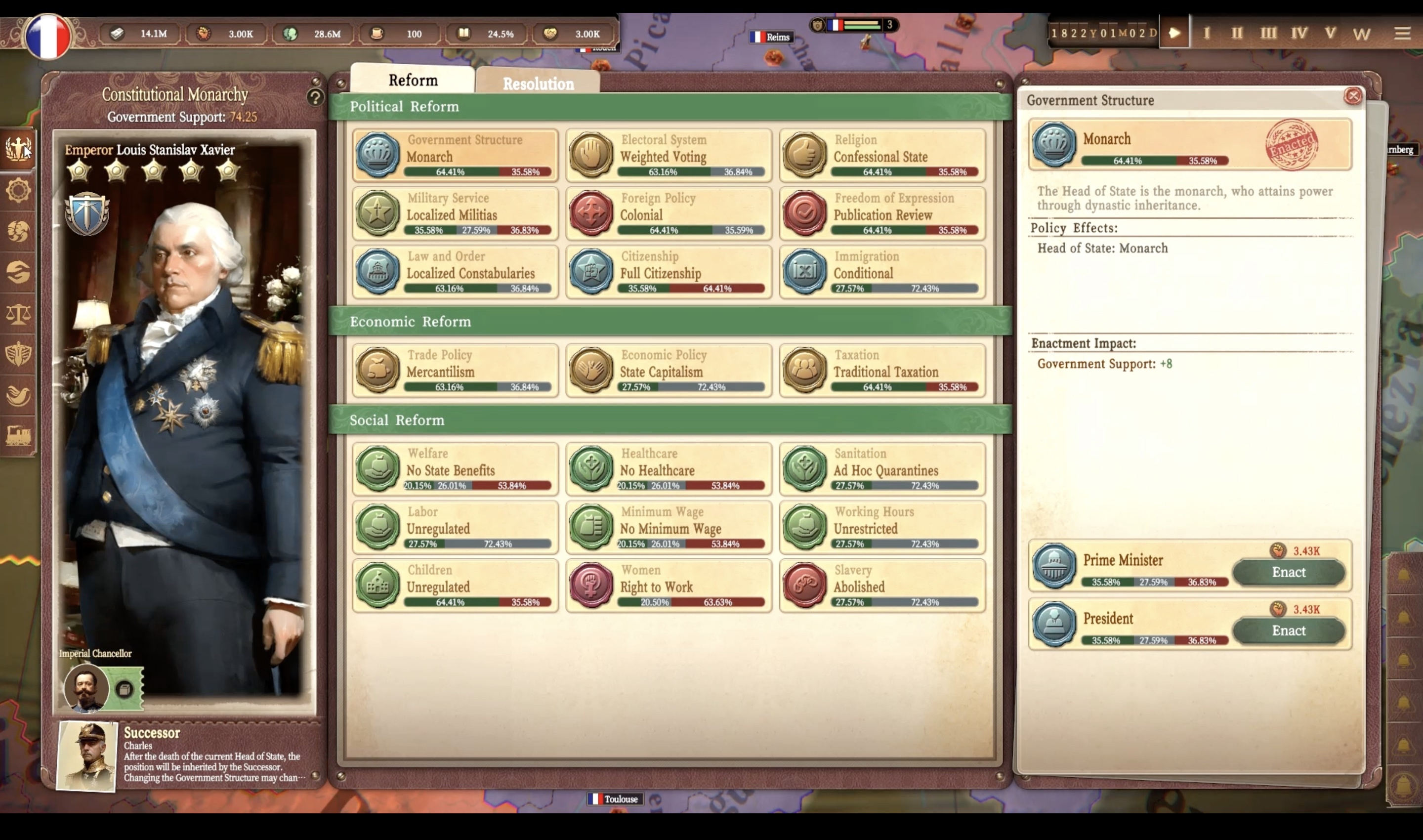
As you would expect from a grand strategy game, you have the power to affect how your society functions. One of the main ways you can accomplish this is through policies: the laws and ordinances that your government puts in place that dictate the running of the country.
For this Dev Diary, we are using the Kingdom of France, just after the Bourbon Restoration, as an example. If we open up the policies tab, we will see the various policies that we currently have enacted. To enact a new policy requires spending a certain amount of Authority. The cost varies depending on how much popular support or opposition that policy is currently facing. Once a new policy of a particular type—Foreign Policy, for instance—has been enacted, there will be a cooldown period before that type of policy can be changed again.
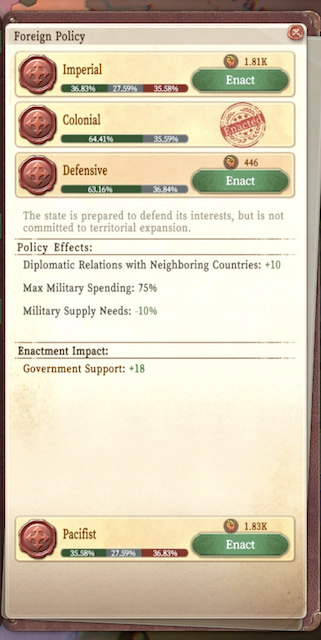
As you can see, policies are grouped under reforms which cover a number of different areas, ranging from the military, to the economy, to rights, to sanitation, and so on. Now, it is worth mentioning that for the most part, policies are not straightforwardly good or bad—at least not in the moral sense (this is the 19th Century, after all). But in general, there are pros and cons to implementing any policy, and it will be up to you to decide how you want to run your country.
On that note, we have tried to make sure that most policies are not locked or chained together or anything like that. A few require researching certain technologies—some of the sanitation policies, for example. But in general, our overarching design principle is to give players as much freedom as possible—including, of course, the freedom to make bad choices and run your country into the ground.
Now let’s take a look at the policies themselves in a bit more detail.
Government Structure and Support
First off, in our example, France is a monarchy, and so when it comes to the policy determining our Head of State, you will see that we have Monarch enacted. However, King Louis XVIII doesn’t currently have absolute power—there is an electorate and a parliament, as we see here under Electoral System.

At this point in history, the French legislature had just passed a law giving the wealthiest members of society a double vote, so at the moment Weighted Voting is enacted. So while members of both the upper and middle classes can vote, the Political Power of the Upper Classes is doubled. This in turn affects how much some policies are supported or opposed.
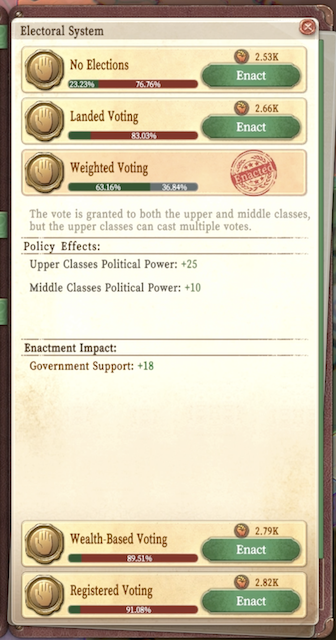
To talk a bit about support and opposition, it is worth clarifying that we do not represent political parties in the game directly. Instead, each social demographic will have a political opinion, which determines the policies they support or oppose. The relative political power of each demographic—basically how much their support or opposition actually matters—is then determined by a combination of their relative wealth, on the one hand, and whatever electoral system is enacted, on the other.
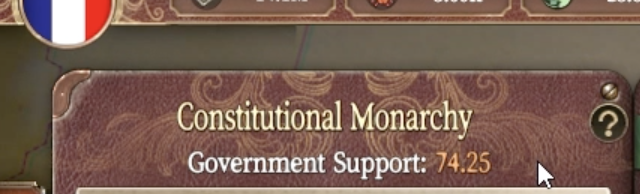
Enacting particular policies will have an overall effect on Government Support, shown here. How much support your current government has will affect various things, like the generation of Authority, Tax Efficiency, your army's effectiveness, and the chance of rebellion.
So with both some sort of electorate and a monarch as head of state, the Governmental Structure of France is a Constitutional Monarchy. The Governmental Structure of a country is not something you choose directly—instead, it emerges based on the policies you choose. Different types of government have different conditions. Some of the more common and flexible structures—like Absolute Monarchy or Presidential Republic—are based on just a couple of policies. More specific forms of government—like a Fascist Dictatorship or an Anarcho-Communist State—involve having several policies enacted to meet all their conditions.
Policies in Detail
Moving on, you can see that there are policies affecting the relationship between church and state—the laws regarding military recruitment and conscription—and the foreign policy that influences what we think we are going to be doing with all those soldiers. As you would expect for this period, there are also policies determining just how much we are going to let our people openly disagree with our policies—you can see at the moment, we are not too fond of the idea. On top of that, there are policies dealing with how we maintain public order—covering the development of the modern police force during this period—and dealing with immigration and citizenship.
Economic Policies

Next up, we have the three main policies that influence our finances: taxation, trade, and economic policy. The first two affect other tabs that we will cover in another dev diary, but in a nutshell, they enable or lock certain options on those tabs. Economic policy, on the other hand, affects how much control the state has over its internal market. This includes whether or not the state can compete in the market by building its own industries, whether it takes a laissez-faire approach and just lets the market regulate itself, or whether it decides to take ownership of everything and end private ownership—that last one being a condition for a communist government.
Social Policies
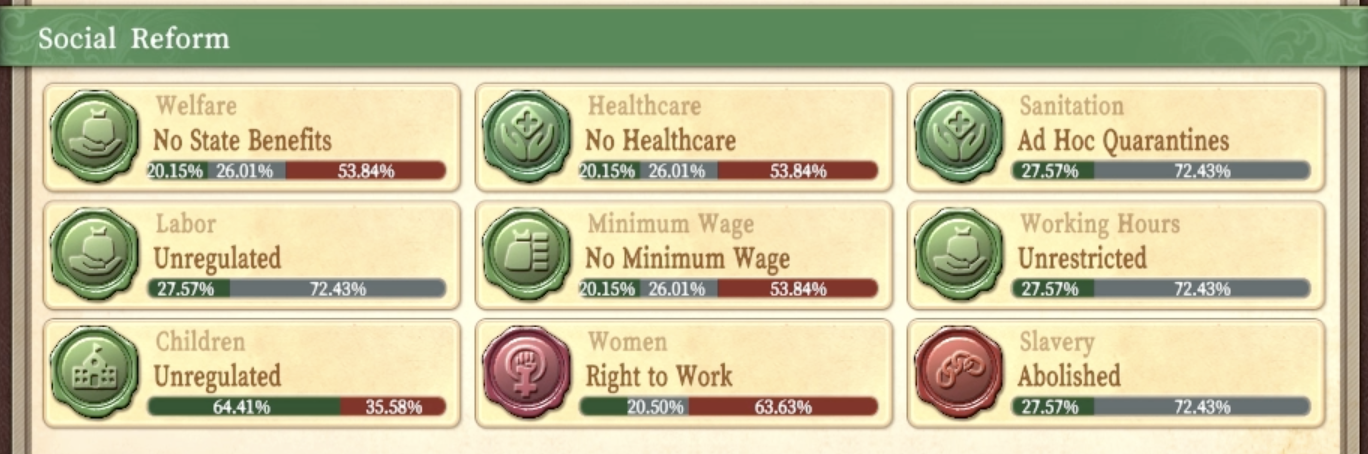
Finally, there are the policies covering most of the major social reforms that happened during this period. As with most of the policies across the board, there is some abstraction—not every country did things in exactly the same way, or called it exactly the same thing—so we have tried to capture the essence of what certain reforms were designed to achieve. it is also worth noting that occasionally we have reforms that did not happen until after the period the game covers—the idea here is that they were still things that reformers of the time had their eye on. So maybe they could have happened, if conditions had been right—and if you want to create those conditions, that is up to you. On top of that, the policies are designed to be moddable, if there is a policy or reform that you want to add to the game.
So, here we have seen the ways you can try to use your country’s government to mold society in the way you see fit. That does not necessarily mean that your pops are going to want or like your changes—and maybe you will have to make concessions to appease certain groups, or find ways of suppressing political agitators. Of course, you could also try getting your populace to want the things you want—but that is something we will have to cover in another dev diary.
Final Thoughts
We hope you have enjoyed this video, and as always, please let us know what you think in the comments—we do actually read them.
Remember that nothing we have shown is final, and some is solely illustrative. With the game still in the Pre-Alpha stage, most content will likely change significantly before release, and some placeholders are used. We hope this video gives you a better understanding of where the development is going!
If you have not already, be sure to wishlist us on Steam to stay up to date!
https://store.steampowered.com/app/2189430/Gilded_Destiny/
Join our Discord community!
https://discord.gg/3d77T9gxDF
Also, a few final things:
If you are interested in what we do and want to join us but do not see a relevant job, send us your resume at [email protected]!
Be sure to listen closely to the backing tracks in this video—they are the pieces you will come to hear in the game, composed by John Skoog.
Listen to some of John Skoog's other work on Spotify: https://open.spotify.com/artist/3PGd3lmURa72oFasqK3N7N?si=nDl4DUTRQGKKLaDtGcHBJw
John Skoog Music: https://www.johnskoogmusic.com/