Hello!
We're getting really close to early access launch now. Current plan is NEXT WEEK. This update is focused on one of the features of the game that has had the most iteration, but still wasn't up to the quality level I wanted to ship. Now it is!
Let's go on a little journey and talk about these panels. For your reference, they look like this:
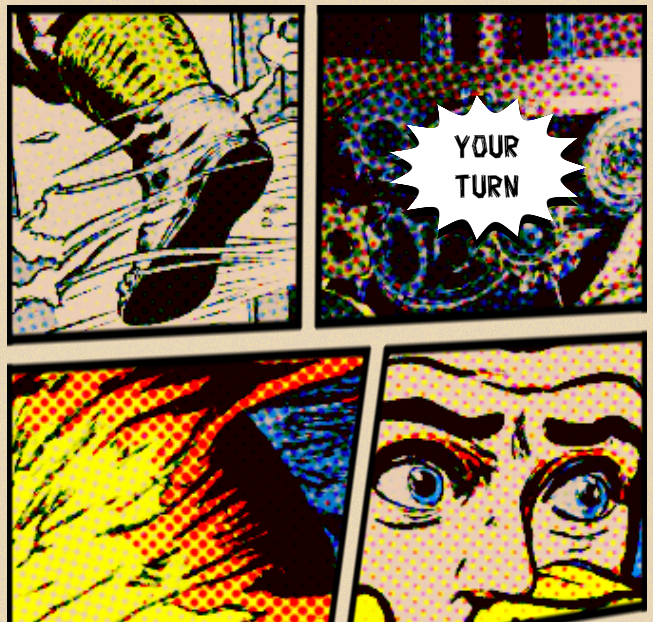
Years ago, nearer the beginning of this project, this was a text-rendered proc-gen roguelike. After my first playtest, the player was very confused. He was confused because there was no feedback about what he did, whether anything had happened, etc. To communicate better, I added a temporary little log system where it spits a little bit of text on the screen.
A million tiny iterations later, those bits of text are now comic panels. This update changes those panels in a few ways:
- I added a lot of art, filling in a lot of the gaps, and fixing panels that were using the same art.
- The black lines that separate the panels are called gutters. The gutter generation is now more dynamic, so the page will never look exactly the same.
- When you mouse over a panel, sometimes you get more information. The system that supports those was very broken, but now works.
While we're here talking about the panels, let's talk about the rendering a little. The little dots you see are commonly called "Ben Day dots". You may recognize them from the work of Roy Lichtenstein, or his contemporary pop artists. They originated as an artifact of a lithographic printing process called halftone printing.
The basic idea is to chemically etch away parts of a metal plate. You would use a mesh to protect some parts of the metal surface from the etching chemicals. The holes in that mesh (or their negatives) would become the places where paint could attach to the plate, and then get passed along to the print. The higher the density of the dots (or the smaller the gaps in paint), the more intense the color. Mix a few colors of paint together, and you can reach a large number of colors. This is the origin of the cymk color space that printers still often use today.
The rendering in game isn't completely faithful to the time period. For example, colorists would have to choose one of 4 color intensities for each colored section, whereas I've chosen to have a larger array. I've also significantly increased the size of the dots, for style.
I think they look really nice now. Getting this system right has been a surprisingly large part of this project, so I'm really happy I've gotten to this point. But I'm not done yet! More changes to come as I continue to iterate during early access.