
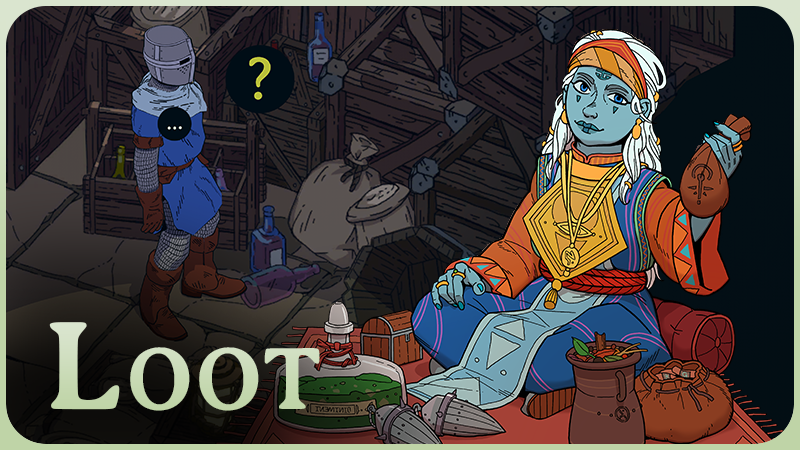
Why else would you dungeon-delve? Why else risk your life to throw yourself into devious traps and foul esoteric pockets? Items are pretty important to the end. Progression-wise, most players love to gather up powerful magic items, gear, or equipment. Consumables help balance the experience, to give some depth to the quest->explore->get-the-shit-beat-out-of-you->rest->repeat, game loop. And everybody loves to accessorize! The cleric has to wear his Urthguard uniform wherever he goes - but unique weapons? Switching out that old crusty helmet? That's perfectly fine.
So how does the LOOT look in Esoteric Ebb? I've shown a fair bit in the past, but now it's time to go over the exact designs at play, including the item categories, how you GET items, and how you MANAGE your items.
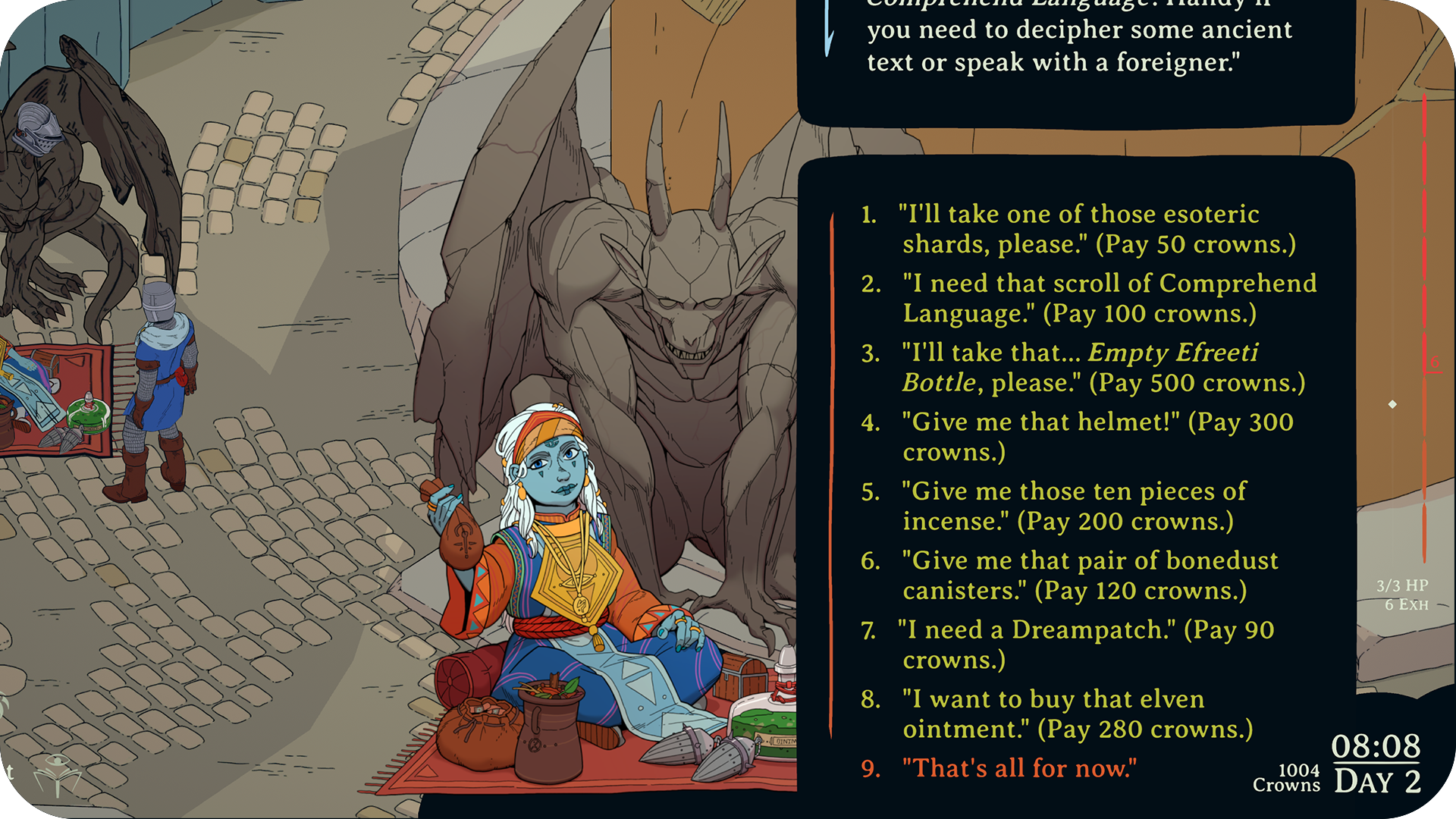 The average monthly rent of a studio apartment in Norvik is ~100 crowns.
Looting
There are three ways for the cleric to get items. He can receive them as rewards. He can steal them (after succeeding on, usually, a dexterity roll). Or he can purchase them. Esoteric Ebb is designed with these three paths in mind at all times.
Most things you do in the game will be rewarded, in big or small ways, by items. Usually, this means consumables. A health potion left on a shelf. A Pebble of Sending found in the drawer of an abandoned office building. A Ring of Spell Storing hidden in the darkness of an ancient snail burial-ground. The more danger you put yourself in, the better the reward. A handful of NPCs in the game also offer wares for you to purchase. This can be rather pricey- but you do end up gathering a fair bit of coin if you succeed in your delving-attempts. Of course, whether it's quest rewards or vendor stocks, you can also, almost always, simply attempt to take items from other characters. This allows you to sometimes skip entire quests, yes, but in the best cases you can actually even manage to double dip - steal the quest rewards before you succeed? Get another, second reward instead.
This method is risky though. Getting slammed in the face by a gargoyle bodyguard might seem fun the first time, but I promise you: HP is valuable. You can do the math yourself, but healing items tend to come out at around 10 crowns per HP. Doing that math in your head should make you a bit more risk averse- unless you're walking around with 20+ DEX. In that case, you can probably take anything you want.
Consumables
You can use healing items out of dialogs. This includes food items - Garden Apples, Svamp Extract, and Kardemum Treats - as well as more potent esoteric stuff like Potions of Healing and Illymian Ointment. Then you've got incense/bonedust/dreampatch, which restore spell slots. These two types of consumables are extremely important, since they are capable of extending your adventuring day. If you run out of resource way, way before you're able to take a long rest, just eat something. Burn some incense. Then get back to it.
(The only thing you can't fix with consumables is exhaustion, so make sure to keep that in mind if you keep rolling death saving throws.)
Finally, there's also potions that offer week-long ability score boosts. These are pretty good. Primarily because Esoteric Ebb takes place over the course of about five days, which is actually less than one week long. There are exactly three (of each) of these hidden throughout the game. Thus, the game is balanced around the fact that the player is able to permanently boost their ability scores
Equipment
As much as consumables are important, this is what players really want - and what they really think of when they hear the word LOOT. In Esoteric Ebb, there are over a hundred different items that you can equip. Many of them are a bit silly, maybe even terrible, but each has SOME type of function for SOME type of build. And personally I find it really fun to toss items around to see what kind of weird setups I can make with my base-cleric.
There are six default equipment slots. Three for accessories, and one each for helmets, weapons, and spell books. However, as you can see here, there are also 'secret' equipment slots that you unlock as you increase your natural ability scores. Strength is the most useful here, gaining access to several new slots if you get it high enough. (You can even equip multiple helmets at once!) But the other ability scores also have the ability to unlock ONE additional equipment slot if you get them high enough.
Important to note here, when you equip items your ability scores change drastically. However, this is your dynamic ability score level. This impacts your rolls and your chimes in dialogs, yes. But it does not impact core mechanics like these equipment slots, how many spell slots you have available, or DCs for your spells. This is another reason why those weekly stat potions are so powerful- they do actually count towards this natural ability score amount, just like in regular level-ups.
(And I just now realize I haven't actually written a devlog on the progression system, but in short: you get one ability score per level + new spell slot levels on level 3 and 5. God, making an RPG sure is complicated. So many systems! So much STUFF to BALANCE!)
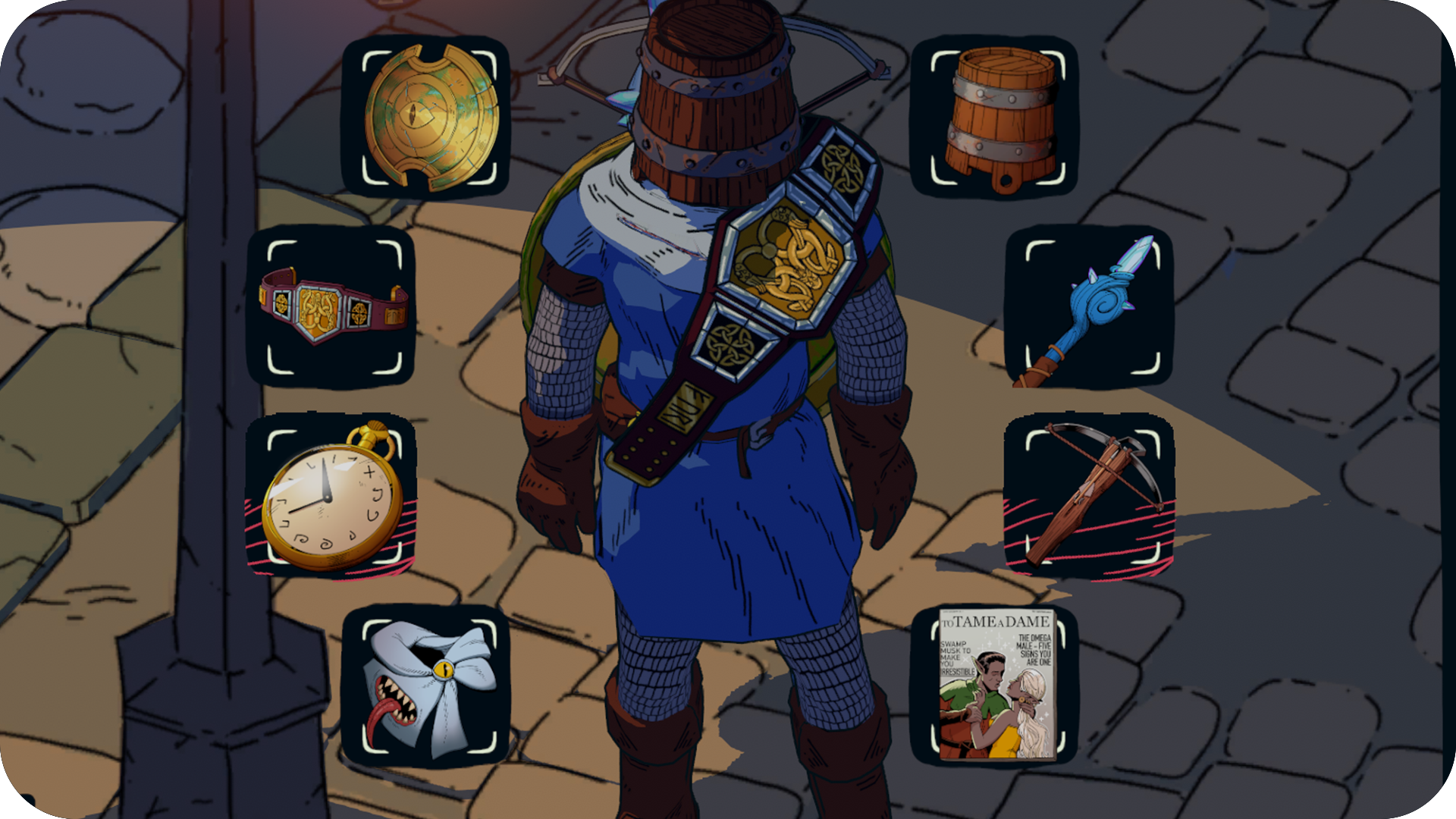 Yes, that is a mimic-scarf. His name is Meek.
Helmets
Here we go. The real stuff. Helmets offer, beyond the obvious aesthetic advantage, a zero sum stat modification. That means, you will always lose in one ability score, and win in another. The goal here is to push the player into building a more dynamic cleric- one that gets to see both high DC chimes, and the low (in your dump stat).
The negative here is that a player might really love the look of one helmet, and be unable to wear it due to the stat modifications. But as with all aesthetic limiters, whether we're talking about a paladin being unable to break a vow, or a dwarf being stuck with a CON modifier, I like it. I think it, when handled correctly, can lead to the world and mechanics feeling more entwined. So the Sallet is heavily connected with the Freestriders, thus it has a DEX focus. And the pot... is a pot. You look dumb as shit wearing it.
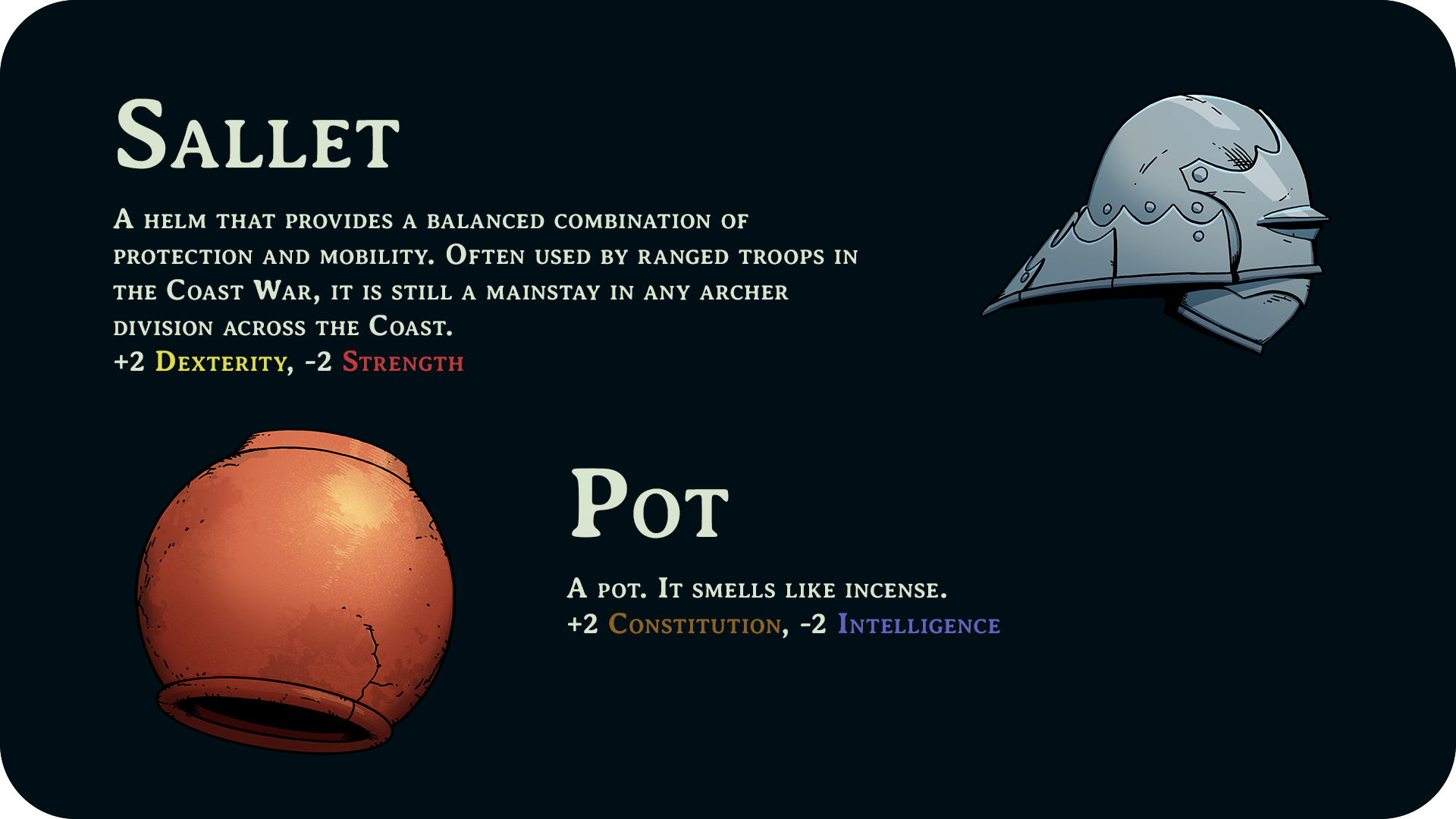 There aren't that many helmets in the game, but each offers a completely different visual style.
Weapons
Sorry to spoil you, but the cleric will never, ever, actually find a functioning weapon. He cannot use them in encounters, but he can still wear them, in a very manly manner. The stat modifiers on these are generally positive, and allow you to push your cleric more towards whatever build you're focusing on.
Now, I'm expecting at least a handful of people to be at least a little bit annoyed at not being able to wield a real weapon in the game. Logically, even the broken sword should be capable of being swung with disadvantage, right? But this is entirely a trade-off in coolness. I simply did not have the time to implement unique weapon interactions in the encounters. I knew this from the start. Originally I wanted to avoid weapons entirely, but... it's worth it. If nothing else than for the running joke that every single weapon you find is impossible to use in fight for one convoluted reason after another. My personal favorite is the sentient vorpal zweihander with performance anxiety.
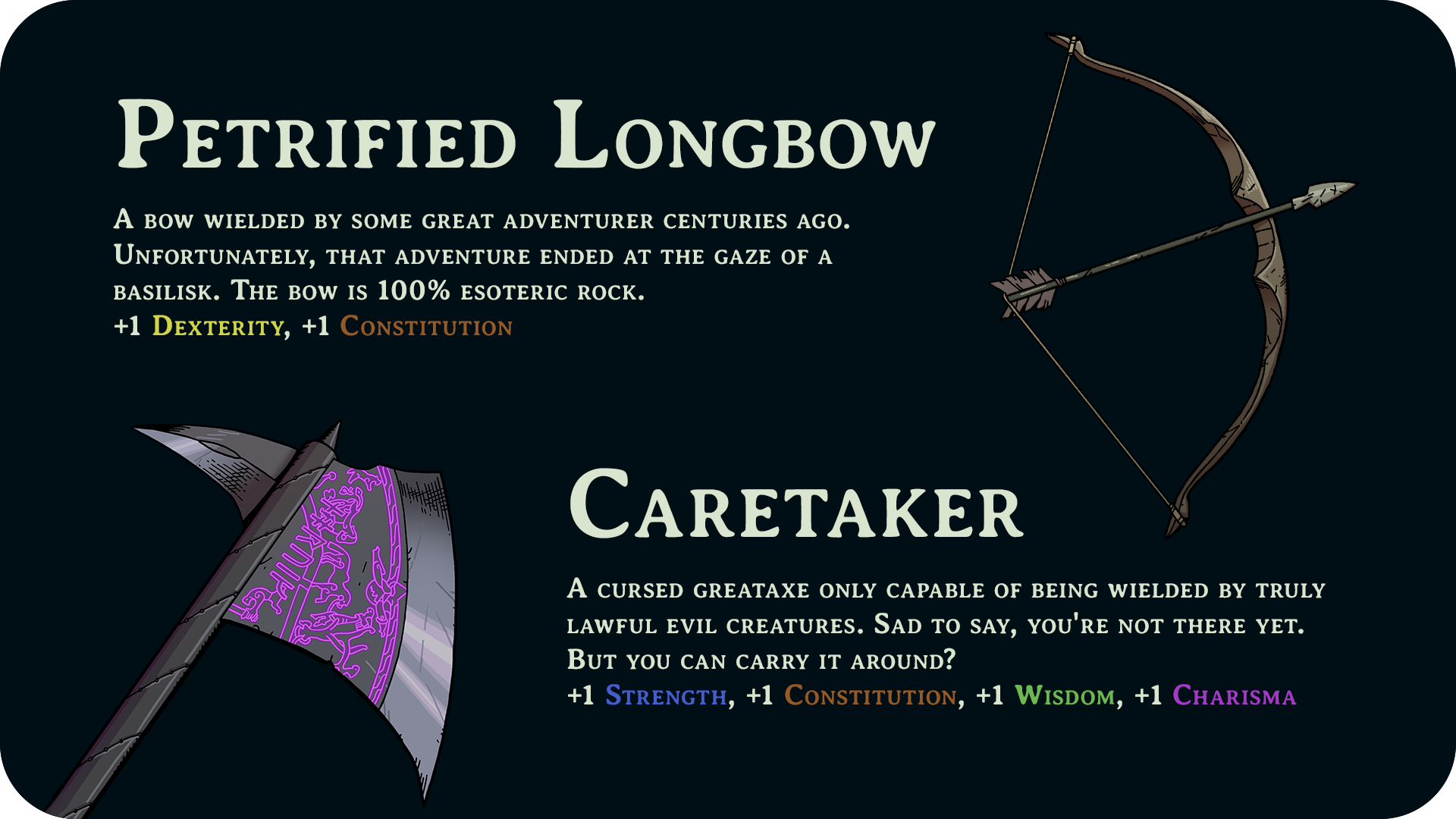 Caretaker is arguably the best item in the game. It is VERY difficult to get your hands on it.
Texts (Spellbooks?)
These can be anything from a random piece of paper you find in the dungeon, to highly esoterical, ancient tomes (that you also find in the dungeon). Generally speaking, these give less stats than weapons, but there's a handful of actually 'good' books - including your prayer book here - that should take up that slot permanently. There's one book for each stat available, but you can't get all of them during a single playthrough. So I'm expecting most players to walk around with newspapers for most of the game.
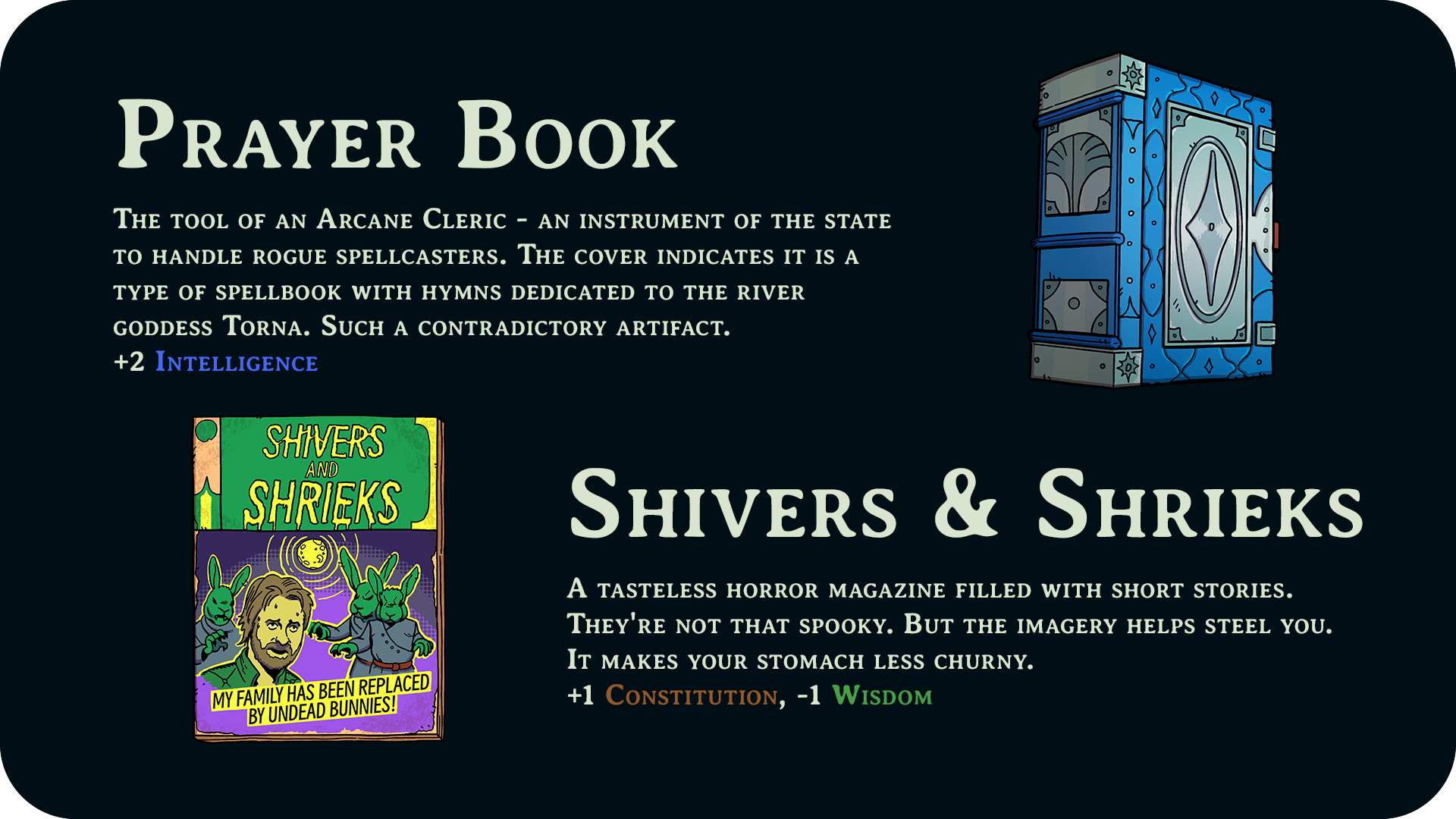 Early game, you can fill your spell book slot with magazines. For good or bad.
Accessories
The most common type of item. Since you've got at least three (attunement?) slots, you're able to mix and match these pretty freely - meaning: they usually don't give huge stat boosts. Once you're able to find one that gives more than +1 of your preferred ability score, you'll probably keep it equipped until the end of the game.
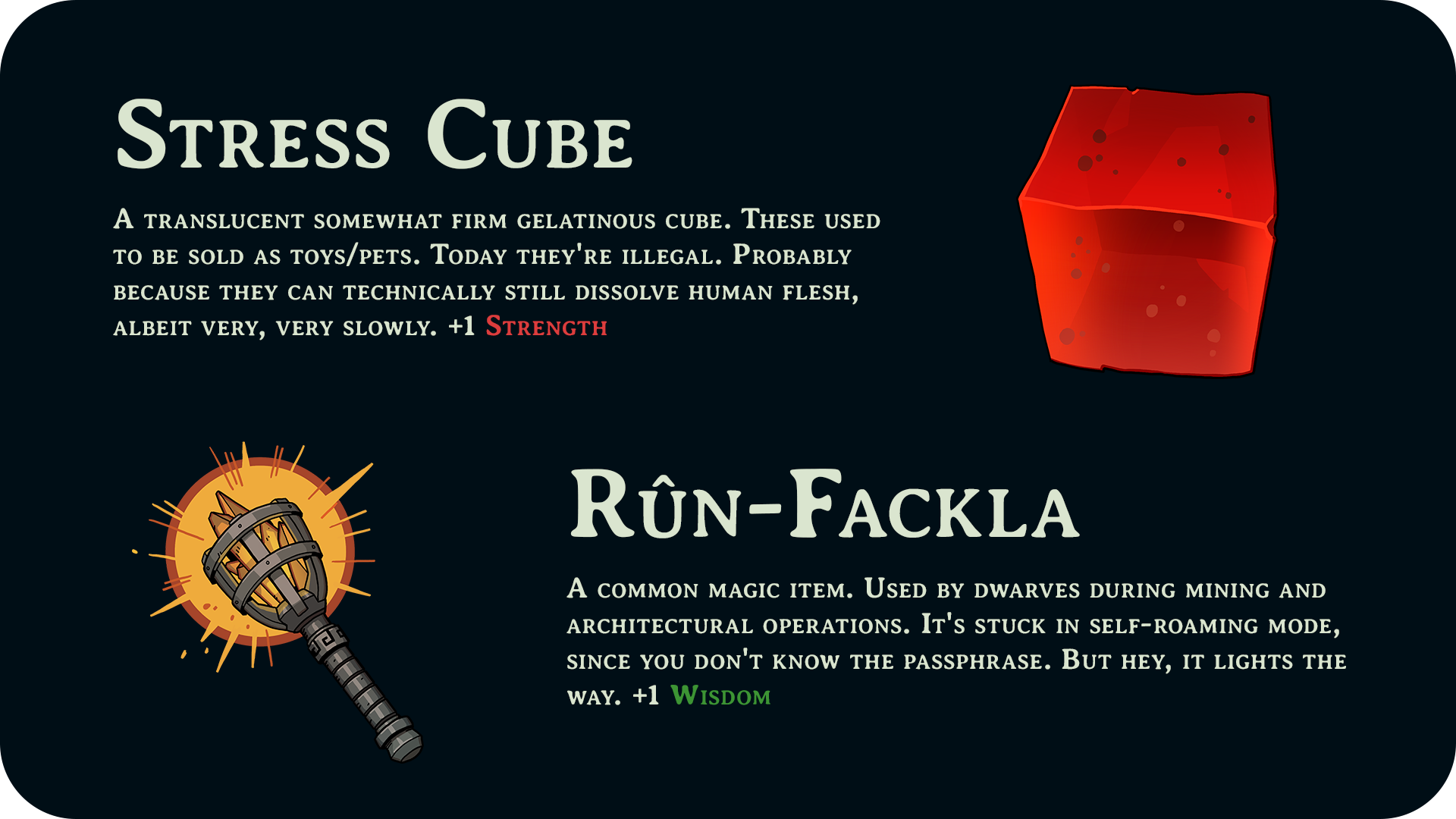 The rune-torch does also light up your surroundings, in case you prefer that over a temporary cantrip.
Additional Modifiers
While most items act as stat modifiers, allowing you to customize your cleric's roll chances and chimes, a few items also have unique effects. Some characters will comment on the bucket you put on your head. If you equip the Tiny Dictator, you'll obviously gain advantage against any bureaucrats you encounter. And if you wear your Ring of Regeneration (which you probably stole from Lady Sageleaf, I assume?) then you obviously regain a bit of health over time.
As for 'key items', originally I did have that fourth type of category as well. Technically it's still in the code as well, but I realized at a certain point that it didn't make sense to make the quest-relevant items less interesting, so yes, you can equip any key item you want. They usually suck, though.
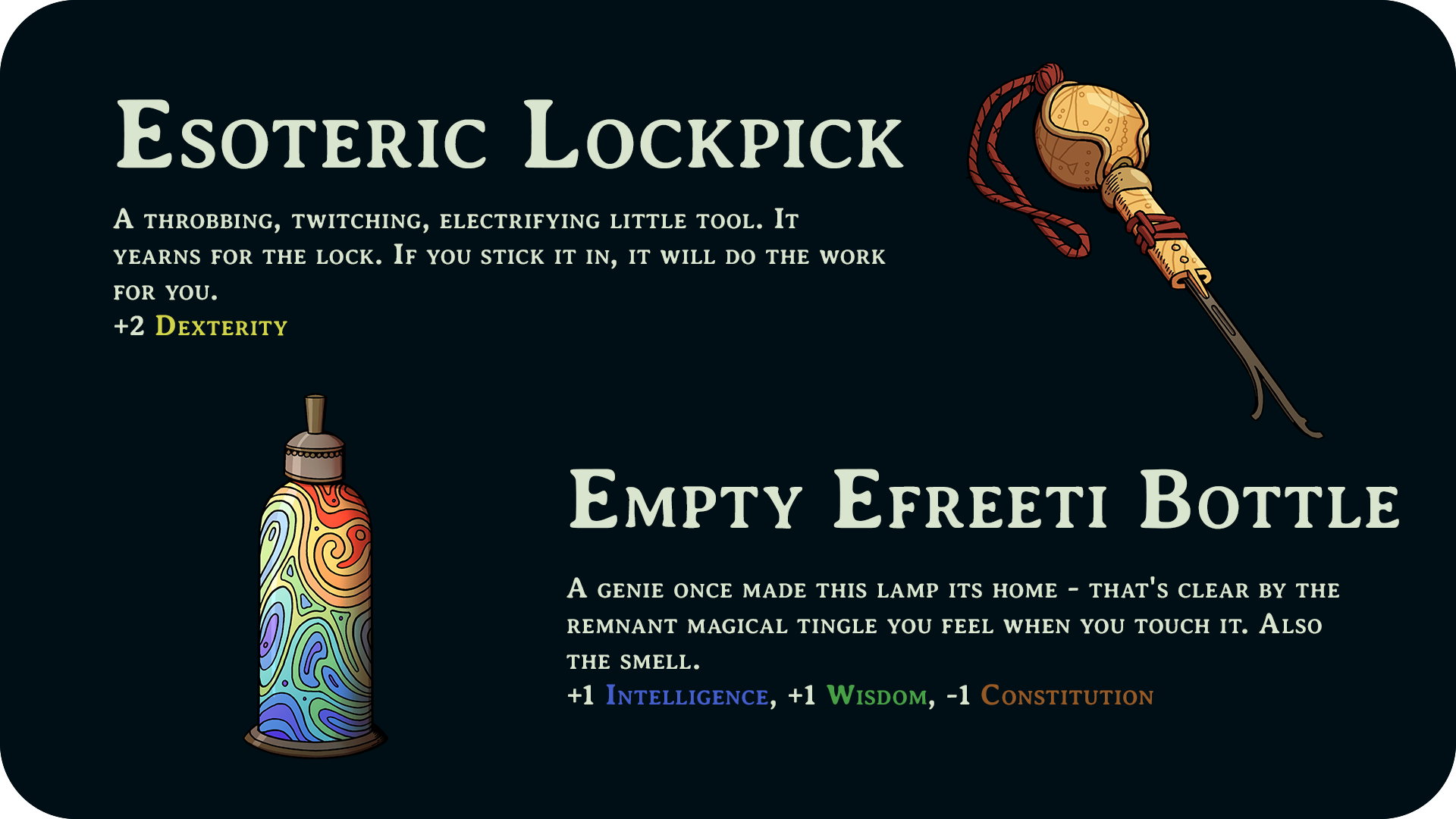 That bottle costs 500 crowns. Expensive! Though, like with lot of items, you can find special uses later on.
Dialog Uses
There are also certain dialogs in which that one perfect use for that one very niche item might actually come up- so make sure to always loot everything you can. Even if it seems useless for your particular build. But then you might ask: "Chris, what if my inventory gets really full of terrible stuff I don't want to equip?" To that I say: that's actually a pretty big issue. You see, in order for the narrative function of certain item to work, I needed the player to feel perfectly able to loot everything, and not worry about carry weights or a full inventory. One of the things you'll find out very early in the game is that the Cleric has a Pouch of Holding. In short, that means infinite bag space. So narratively, we're working on point and click logic here: you can loot anything that could arguably fit through a 1-foot hole. But then you'll end up with a massively over-stuffed inventory. Which could be solved through a more advanced inventory UI. But I really enjoy the '5 by X' grid that currently represents the cleric's pouch. So instead of changing that, I added the DEEP STORAGE.
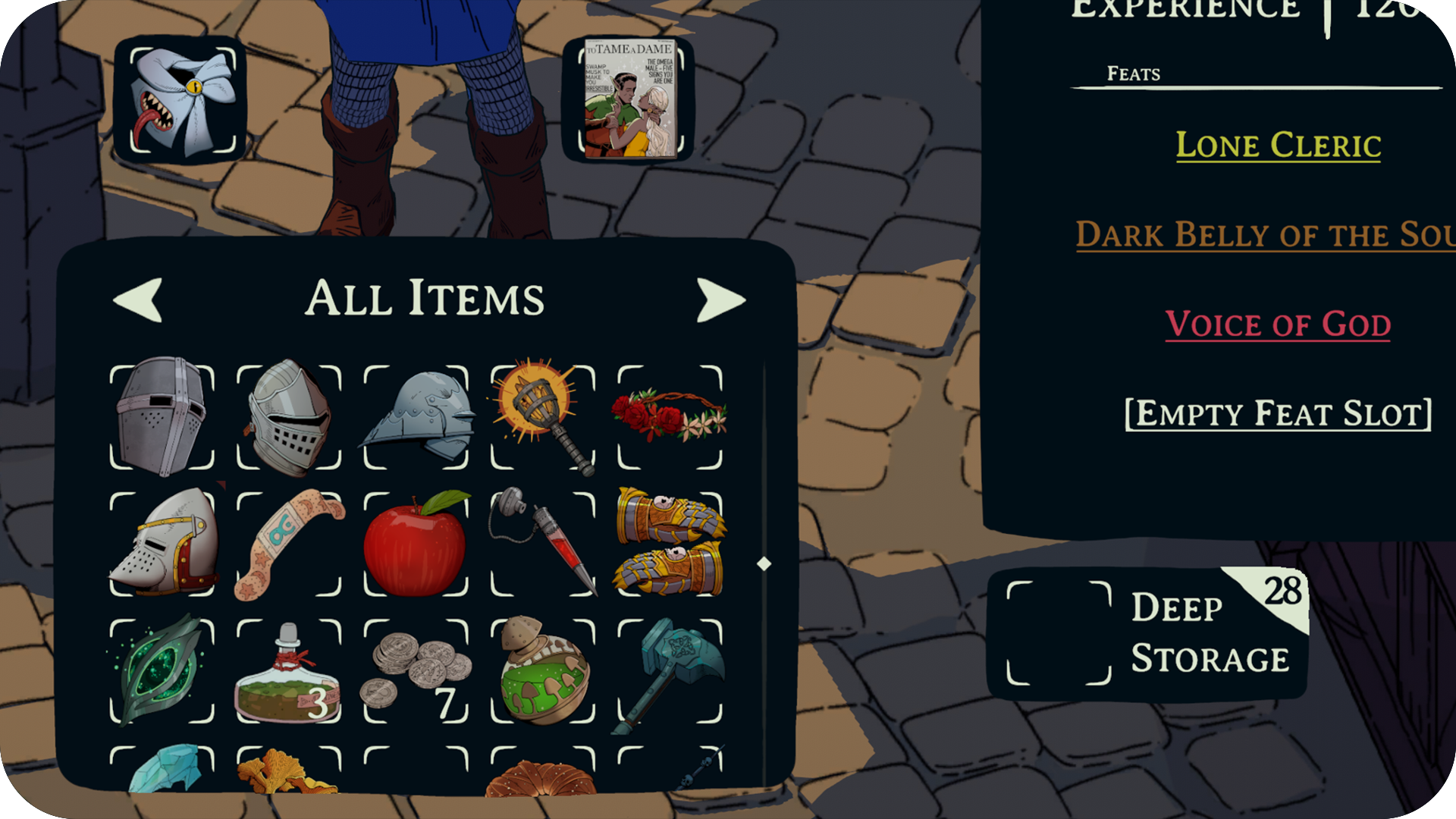 There's an achievement for putting 50 items in your Deep Storage. It's not hard to get.
Deep Storage
You can drag and drop items into the 'bottom of the pouch'. This makes them disappear from your inventory. Once down there, they won't return until you decide to turn your whole bag inside out. This way, you can easily 'delete' items that you never want to equip. But you can still use those items in unique dialog interactions. Hells, you can even toss in your coins in there if you don't care about having a visual reminder of your impending economic doom - while still automatically using them when going shopping at any vendor. Same thing with incense/bonedust/dreampatch (items you spend to regain spell slots) - they can all be used automatically when you cast spells. So unless you're doing some real special setups (you can only burn incense outside of dialogs for example) then you can keep your inventory as clean or cluttered as you wish.
Quick reminder: Esoteric Ebb is releasing in SPRING 2026. That's VERY SOON! Go play the demo if you haven't, and make sure to WISHLIST!
-Christoffer Bodegård