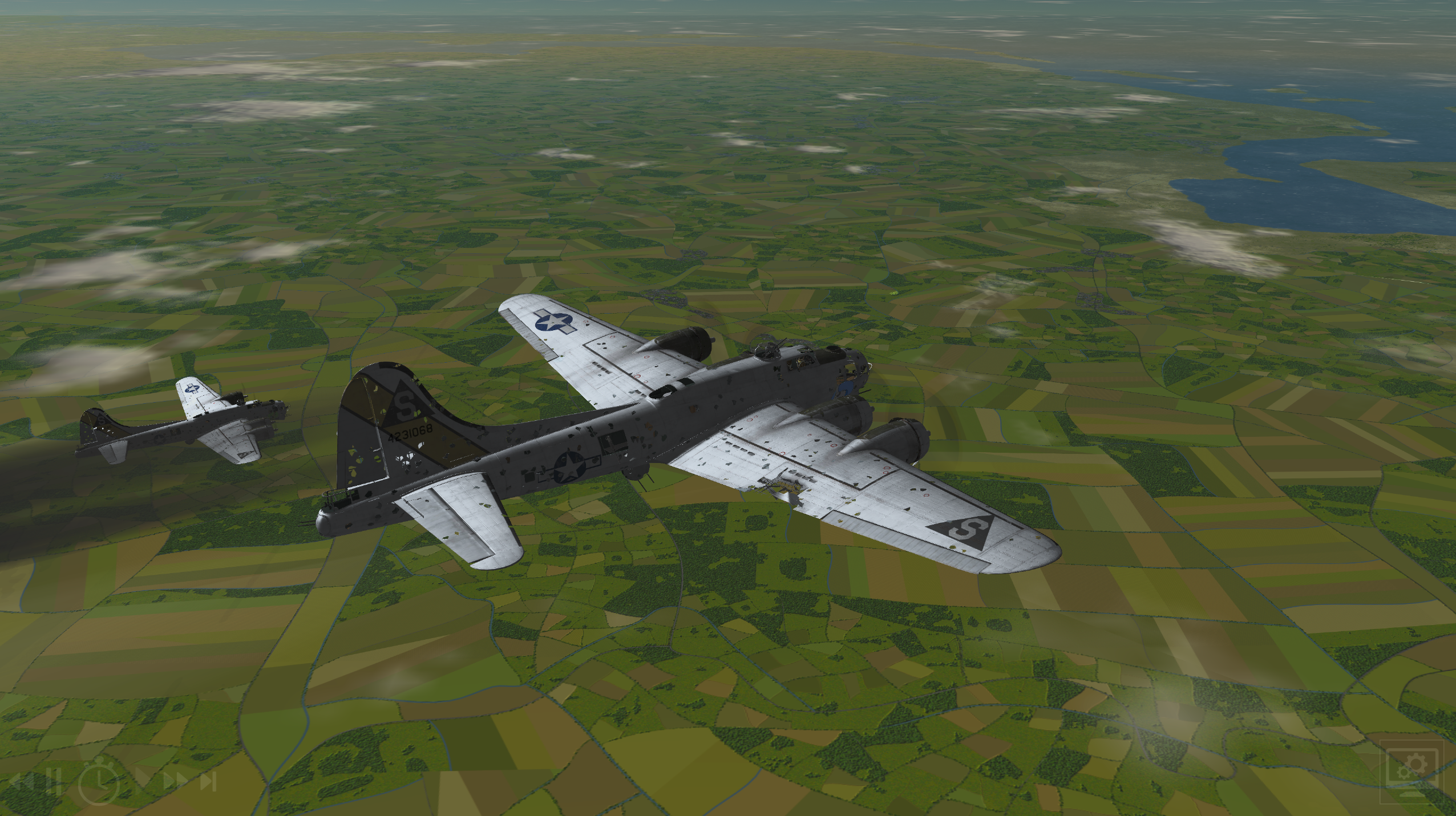
Today is a good day. Today we ship a build. This one is the culmination of our efforts to transform the terrain rendering in the game from 30 year-old tech to modern. And we’re super happy with the result. Today’s build brings:
all new terrain system (including atmospheric haze);
all new astronomically correct GPU rendered sky;
performance and quality enhancements to the texture damage system;
JSON editable historic missions including a new 7th historical mission (Oshersleben);
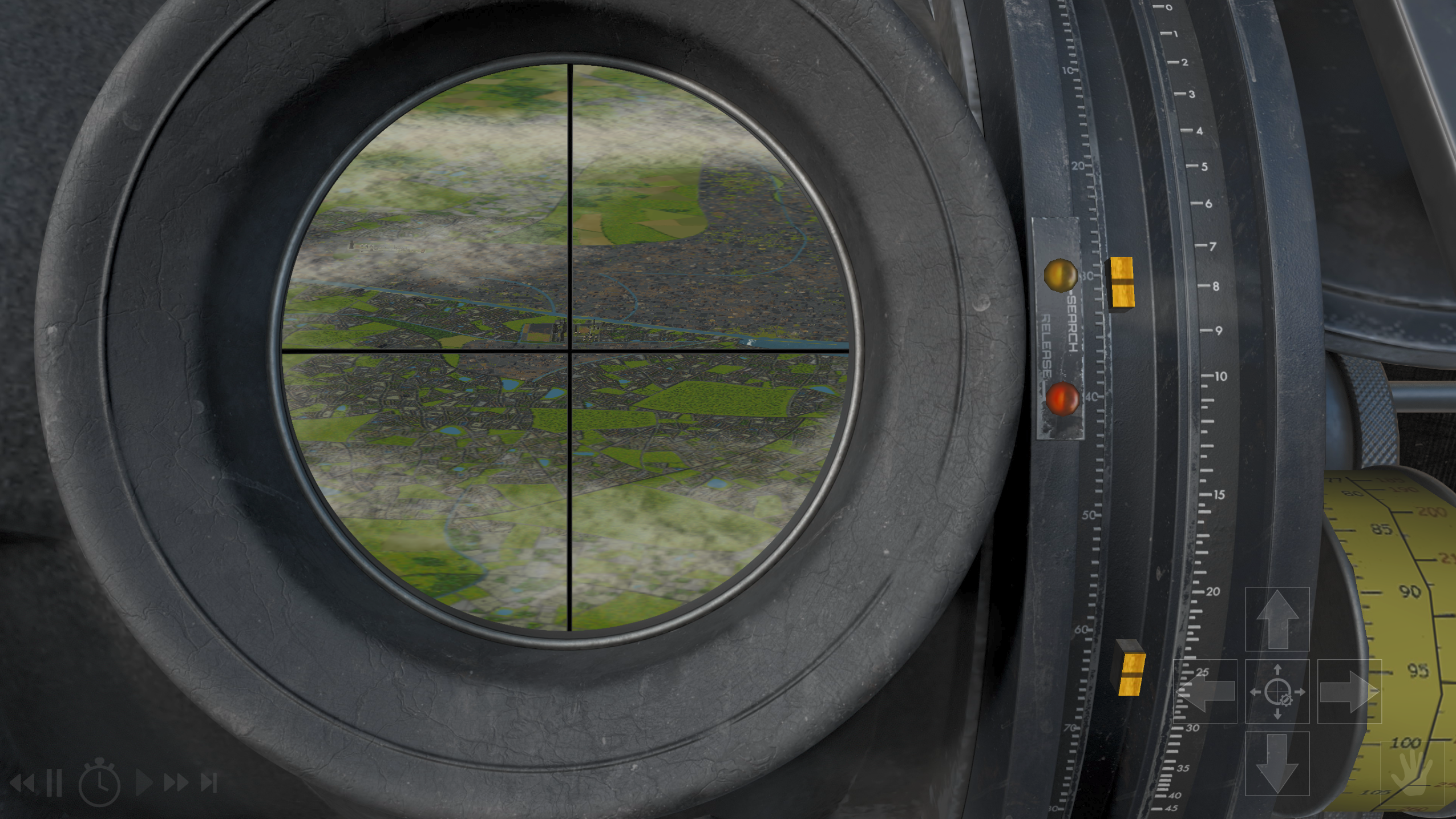
Improved target object rendering; they’re now visible from much further out making for an improved bombardier experience
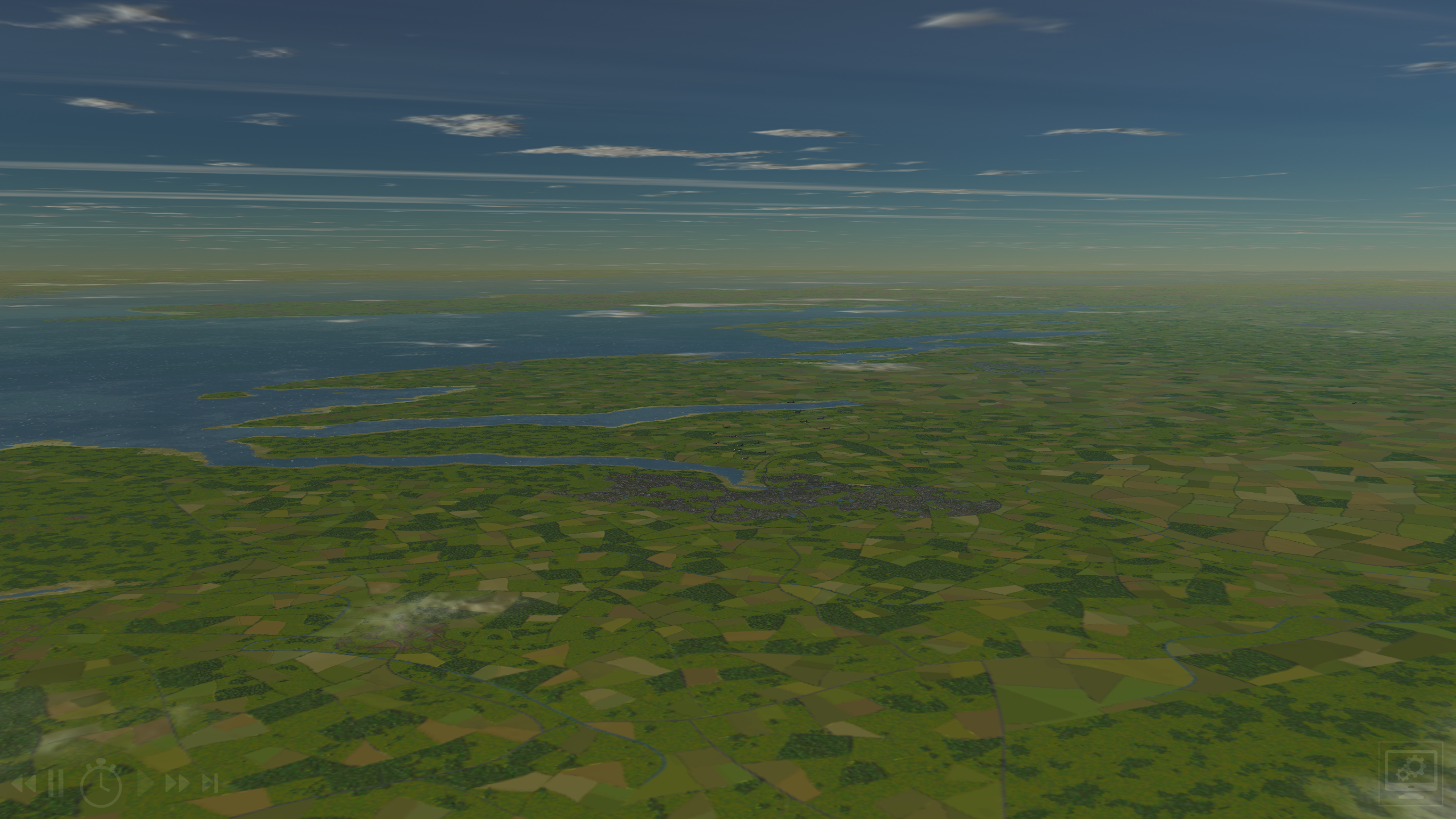
The bulk of the terrain work since our last update has been to drive quality through performance. Performance drives quality because the more tiles we draw the more detail we get and the better the terrain looks - for this first pass we’re topping the quality out at 11 4k textures, each of which needs 4096 tiles. I’m incredibly proud to say that we’ve achieved three orders of magnitude in throughput of tiles. In the original game we ran at 30fps and one tile per frame was drawn - 33 tiles per second. With the new code, on a mid-spec machine we’re seeing 30k+ tiles drawn per second.
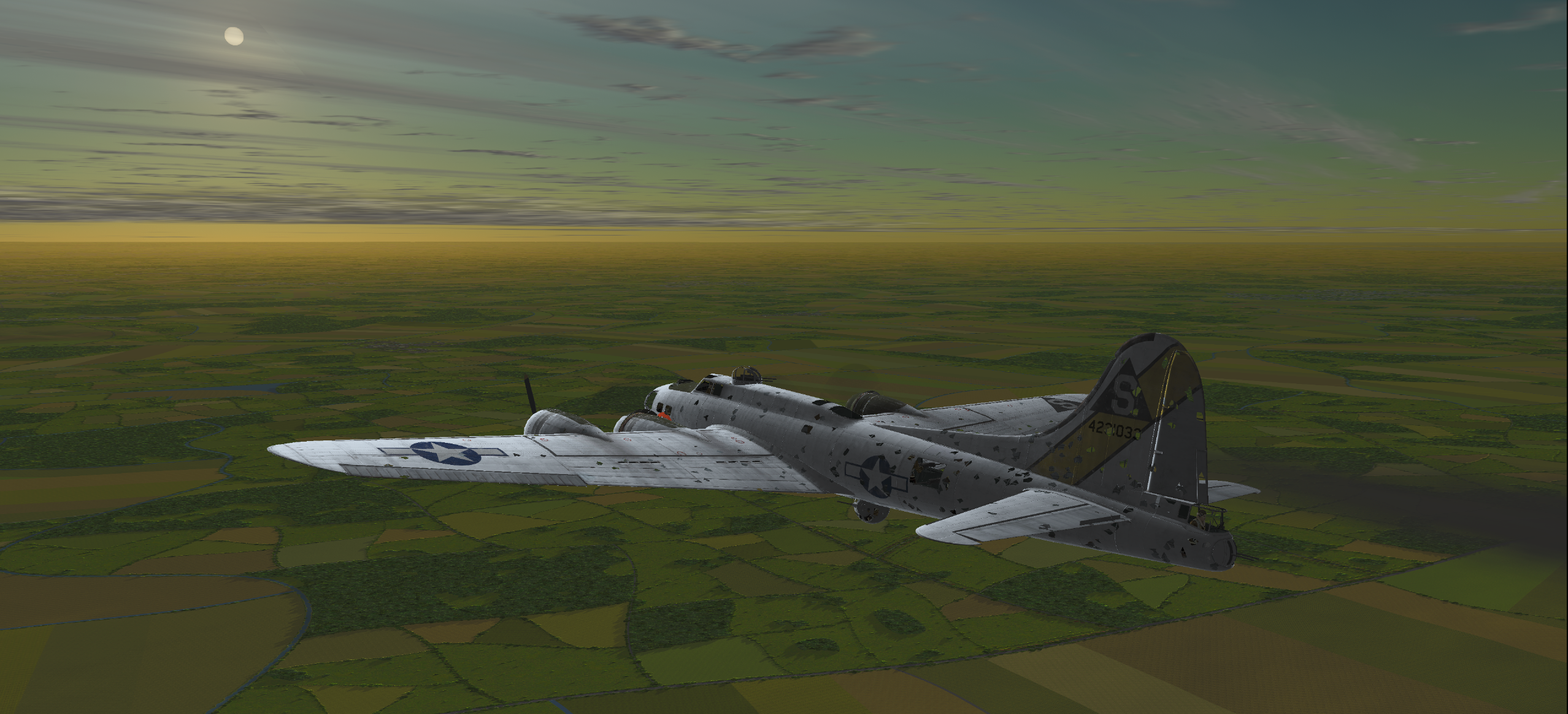
We’ve also worked hard on improving the performance of the texture damage system; primarily to maintain stable framerates through flak and fighter attacks, but as a result of that work we’ve been able to increase the amount of damage we’re able to draw on the bombers - should better reflect the punishment these birds absorbed.
“Old Faithful” 42-37958
I (Crabby) got to choose the aircraft and crew story for today’s update. I chose the B17 that has the biggest impact closest to where I grew up in Wincanton, Somerset, UK.
“Old Faithful” was part of the 401st Bombardment Squadron, 91st Bombardment Group (Heavy), Eighth United States Army Air Force, and was based at Bassingbourn, Cambridgeshire. The aircraft was flown by 2nd Lt. Peter Mikonis and his crew.
“Old Faithful” is believed to have been named after Gene Autry's famous song. The aircraft took part in a bombing mission to southern France, in the area of Toulouse. The mission overall involved bombing an airfield and also dropping supplies to the French Resistance.
The 324th Bombardment Squadron recorded that the group put up a combat wing of three boxes to attack the Toulouse/Blagnac area. In CAVU (Ceiling and Visibility Unlimited) weather, all three boxes reached their assigned M.P.I.s (Mean Point of Impact). The report described this as the group's second outstanding bombing achievement in as many days. It also noted that the result had done much for the morale of the group, whose bombing record of late had been somewhat indifferent.
On the way to the target, near Caen, crews reported seeing a tank battle in progress between the British and Canadians and the Germans. Over the target, the flak was accurate, although there was no enemy fighter opposition.
“Old Faithful” was in the low group lead squadron and took the full force of the enemy flak over Toulouse.
From this point, however, the exact sequence of events becomes difficult to reconstruct.
The aircraft was damaged and fell out of formation, although the available accounts disagree over which engine was affected.
The official 401st Bomb Squadron Daily Diary states that “The aircraft was last seen with its No. 2 engine on fire and appeared to be heading toward Spain”, and Lt. Mikonis and his crew were initially listed as Missing in Action.
A surviving in-flight photograph of “Old Faithful”, however, appears to show damage around the No. 3 engine. The IWM American Air Museum archive also describes the aircraft as being “hit in the #3 engine”.
It is unclear which account is correct. This may simply be an error in the reporting of the aircraft's damage, or it is possible that more than one engine was affected during the aircraft's final flight. By the time “Old Faithful” was last seen, the situation may have changed again.
The dilemma faced by the crew was that if they went to Spain, the aircraft would be impounded and the crew detained for the duration of the war. American and British aircraft were being lost in great numbers, and pressure was put on crews to “bring back the aircraft” wherever possible.
Another account states that all went well until the aircraft approached Lyme Bay, when another engine burst into flames before being extinguished. If accurate, this may help explain the discrepancy between the engine identified in the official reports and the damage visible in the surviving photograph.
Accounts suggest that the aircraft attempted to reach an airfield in the area of the Dorset coast before RAF Zeals, in Wiltshire, was selected as an emergency landing place.
As the aircraft approached Wincanton, the pilot apparently did not realise that RAF Zeals was on the other side of high ground. The aircraft continued towards the area while flying very low.
Local people who witnessed the final moments recalled that the aircraft appeared to be heading towards a populated part of Wincanton. They reported that the aircraft was full of holes and appeared to be almost falling apart. The crew then appeared to attempt to bank the aircraft to the right.The crew were also reportedly seen throwing out anything that could lighten the aircraft, like guns and radio equipment.
The aircraft came down over Snag Farm, Wincanton, and all nine members of the crew were killed.
Michael Watts, was 11-years- old when he heard the bomber crash into his family’s farm.“My brother and I were making a den in a field and my sister was outside. It happened quick as a flash. We heard a bang, then turned around and all we saw was a ball of flames. We ran like the clappers, then we saw the wreckage, smack bang in the middle of the cow yard. It put the milking hall out of action for weeks and I remember people coming and bringing their buckets down to milk our cows themselves. We had a large pig as well which was being fattened up for Christmas. Nobody could work out how it got out of its barn. Then, under the hay we found part of “Old Faithful’s” propeller blades in its trough.”
There are differing accounts of what happened in the aircraft's final moments. Some local eyewitnesses recalled seeing “Old Faithful” explode, while other accounts describe a wing shearing off before the crash. The wing-shearing account appears in several of the available official military records and may therefore be the more likely explanation, although it is impossible to know exactly what those on the ground saw in the confusion of the crash.
The crew that flew “Old Faithful”’s last mission:
Pilot: 2nd Lt. Peter Mikonis
Co-Pilot: 2nd Lt. Frank E. Pepper
Navigator: 2nd Lt. Joseph E. Sulliva
Bombardier: 2nd Lt. Will E. Stevens
Engineer/Top Turret Gunner: S/Sgt. Roy C. Anderson
Radio Operator/Gunner: S/Sgt. Douglas K. Neumyer
Ball Turret Gunner: Sgt. Ralph Stein
Waist Gunner: Sgt. Richard A. Mehlberg
Tail Gunner: Sgt. Dean A. McDowell
SGT Cyril Powers was not on this mission. He had previously flown as the crew's tail gunner, but the reason he was not flying with them on this occasion is unknown.
Here at MicroProse we consider working on Mighty 8th Redux to be a labour of love. It serves as a real and direct link to our company’s history. Thank you for helping us bring this game to a new generation! Brave the deadly (physically modelled!) skies!