Dear Scholars,
It has been a while since the last entry. Usually that means an exceptionally busy period and this was no exception! I'll give you a personal update first and then tell you about some of the progress we've made in Selenwald's development recently.
Stronger than ever
First of all, the last 3 months were an incomprehensibly busy period for me. I've always worked a lot but recently I've managed to beat any of my previous personal records, working ~90h weeks quite consistently. No worries though - I'm also physically active (cycling every single day), eat healthier, and most importantly I'm feeling great mentally, so it's all fine!
As those of you who are on the Discord server already know, all the struggles I've had for over 3 months beginning in early January have finally ended. At the end of April I started a long term job at a studio I've been freelancing for for around 1.5 years prior. Due to having accumulated debts during the job-hunting period, I've started at a full time position to first get back on my feet. However, my intention was to switch to 4/5 after 3 months. In addition, half-way through that full time period, I've taken a side gig with a friend. On top of that, I decided to focus on improving some aspects of my life during that time - getting some overdue medical tests done, buying stuff I *desperately* needed to buy for a long time and optimizing the hell out of my daily routine to waste as little time as possible.
Despite all this, I still managed to spend an impressive amount of time working on Selenwald (especially during the last month) but that was just the beginning because that transitional period is now coming to an end. I have just switched to the aforementioned 4/5 and my side gig is also ending very soon. With all the optimizations I made (along with sacrificing any entertainment), I will now able to spend more time on Selenwald on average than I ever have.
Getting closer
As I've mentioned in some earlier entries, thanks to having decided to finally cease my attempts to get a publisher or an investor for independence's sake and thus not having to constantly focus on the short term goal of polishing the publisher demo, I have started a long overdue, massive revamp of the code architecture in December. I have originally planned to have it finished by now but unfortunately those misfortunes struck me in January. However, most of the rework is done and I am very pleased with the results. Finally, almost every piece of code works in perfect harmony. The new system is very robust. Coding new systems feels like a breeze now and implementing new content is trivial. Additionally, the framework makes for a great foundation for future modding support.
Here are some new things I made during the last 3 months:
- many fixes, improvements, and optimizations to my new architecture, including pooling for event objects that all systems communicate with
- a node editor (I intend to use it for AI behaviour and dungeon generator settings authoring in the future)
- entity preset previews (a tiny but very helpful QoL feature for faster development)
And here are some old systems that I rewrote inside the new architecture during the last 3 months:
- field of view obstacle system
- fog of war system (along with massive optimizations and a dramatic increase in quality as compared to the old solution)
- a significant part of the core AI logic
- doors (it's not as trivial as it sounds - see "The Door Problem")
What's left
There are still a bunch of non-trivial systems in need to be moved to the new architecture (and some of them, like the UI logic, should be done from scratch because the old code is so dirty it's completely unusable) so it's still too early to open a bottle of champagne. The most important ones are:
- dialogue system
- user interface
- occlusion system (high obstacles becoming semi-transparent when they occlude areas that should currently be visible to the player)
- the rest of the AI logic
- character generation (using outfit pieces)
- likely some other things I'm yet to realize I forgot about
There is also quite a lot of very small systems awaiting a rewrite. However, thanks to the new architecture, such systems take almost no time to implement. For example, reimplementing the night vision system (that relies on the fog of war system) took me literally around half an hour.
Another thing related to the rewrite that needs to be done is the migration of existing content to the new format. Only some of it is done and most will be moved in bulk once all systems are rewritten. However, that's another thing that has been dramatically simplified by the new architecture. Hell, this was one of the primary reasons behind the rewrite - making content implementation extremely fast and easy.
In summary, the end of the rewrite is clearly visible there on the horizon. What's worth noting is that the end of this whole undertaking will be a tremendously important milestone that will pave the way for the first public demo. Despite the delay, I'm still hopeful for the first playtests to take place until the end of the year. The nearest months will tell how realistic this deadline is.
Not all heroes wear capes write diaries
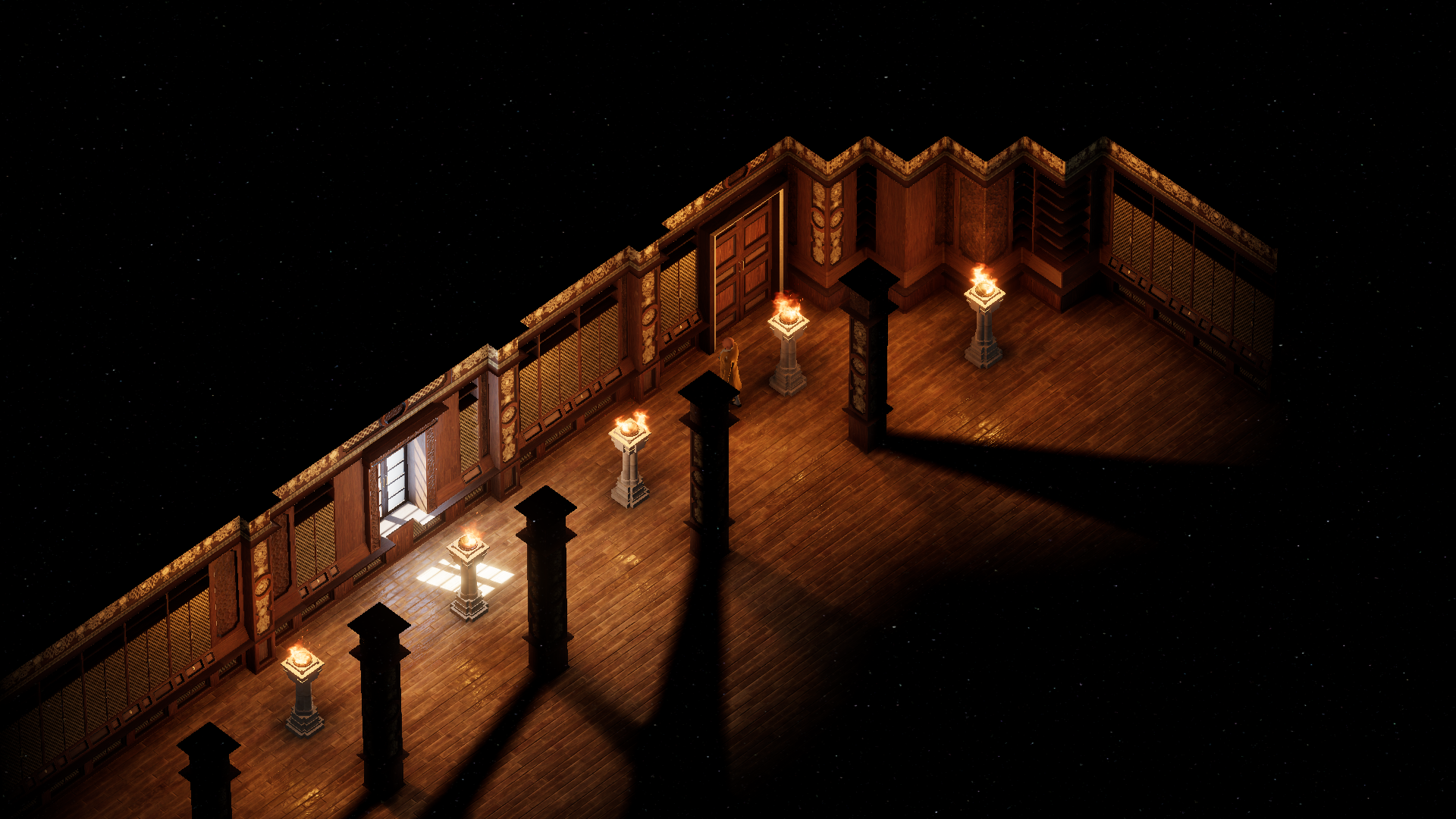
Don't forget I'm no longer working on Selenwald alone. Maksim has been creating 3D art for quite a long time now. In fact, he started exactly 2 years ago! Even though he's not spending nearly as much time on the project as I am, he has made quite a collection of great art by now. To not leave you with just text, let me wrap this diary entry up by showing you some of what he's been up to for the last couple of months.
He started two sets of models simultaneously around December/January and recently wrapped up the last one of them. Today, I'd like to show you the first one - a large modular set of walls counting 17 pieces for the procedural dungeon generator to build levels from. Like the other wall collections, this one also consists of various straight pieces, inner and outer corners, a door, a window and a standalone column. It's been done using the trim sheet technique. This means it will be very easy to add more new pieces to this set without the need to do any additional high poly modelling, baking, or texturing.
This set of walls also functions as a library that will be filled with books. It was inspired mainly by the Spanish renaissance Library of the Monastery of San Lorenzo de El Escorial which Maksim has personally visited and photographed.
I hope this will satiate your appetite for now! I still plan to start a series of entries where I could do a deep dive into the intricacies of Selenwald's code and also show you how some of the unusual mechanics work but I want to first finish the rewrite. Besides, writing such technical logs can take a lot of time (easily a full day) so I only want to get into it when I know I can actually deliver interesting and educating content. This will happen - I just don't precisely know when yet.
Thank you for reading,
Wiktor