
Dear Early Access Supporters,
I know it has been a while since our last update so, to honor my promise to keep you regularly apprised of our progress with Unsung, I felt it was time to roll up my sleeves and just dive in. The truth is, we’ve been wanting to put out an update for a while, but we are currently deep in the weeds on a number of redesigns and rewrites. This is a difficult part of game design to talk about because it is not only critical to the success of Unsung but also probably not that interesting for you all to read about (unless you really, really like spreadsheets). Still, today I would like to cover in more detail the 3 main areas we are iterating on (as introduced in my last update): Character Classes, Story, and Cutscenes.
Character Classes
As feedback on the Chapter 1 build and our internal audits both showed, our current classes needed an overhaul to ensure that each has a unique identity, offers emergent gameplay when combined with other classes, and are ultimately fun to use. With that in mind, our design team has continued to refine the class system.
Our initial thought was that we would tackle classes the same way we plan to release the story—chapter by chapter. This proved to be flawed because it prevented us from looking at the classes holistically and building those critical synergies that make for an amazing tactical experience. For that reason, in addition to improving our existing designs, the design team has been making a spreadsheet that breaks down each of our classes by type, shared mechanics, and points of synergy across the entire game.
Taking the time to do this work up front gives us the following benefits:
- It allows for improved level design. By building out all of our class details, we can ensure that there are interesting synergies and challenges every time you engage in combat.
- It allows us to more easily tune our power curves for challenge and complexity.
- It allows us to make sure the emergent gameplay elements we are targeting play well across many classes throughout the game instead of just with those that appear at the same time as the given class.
Unfortunately, as critical as this work is, it is not easy to show the work in progress. There’s a lot of back and forth at the office as the team works through all the different elements they have to keep in mind while making these documents. We have another big meeting next week, and I am looking forward to seeing more of their progress then.
Story
As we have been doing our class-rework, similar care has been put towards our narrative elements. This has been happening on both a micro and a macro level. Top down, we are in the midst of an audit of the entire story arc, beat-by-beat, to make sure each chapter features exciting moments though both level design set pieces and narrative hooks. Bottom up, we are going through the dialogue to raise the level of our prose and inject more character into each line. This is a significant task. To give you some idea, the script for Chapter 1 alone is 107 pages long and has a little over 12 thousand words.
Cutscenes
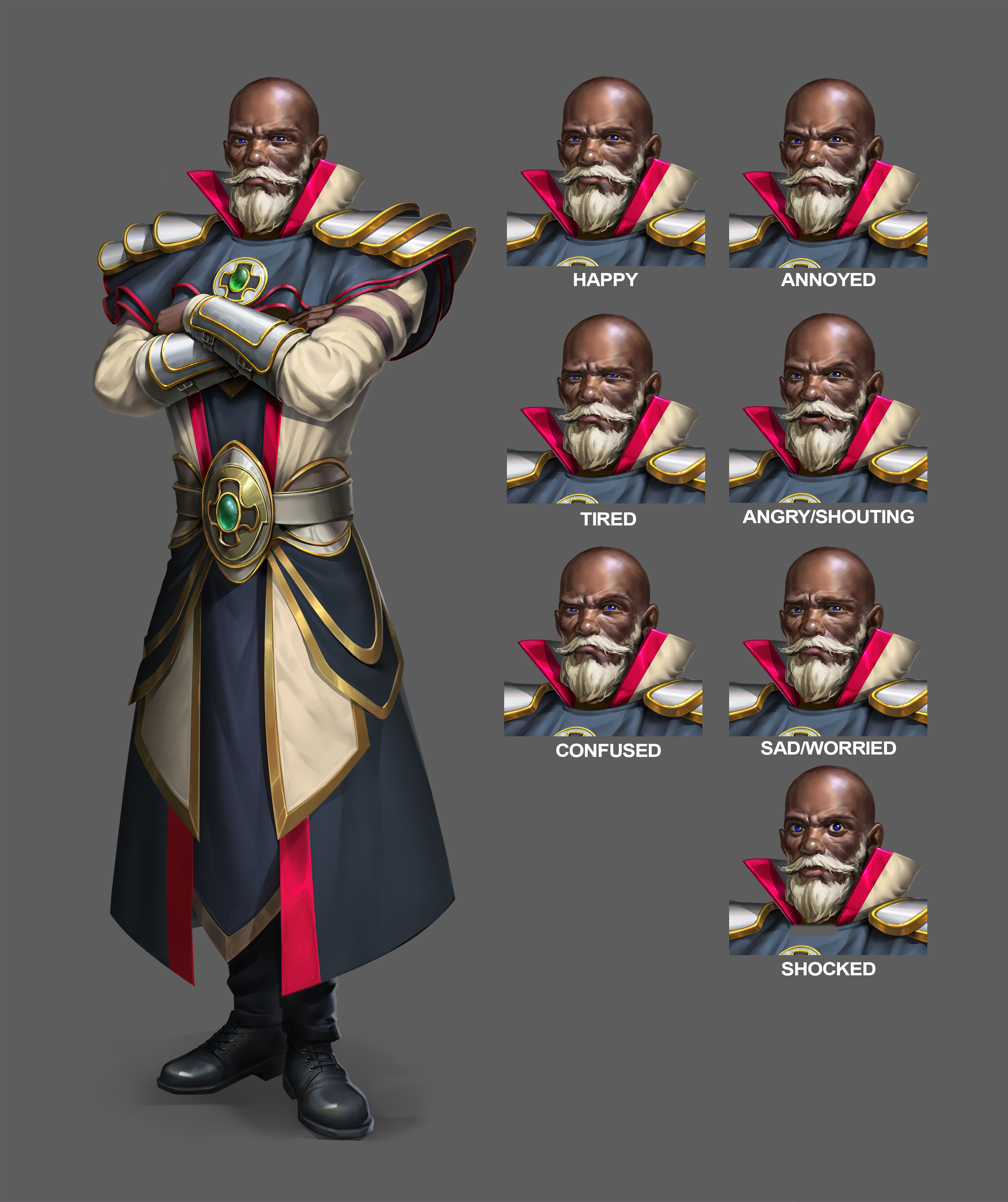
Speaking of characters, the last big area we have been focusing on is dialogue presentation. As I mentioned last time, we have moved away from a 3D talking head approach towards a traditional JRPG presentation with full character portraits. A big part of a modern portrait system is the use of expression and emotion instead of just a single bust to convey characterization. The art team has been working closely with the narrative team to figure out what kinds of poses we will need for each of our character portraits to best support our major story beats.
Last time I showed you some dialogue examples featuring hand-painted busts of Greymore and Sirena. Today, I can share some of our work-in-progress emotions for Greymore as well:
That’s it for this month. I know it continues to take time, but I truly believe that Unsung will be a better game for this work.
As always, I appreciate your patience and support.
Sincerely, Matthew Scott