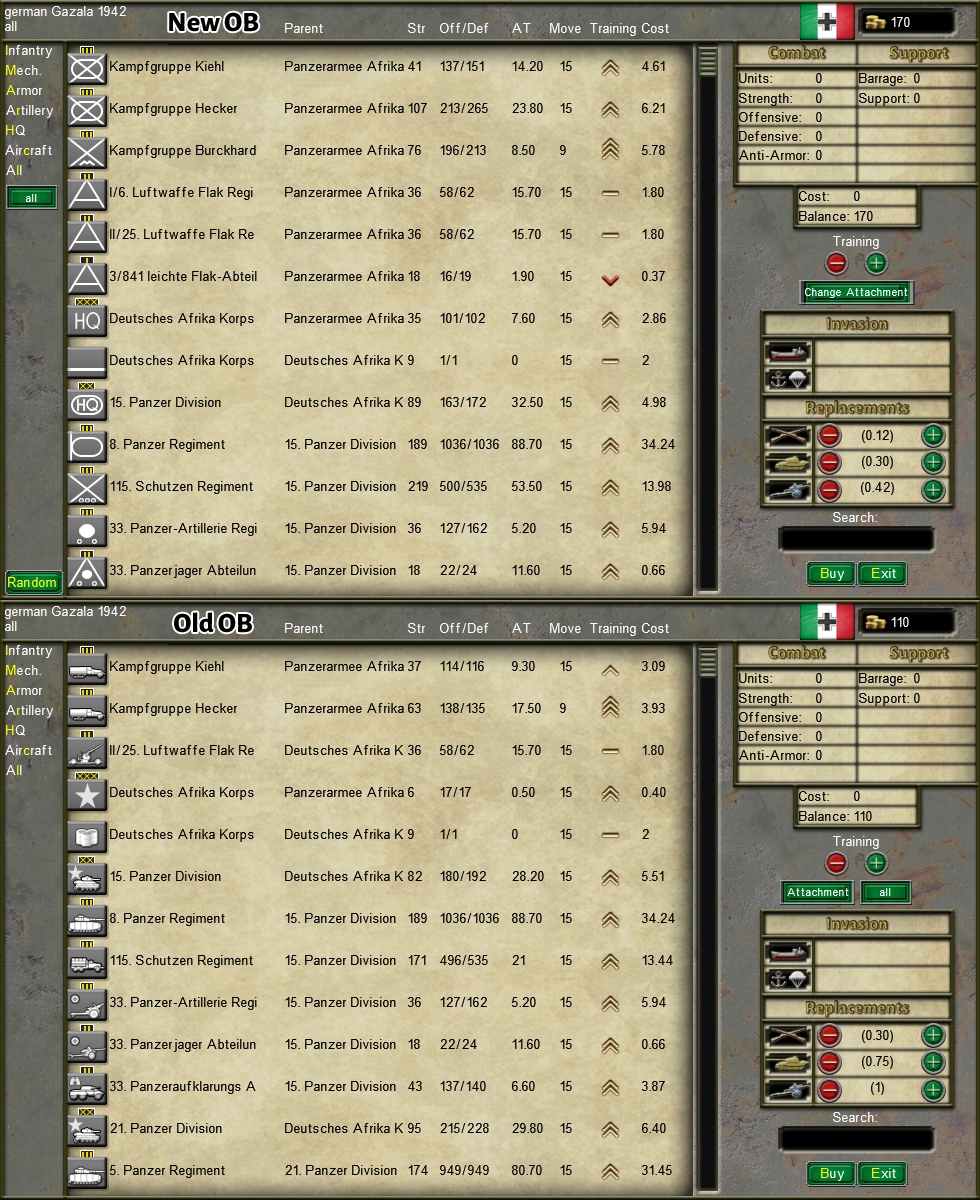
Update 1.0.9.5 - Comprehensive Update Tiger
Update 1.0.9.5 has finally arrived, and we nicknamed it Tiger because it started off big and just kept getting fatter. Tiger includes: a pair of overhauls, major system improvements to stacking and air combat, OB updates for the US, USSR, and Germany, new air squadrons across ove
Update 1.0.9.5 has finally arrived, and we nicknamed it Tiger because it started off big and just kept getting fatter. Tiger includes: a pair of overhauls, major system improvements to stacking and air combat, OB updates for the US, USSR, and Germany, new air squadrons across over half the OBs in the game, and much more! On the overhaul front, we have substantially revised Combat Engineering and totally restructured Attack Scenarios. This update also brings the first pillar of the general AI revision. Regarding general improvements, we have (among other things), completely revised how we calculate unit weights, refined air zone generation and propagation, tweaked artillery fire tables - especially for counterbattery, and made numerous user interface improvements/clarifications.
System Updates:
Combat Engineering Overhaul:
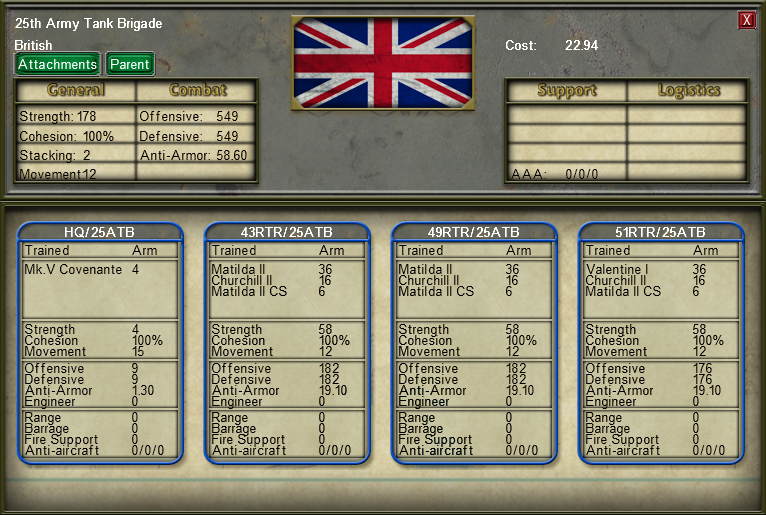
Churchill Crocodile enjoyers rejoice! We have improved the combat engineering system to make it more consistent, detailed, and accessible.
What’s New in Combat Engineering?
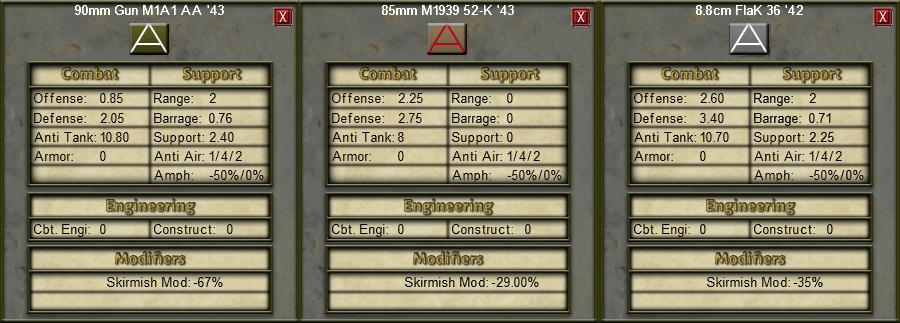
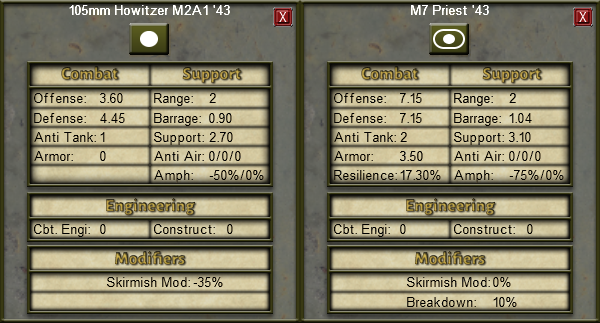
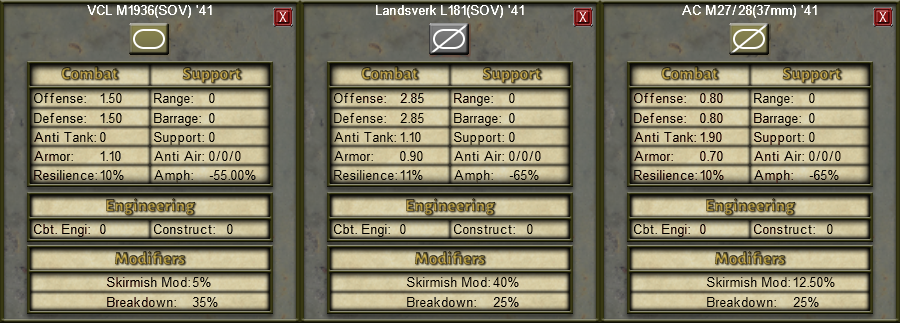
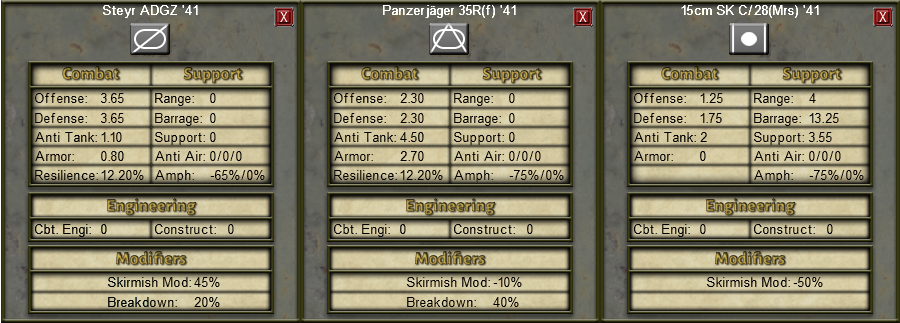
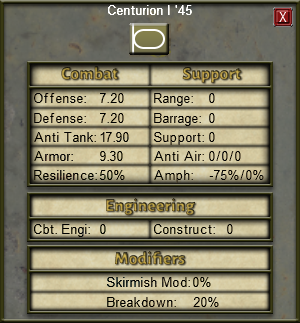
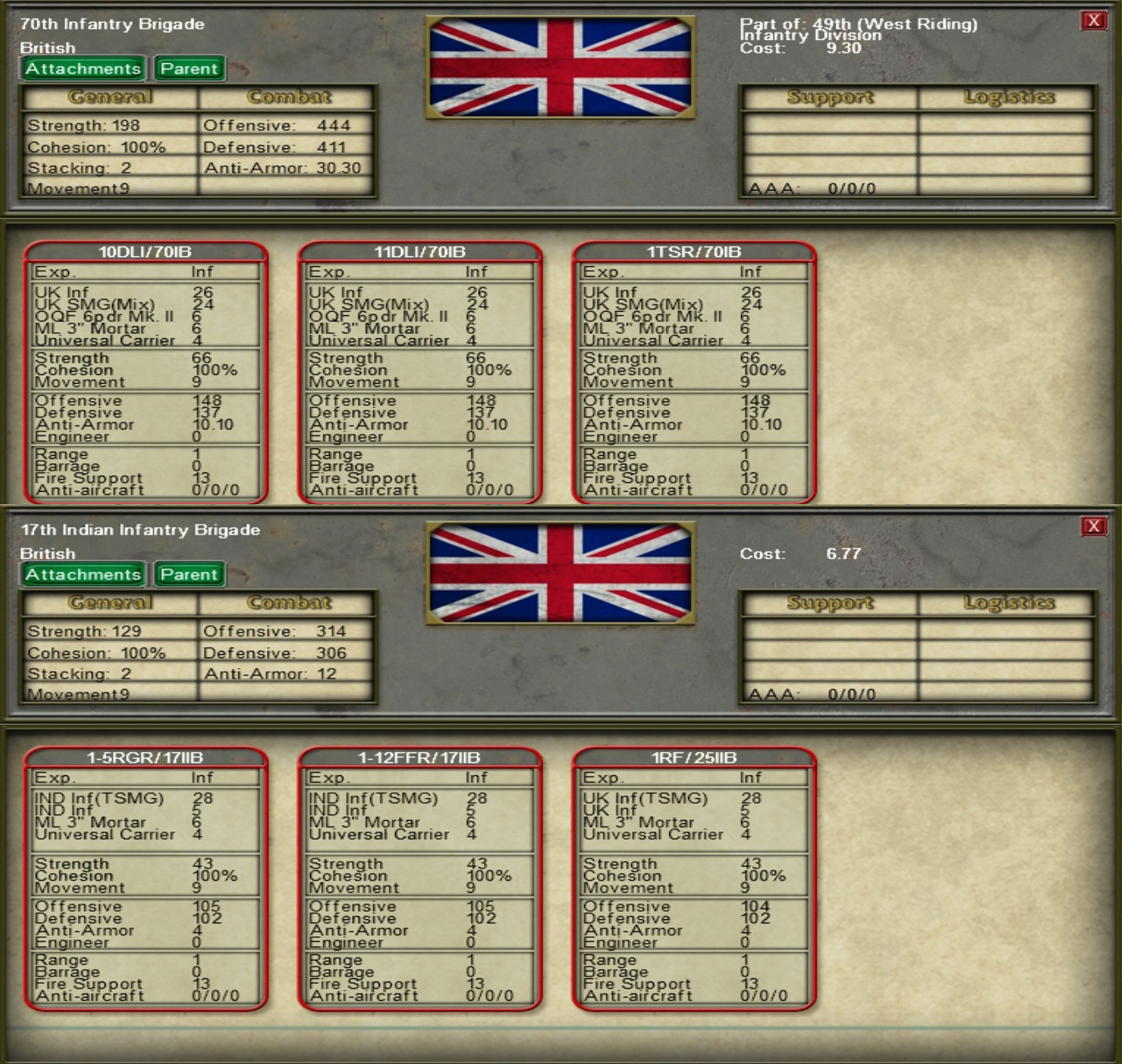
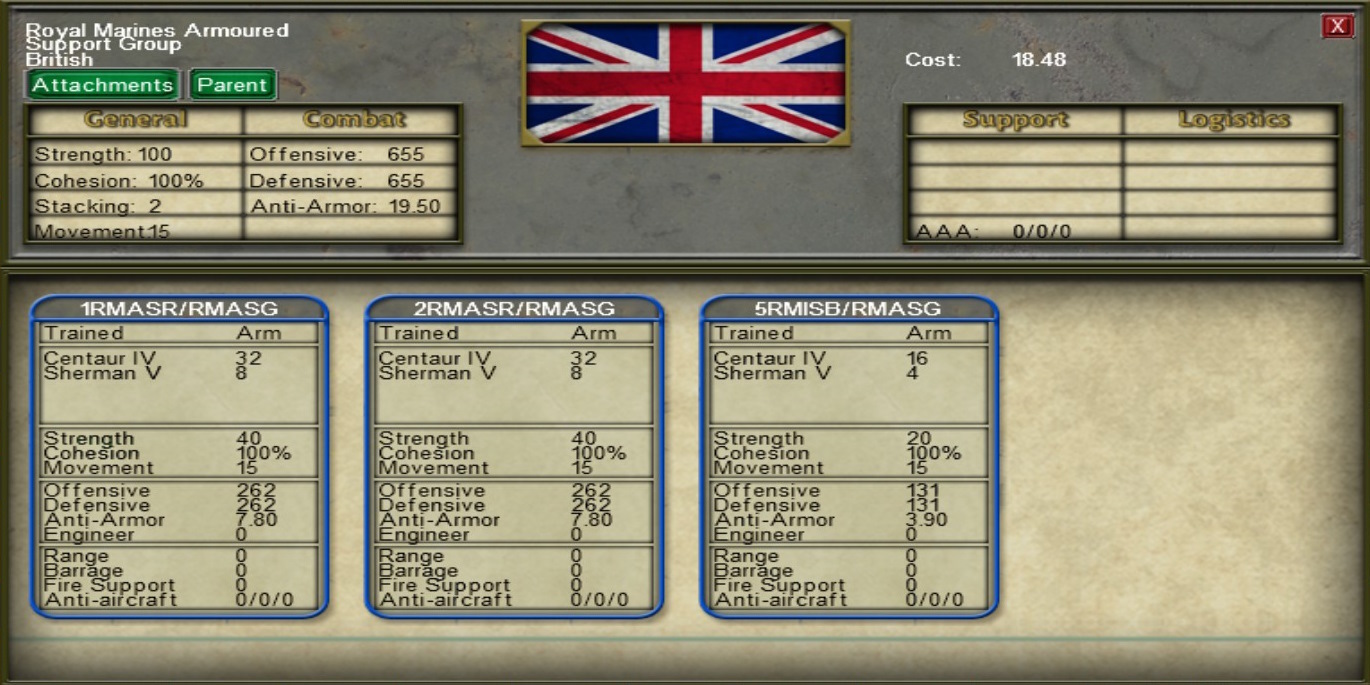
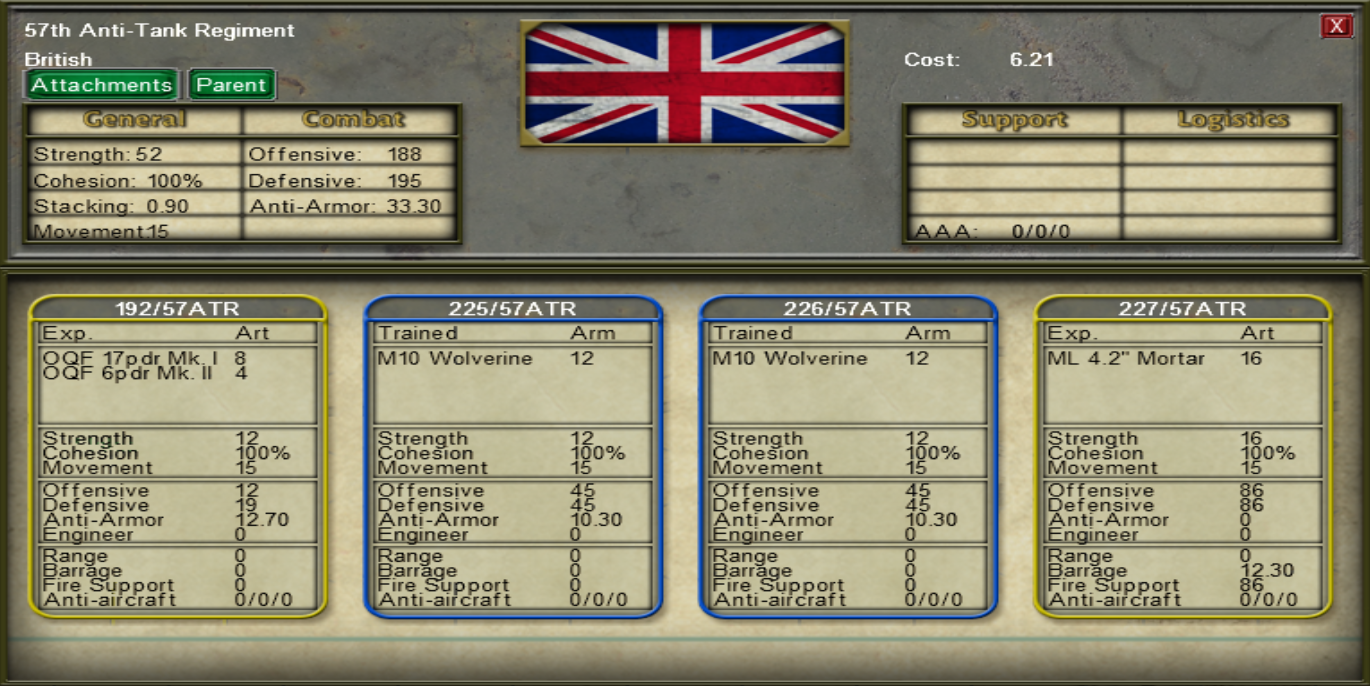
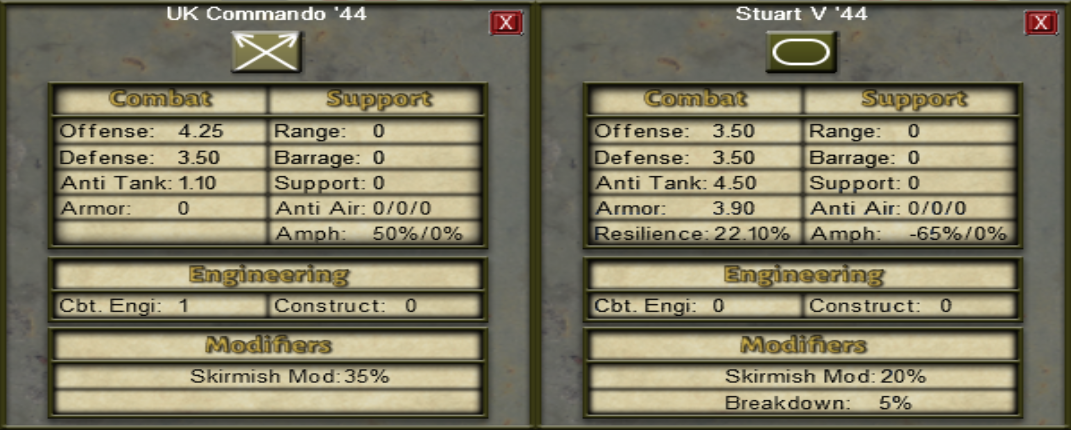
Combat engineering now consists of the combat engineering value of participating units +50% of the fire/air support value assigned to the battle. Moreover, most tank guns over 95mm in bore now possess a combat engineering value proportional to their explosive yield. Combat engineering now further models the intricate details of differences in availability of breaching charges, tactical de-mining equipment, man-packed flamethrowers, and flammable oil capacity in flame tanks. Consequently, the radically different combat engineering capabilities between nations, years, and unit types are readily apparent now. See the example weapon cards below for some of the more striking differences in combat engineering capabilities. 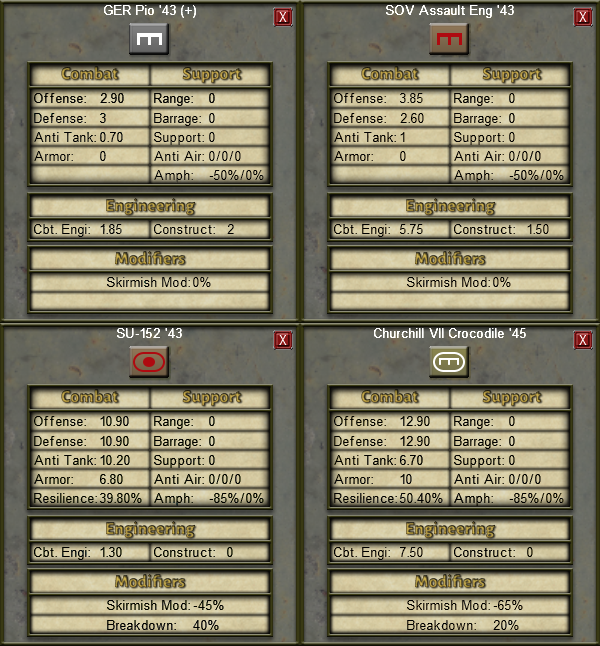
Update 1.0.9.5’s engineering update creates 3 broad schools of thought for assaulting forts, all reflective of wartime practices: 1) The American approach: employ a few strong combat engineer regiments and back them up with apocalyptic levels of fire support. 2) The Soviet approach: concentrate flamethrower engineers and back them up with heavy assault guns such as SU-152s. 3) The British approach of de-prioritizing infantry engineers entirely and smashing forts with highly specialized assault engineering vehicles, such as the Crocodile.
There is of course the 4th option....to just barrage the fort until you crater it out of existence. But this strategy only works against level 1 forts and its efficacy is hit and miss.
Dynamic Stacking:
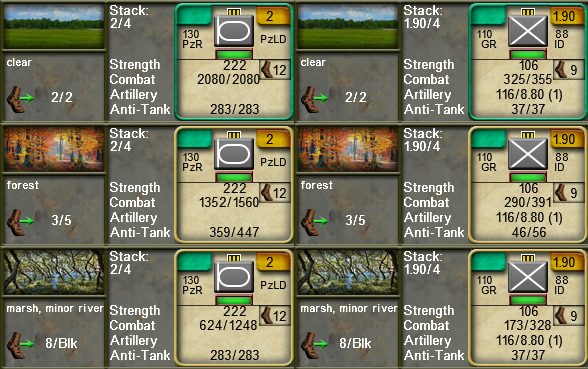
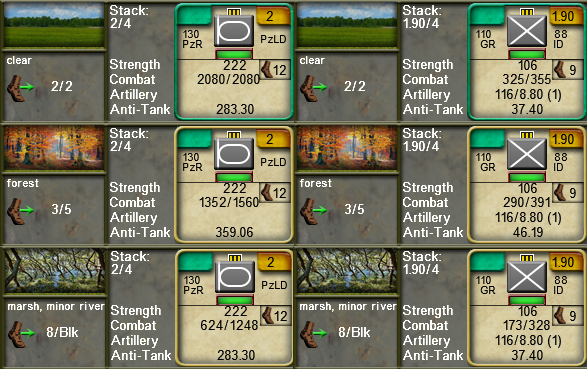
Unit stacking weight now dynamically scales based on current strength, with some minor deviations for battlegroups (see below). No more crippled cavalry brigades with 10 squads left somehow still exerting Zone of Control! The new system is designed to make stacking more dynamic and create situations where Zone of Control collapses due to attrition more frequently. The benchmark of 60 strength points to reach 1.0 weight, and thus extend a Zone of Control, means most individual battalions no longer exert ZoC without backup. Regiments/Brigades are generally safe, but some leaner regiments (particularly late-war German Infantry, and some Soviet Regiments) run a real risk of falling below 1.0 stacking value in prolonged combat. See the example of the 377th Grenadier Regiment below for the decline of an individual unit's weight as casualties mount.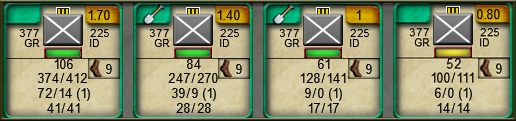
Key Points of the new stacking system:
6 strength points = 0.1 stacking weight.
Weight for individual units caps out at 2.0 at 120 strength. If a unit (usually a brigade or regiment) has say 210 strength, it will still only have a weight of 2.0.
Weights round down to the nearest 0.1.
Battlegroups can still contain up to 3.0 weight, and they still receive a stacking reduction bonus to represent the command/control benefits of grouping multiple smaller units into a combined force. So a battlegroup with 3.0 weight worth of strength will still have a weight of 2.0.
Dynamic Stacking Impact On Battlegrouping
The new system is easy to get used to; 60 strength gets you Zone of Control, and any single unit over 120 strength caps out at 2.0 weight. But it also has far-reaching effects on Battlegrouping because individual battalion/company weights have generally been reduced, so you can fit more units into your battlegroups. Moreover, damaged units can now be grouped together more effectively as their weight dwindles due to casualties, better reflecting ad-hoc provisional units often formed in high intensity combat. Simultaneously, we have eliminated the special treatment that previously allowed some incredibly large individual battalions (notably some Panzer battalions with 96+ tanks) to enjoy 1.0 weight, and thus be grouped into mega-death-stacks with other similarly oversized battalions.
Attack Scenario Overhaul:
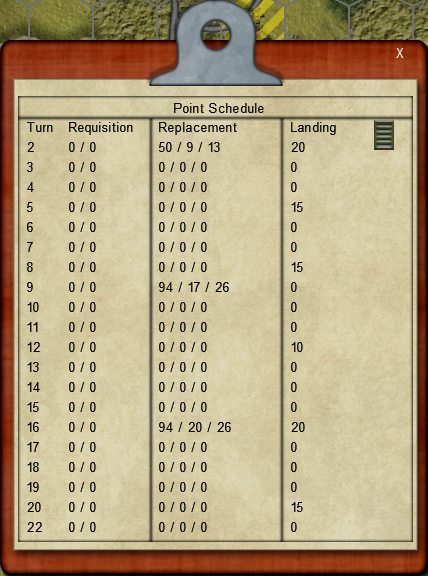
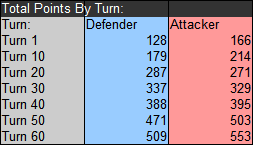
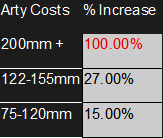
Attack scenarios now use fixed requisition point schedules to craft a more tailored experience that divides attack scenarios into 3 distinct phases: 1) Attacker offensive. 2) Defender Counterattack. 3) Both sides attack. Defenders can now afford to sacrifice land for time and attackers must plan ahead to endure the looming counterattack. See the table below for a general overview of the total # of requisition points each side will amass by major turn milestones out to a max length of 60 turns (although most Attack scenarios will not be longer than 30).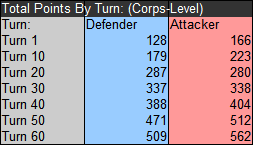
In the spirit of major Eastern Front offensive operations, the Attacker is really just the first attacker. The defender's counter stroke will arrive about 12 turns into the game, and the Attacker needs to make the most out of their initial advantage to carve out a secure lodgment.
On a game balance note, in playtesting we have generally found these numbers feel balanced on wide-open maps such as Somme or Kharkov. But we feel that they are skewed in the defender's favor on highly defensible maps such as Ardennes or Sicily. We may continue to refine these values on a per-map basis in the future.
Scenario Updates/General Gameplay:
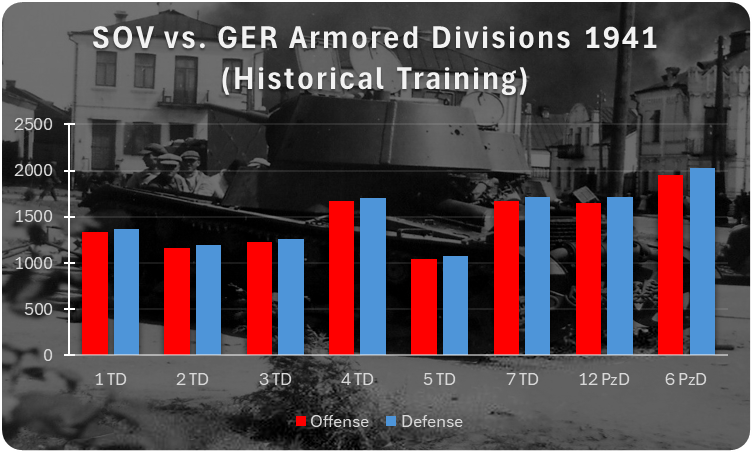
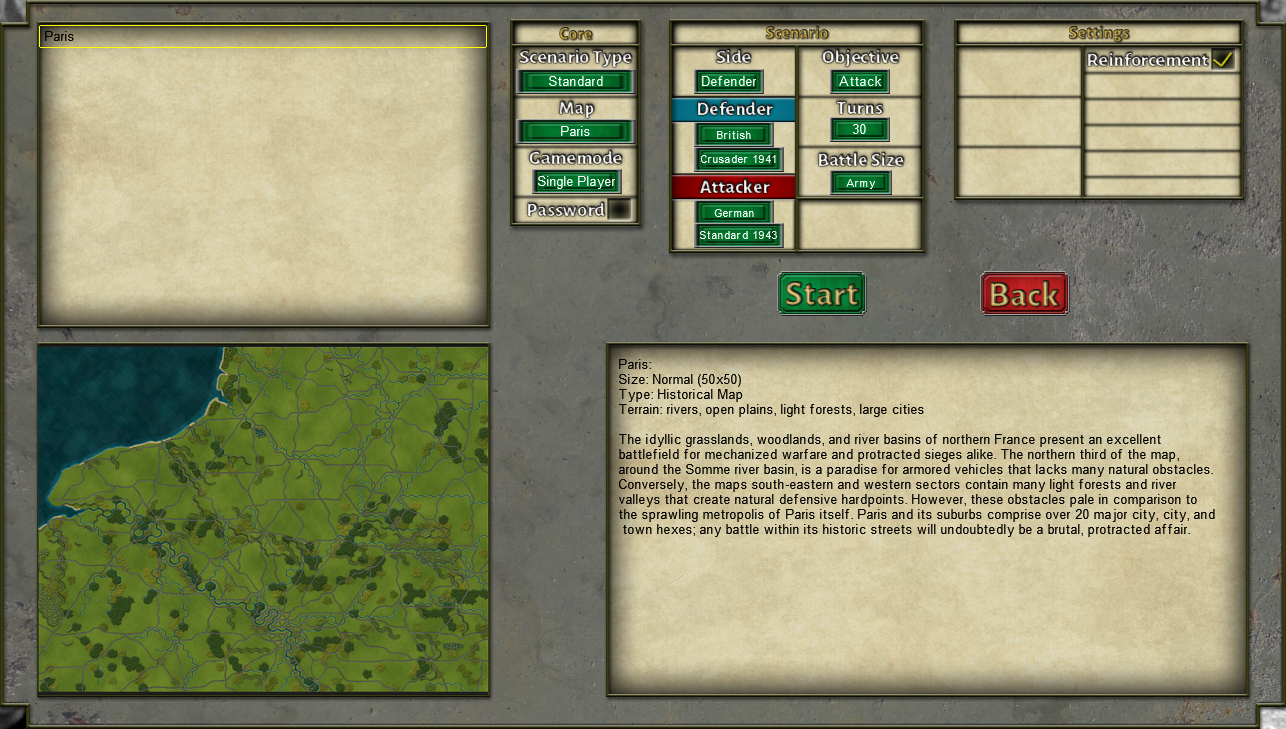
Added Training Lock, a new scenario option that can limit or disable changing training levels. Training lock can be set to free (default), limited (training levels can be changed by +/- 1 level), or historical (no changes allowed at all).
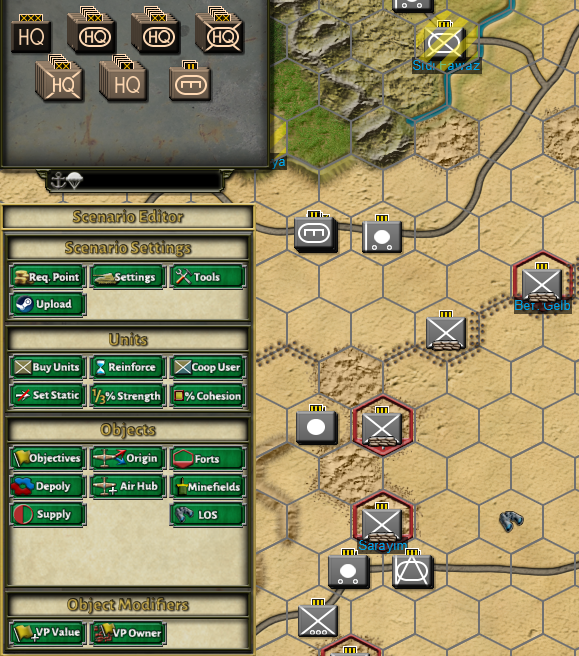
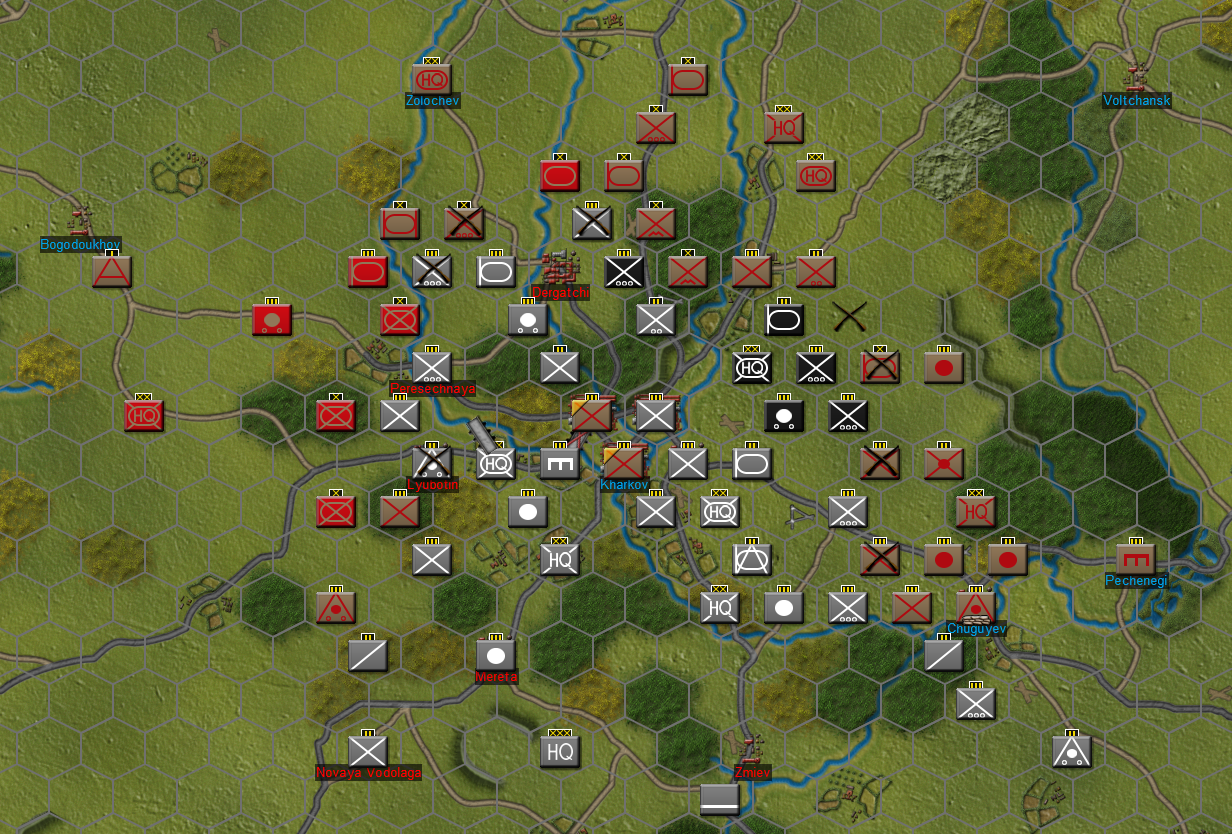
Doubled the size of permanent spawn zones in Attack scenarios. Spawn hexes that will last beyond the current turn are also now have a unique graphic for ease of identification.
Improved air zone generation logic in all standard scenarios.
Lowered the threshold to consider airspace contested. Large swathes of contested airspace between relatively evenly matched airforces are now more common.
Slightly improved AT performance the lower end of the Anti-tank fire tables (between AT values 10-60). Concentrating AT guns in the early war years is notably more effective.
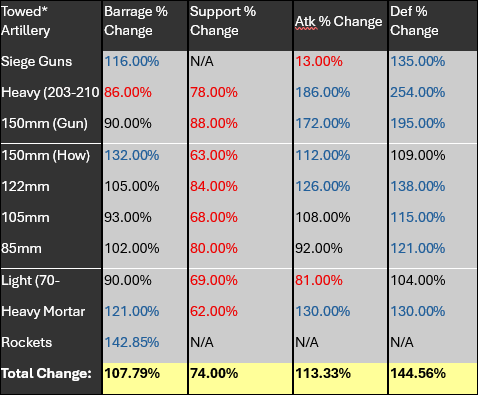
Raised the top of the standard (non-counterbattery) barrage table from 120 to 150 barrage points. Slight general reduction in barrage effectiveness at higher levels.
Slightly increased effectiveness of intermediate strength barrages (40-70 points). Harassment fire from divisional level gun regiments (which often hover around 40 barrage) is more effective.
Substantial improvements to counter-battery effectiveness against large concentrations of enemy artillery. Raised the top of the Counter-Battery barrage table from 80 to 105.
Improved the effectiveness of bombing and strike missions against artillery.
Tweaked value of airfields to both sides (but mostly defenders) in all Operation Husky, Brimstone, and Firebrand, scenarios to align with general improvements to the air system.
AI Improvements:
AI Deployment Improvements - First Step of the Total AI Overhaul.
The Problem:
The CAOS AI has long suffered from the fact that it's actually several collaborating AIs wearing a trench coat, each designed for a specific purposes and written at wildly different times in our careers as developers. Moreover, the CAOS AI was originally designed for corps-level battles or smaller, while CAOS scenarios and matches now routinely reach army level. The key problems have always been that the AI: 1) Excessively fixates on reaching/holding geographic objectives. 2) Places logistics or command units in unnecessary danger. 3) Undervalues destruction of hostile combat forces in favor of trying to reach objectives.
Our Objective:
We are working on a unified AI command logic that draws on our now years of experience to centralize AI planning and then hand off tasking to its subroutines to achieve tactical objectives. Our intention is to create a planning AI that makes better use of defense in depth between objectives, maintains a more cohesive frontline, focuses more on destroying vulnerable/trapped enemy forces, and more effectively 'remembers' hostiles it detected, but subsequently lost sight of. As always, our intent remains to design the AI without letting it cheat, so it will always remain somewhat vulnerable to deception and uncertainty.
What's in this update?
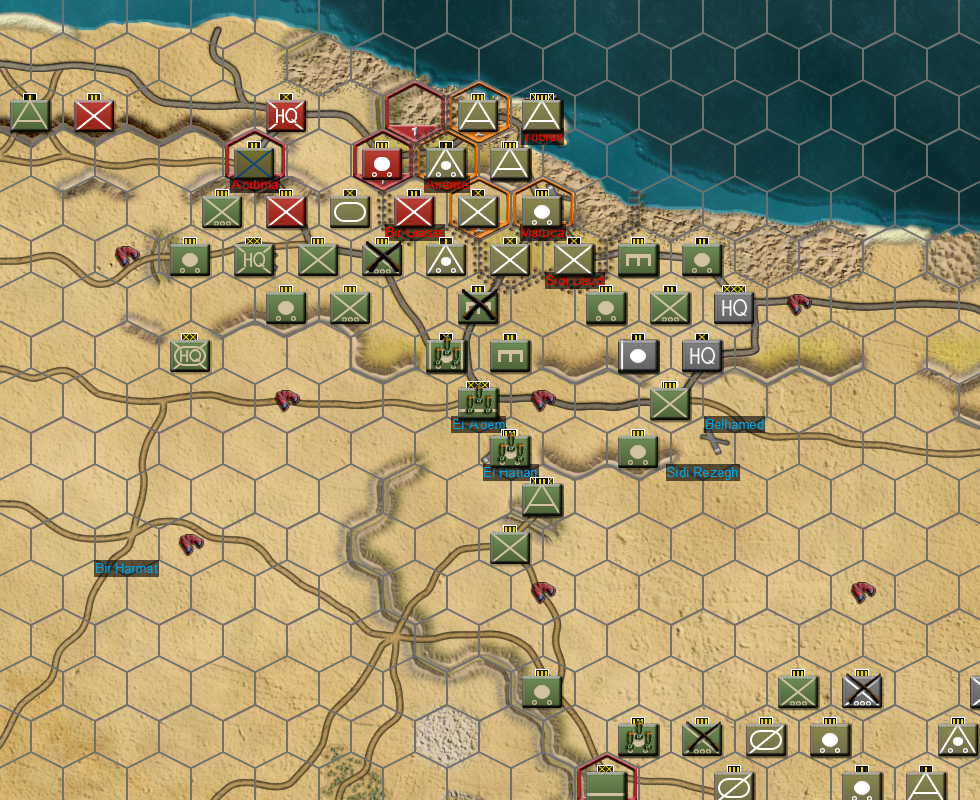
This update implements the first stage of the AI overhaul by applying a draft version of the new combined planning AI to defender deployment planning in Attack and Invasion scenarios in particular. The defender AI will much more effectively create multiple defensive hardpoints, make better use of terrain, and attempt to protect valuable support units. Still, for the moment, this only applies to deployment logic, the moment the first turn is run the old AIs will kick back in for now. This is the pilot run for the new combined planning AI, and we will gradually integrate all aspects of AI planning to it over successive updates.
User Interface Updates:
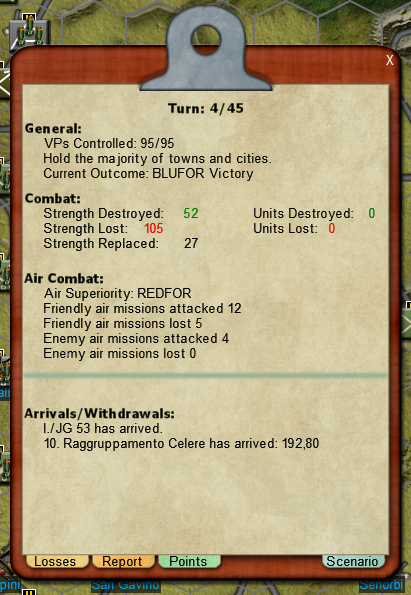
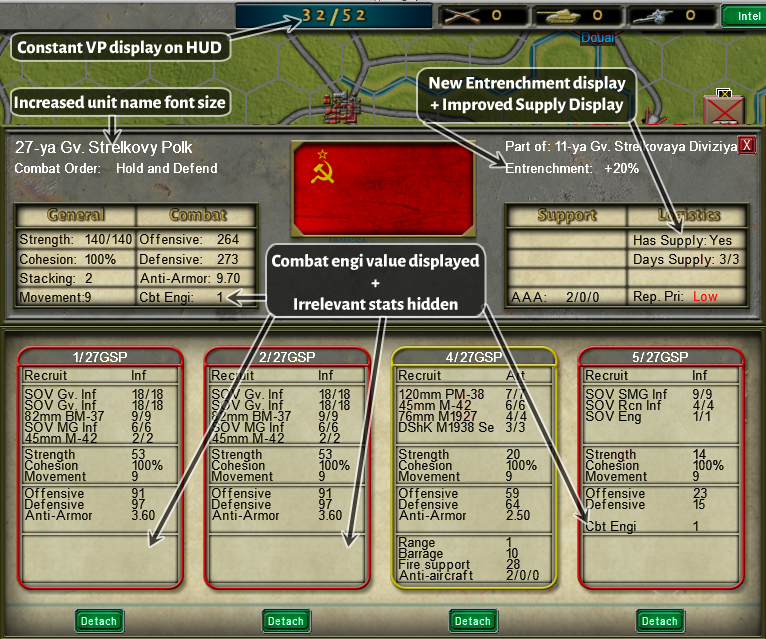 Update 1.0.9.5 continues our efforts to gradually improve the UI by highlighting information that was previously either poorly communicated to the player or totally absent. As an example, Anti-Tank, Barrage, and Combat Engineering now all display a 1-word assessment in combat reports so players can immediately determine what’s “enough.” See the example below.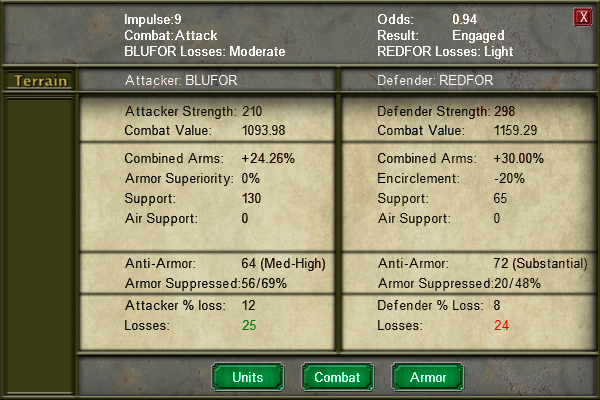
Total controlled VPs out of total VPs now constantly displays at the top of the HUD, drawn over the side/color patch.
Permanent reinforcement hexes (spawn zones) are now graphically distinguished by a ring of arrows pointing inward on the hex during preturn deployment. You will no longer look at your turn 1 deployment and wonder where your future reinforcements will come from.
Revised Air Command graphic to more clearly communicate total air strength, and draw the player's attention to the active operational air focus.
Combat reports now display attacker combat engineering value if the battle involved a fort, along with a rough assessment of combat engineering strength (light, moderate, heavy, extreme, etc.).
Anti-tank value on reports now displays a rough assessment of AT strength (light, moderate, heavy, overkill, etc.), in addition to the number.
Barrage reports now display a rough strength assessment (light, moderate, heavy, overkill, etc.), just like anti-tank values in combat reports.
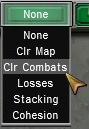
The bottom HUD now displays red text stating "No ZoC" when a friendly stack with under 1.0 stacking value is selected.
Regiment cards now display “Entrenchment bonus as +20%” instead of as a cryptic “Dug In: 0.2”
Improved text formatting on unit names/unit parent names on regiment card to make it more readable.
Selected unit support totals now display combat engineering value in the requisition menu.
Regiment cards no longer display statistics that are either 0 or not relevant to the unit, to reduce information overload on cards. For example, units with 0 AT simply will not display an AT value. Likewise, attachments that cannot execute fire missions, but have some artillery inside of them (such as mortars inside infantry battalions), no longer list artillery statistics.
Improved display of supply status on regiment card to eliminate potential points of confusion as units reach the end of their supply.
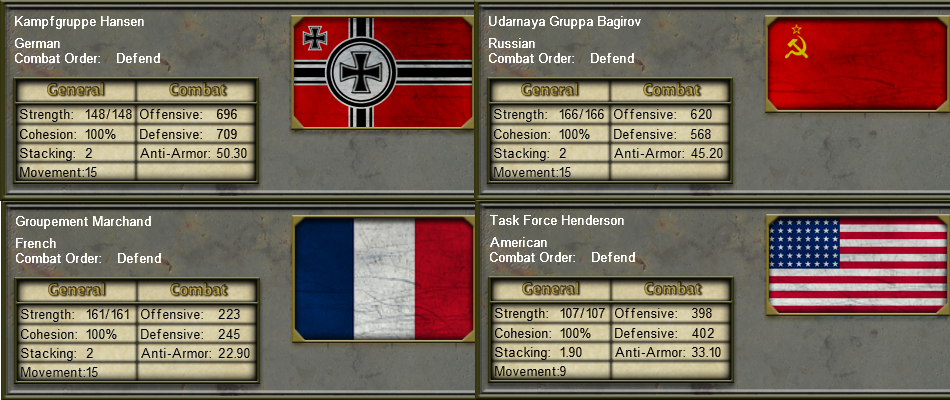
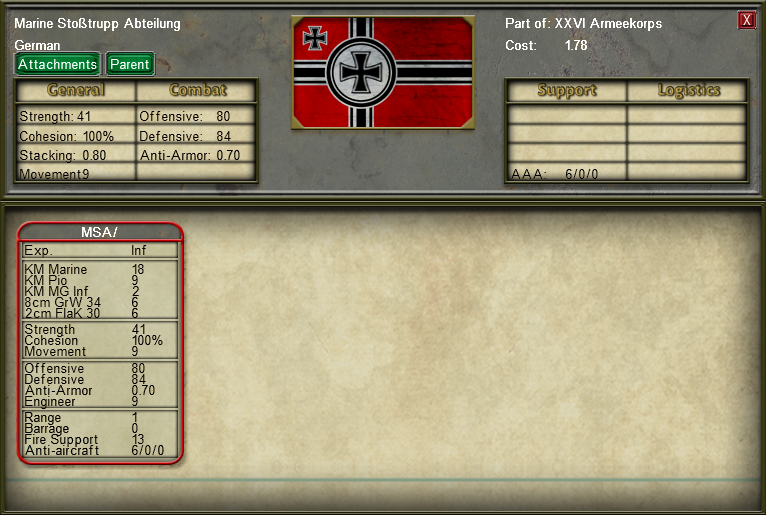
National banners on unit cards now visually take damage as unit strength diminishes.
OB Additions and Updates:
Germany:
Standard Germany 1943:
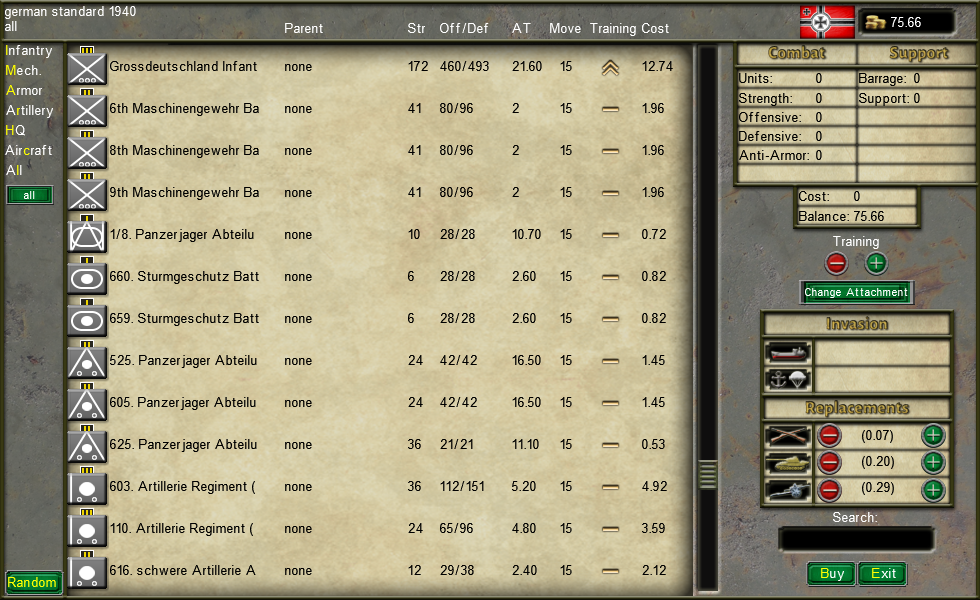
Germany 1943 rolls into Tiger with a trainload of new units to throw into the meat grinder. Many of the new updates are drawn from Kursk, but we have brought fascinating oddities from occupied France as well. The new assets range from nebelwerfers to Char B flame tanks, and of course, more StuGs, because it’s impossible to update a German OB without being ambushed by StuGs.
Added 113. Infanterie Division in its July 1943, Kursk organization.
Added 227. Infanterie Division in its November 1943 organization as a freshly re-formed division.
Added 332. Infanterie Division, as it stood in garrison on the Channel Islands in summer, 1943. The new organization includes other elements of the islands’ garrison under division control, including 213. Pz. Abt (Char-B/Char B Flame).
Added 343. Infanterie Division, freshly reformed in France in summer, 1943.
Added 14-vehicle StuG III G companies (officially “battalions” at the time) to the Panzerjager Abteilungen of 5 and 28th Jäger Divisions, in keeping with their June/July 1943 equipment delivery schedules.
Added 1, 5, and 13. Jäger battalions, motorized (on RSOs). These former anti-partisan units were adapted to serve as QRF forces and later motorized infantry at Kursk.
Added 4. AOK Sturm-Battaillon in its October 1943 organization.
Added 68 and 95. Aufklarungs Abteilungen, both bicycle mounted.
Added 1. Werfer Brigade.
Added 154. Schwere Artillerie Abteilung (Czech 15cm sFH 37(t)s).
Added 730. Schwere Artillerie Abteilung (x12 10cm K35(t), x4 leFH 18s).
Added missing 11th battery (15cm Nebelwerfers) to 1. SS Panzer Artillerie Regiment.
Lost sanity updating the aberrant organization of the 78. Sturm to reflect its state on the eve of Kursk. This re-organization reflects the division’s extreme over-abundance of 7.5cm PaK 40s (71 on hand), differences in regimental heavy weapons companies, and likely variations between Sturm battalion organizations between regiments.
Updated Marder inventories of the Heer and SS Panzer/Panzergrenadier Divisions present at Kursk to reflect Marders on hand at the battle. This generally lowers Marder inventories by 9-14 vehicles on average per division.
Split SS Panzergrenadier heavy weapons units into separate artillery and pioneer/recon companies, instead of trying to fit the vast diversity of equipment used by these units into a composite battalion.
Updated various infantry divisions present at Kursk to reflect their on-hand AT gun types. This generally increases the number of captured French 7.5cm PaK 97/38s and Soviet FK 39(r) in German units.
Split the heavy weapon companies of the various recon mechanized recon battalions into their own attachment to facilitate battlegrouping and to get around the 5-weapon types per unit limit.
Standard Germany 1942:
Added 1, 2, and 3. Jäger battalions.
Air:
Swapped the I/JG 51 and II/JG 51 from FW-190 A-4s to FW-190 A-5s, in keeping with their summer 1943 organizations.
Added III/JG 11 (BF-109 G-6) and III/JG 54 (BF-109 G-2).
Added 4.(H)/31 and 6.(H)/13 Aufkl. Gruppen (FW-189 A-1).
Standard Germany: 1942
Air:
Added II/JG 5 (BF-109 F-4) and II/JG 26 (FW-190 A-2), I/JG 51 (FW-190 A-3).
Swapped III and IV/JG 51 from BF-109 F-4s to F-2s.
Added I and II/KG 27 (HE-111 H-6s).
Added 2.(H)/14 (BF-109 F-4/R3) and 4.(H)/33 Aufkl. Gruppen (BF-110 C-5).
Standard Germany: 1941
Air:
Added III/JG 26 (BF-109 F-2) and II/JG 26 (FW-190 A-2), I/JG 51 (FW-190 A-3).
Swapped I/JG 3 and I/JG 54 from BF-109 F-4s to F-2s.
Added II and III/KG 4 (HE-111 H-6s).
Added 1.(H)/11 (FW-189 A-1) and 2.(H)/23 Aufkl. Gruppen (Hs-126 B-1).
Standard Germany: 1940
Air:
Added I/ZG 1 (BF-109 E-3).
Added II/ZG 1 (BF-109 E-1).
Swapped I and III/JG 77 from BF-109 E-3s to E-4s.
Added I and II/KG 51 (JU-88 A-1s).
Added 4.(H)/22 and 2.(H)/41 Aufkl. Gruppen (Hs-126 B-1s).
Standard Germany: 1939
Air:
Added I/ZG 76 (BF-110 C-1).
Added II/KG 3 (Do-17 Z-2) and II/LG 1 (HE-111 P-4).
Added 1.(H)/31 Aufkl. Gruppen (Hs-126 B-1).
Soviet Union:
Standard Soviet: 1943
Added the 2nd Guards Mortar (Rocket) Division, totaling 72x M-30-4 towed rocket launchers.
Added the 85th, 93rd, 310th, 313th Mortar (Rocket) Regiments. Totaling 48x BM-13-16 self-propelled rocket launchers.
Added the 13th and 16th Anti-Aircraft Divisions.
Added the 7th Separate Flamethrower Battalion.
Added the 142, 175, and 206th Separate Flamethrower Companies.
Air:
Replaced 29. GIAP (Yak-7B) with 69. GIAP (P-39Q).
Added 15 and 43 IAP (Yak-9Ts), and 274 IAP (Yak-1).
Added 18 and 797 BAP (PE-2FT), and removed 1. GBAP (PE-2FT).
Standard Soviet: 1942
Added the 63, 64, and 175th Separate Flamethrower Companies.
Standard Soviet: 1941
Air:
Added 74. SAKP (I-153Sh Chaikas, in a ground-attack role).
Added 33 IAP (I-16 Type 24).
Added 24 and 130 BAP (SB-2Ms).
Added 117 and 118 ORAP (SB-2s in recon loadouts). Removed 311 ORAP.
Standard Soviet: 1940
Air:
Added 10 and 122 IAP (I-16 Type 24s).
Added 2 BAP (SB-2M).
Standard Soviet: 1939
Air:
Added 49 IAP (I-153 Chaika).
All Soviet OBs: 1939-1941
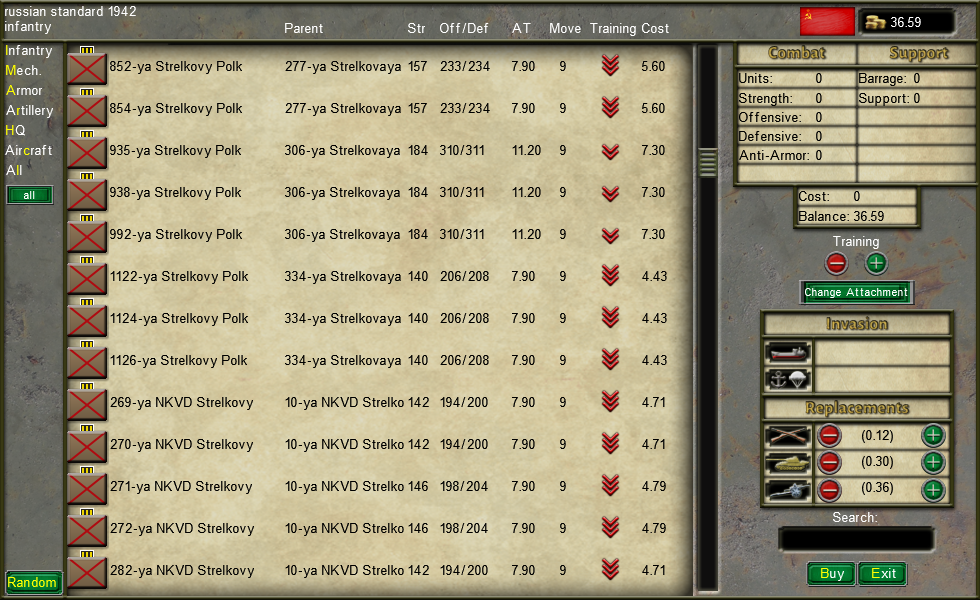
Reorganized engineer battalions in keeping with relevant tables of organization for the division’s formation date. Previously most Soviet engineer battalions used a standardized organization from fall 1940.
Converted generic engineer squads to flamethrower squads in rifle regiments, where applicable.
Added independent flamethrower (termed Chemical Defense Companies by the Red Army), to relevant rifle divisions in 1941.
United States:
Standard USA: 1943
Added the 751st and 752nd Tank Battalion (Medium) in their spring 1943 organization (M3 Lees). As a historical curiosity, the 752nd was a well-trained unit that was accidentally converted into a replacement formation due to an administrative error in theatre.
Added the 749th Tank Battalion (Medium), in its July 1943 organization (M4 Shermans).
Added the 759th Tank Battalion (Light), armed with M3 Stuarts.
Added the 771st Tank Destroyer Battalion, armed with M10 Wolverines.
Revised US Armored Division engineer battalions to include 2 motorized and 1 armored engineer companies, instead of 3 fully mechanized companies 1943-1945.
Added the 9th, 26th, and 30th Infantry Divisions.
Added 442nd Regiment Combat Team, just as it had arrived in the MTO. This is a solid unit, destined for fame in 1944.
Added 3rd and 118th Infantry Regiments, as well as the 181st Regimental Combat Team. Each of these units are second-unit formations intended for rear-security.
Added the 100th (Nisei), and 99th (Norwegian), and 73rd Infantry Battalions.
Added the 190th Field Artillery Regiment, with x2 155mm Gun Battalions.
Added the 40th Field Artillery Group, with x2 155mm Howitzer Battalions.
Converted the 349th Field Artillery group from 155mm Howitzers to 105mm howitzers, consistent with its summer/fall 1943 organization.
Air:
Added 309th Fighter Squadron (Spitfire Vb).
Added 489th Bombardment Squadron (Medium) (B-25H).
Added 85th and 86th Bombardment Squadrons (Light) (A-20Gs).
Added 111th and 154th Recon Squadron (Fighter) (F-6B Mustangs).
Standard USA: 1942
Air:
Added 307th and 308th Fighter Squadrons (Spitfire Vbs).
Added 94th Fighter Squadron (P-38F).
Added 486th, 487th, 488th, 489th Bombardment Squadrons (Medium) (B-25Cs).
Added 85th, 86th Bombardment Squadrons (Light) (A-20Bs).
Added 16th (P-39N-6), 111th (P-39F-2), 154th (F-3A Havoc) Observation Squadrons
Removed 12th Photo Recon Squadron.
Standard USA: 1941
Air:
Added 7th (P-35A), 11th (P-36), 33rd (P-40E) Pursuit Squadrons.
Added 41st Bombardment Squadron (Medium) (B-25B).
Added 8th, 13th Bombardment Squadrons (Light) (A-20B).
Added 15th, 107th, 109th, 119th, 121st Observation Squadrons (O-47s).
Standard USA: 1940
Air:
Added 33rd (P-40B), 40th (P-35A) Pursuit Squadrons.
Added 99th Bombardment Squadron (Medium) (B-18A Bolo).
Added 16th (O-9), 101st (O-47), 103rd (O-35B), 118th and 119th (O-46A) Observation Squadrons.
Standard USA: 1939
Air:
Added 35th (P-30A), 36th (P-36) Pursuit Squadrons.
Added 99th Bombardment Squadron (Medium) (B-18A Bolo).
Added 16th (O-9), 102nd (O-46A), 103rd (O-38B), and 109th (O-47) Observation Squadrons.
Great Britain:
Standard Britain: 1943
Air:
Added No. 243 Squadron RAF (Spitfire Vc).
Added No. 21 (Baltimore IV) and No. 24 (Boston IIIa) Squadrons SAAF.
Added No. 225 (Spitfire PR XI) and No. 241 Squadrons SAAF (Hurricane PR II).
Standard Britain: 1942
Air:
Added No. 145 and No. 601 Squadrons RAF (Spitfire Vbs).
Added No. 55 and No. 223 Squadrons RAF (Baltimore I).
Added No. 21 Squadron SAAF (Baltimore I).
Added No. 40 Squadron SAAF and No. 208 Squadron RAF (Hurricane PR I).
Standard Britain: 1941
Air:
Added No. 222 and No. 603 Squadrons RAF (Spitfire Vbs).
Added No. 84 and No. 211 Squadrons RAF (Blenheim IV).
Added No. 208 Squadron RAF (Hurricane PR I).
Standard Britain: 1940
Air:
Added No. 85 and No. 87 Squadrons RAF (Hurricane Ia).
Added No. 114 and No. 139 Squadrons RAF (Blenheim IV).
Added No. 16 Squadron RAF (Lysander II).
Standard Britain: 1939
Air:
Added No. 46 Squadron RAF (Hurricane Ia).
Added No. 114 and No. 139 Squadrons RAF (Blenheim I).
Added No. 13 Squadron RAF (Lysander II).
Italy:

Standard Italy: 1943
Air:
Added 159. Gruppo Assalto (G.50 Freccia).
Added 3. Gruppo CT (BF-109 G-2) and 155 Gruppo Autonomo CT (MC.202 Folgore).
Added 30. Gruppo BT (Ca.314).
Replaced 33. Gruppo BT with 47. Stormo BT (CANT Z.1007 bis).
Standard Italy: 1942
Air:
Added 8. Gruppo CT and 150. Gruppo Autonomo CT (MC.200 Saettas).
Standard Italy: 1940
Air:
Added 12. Squadriglia APC (Ca. 309 Ghibli).
France:
Standard France: 1940
Air:
Added G.C. II/4 (Hawk 75 A1) and II/6 (MS.406).
Added G.B. I and II/34 (Amiot 143s).
Added G.R. I/14 (Potez 63.11 A3).
Removed G.R. I/35.
Added G.A.O. 501 and 510 (Potez 63.11 A3), and G.A.O 515 (Mureaux 115 R2B2).
Standard France: 1939
Air:
Added G.C. II/3 (MS.406), and III/4 (D.510).
Added G.B. I and II/34 (Amiot 143s).
Added G.R. I/14 (MB.131 RB.4).
Removed G.R. I/35.
Added G.A.O. 501 and 514 (Mureaux 115 R2B2s), and G.A.O 509 (Bre.270). We wish the pilots the best of luck.
Bug Fixes:
Fixed a long-standing bug that caused units in the deployment box to clip through the bottom HUD and deploy on the map when creating battlegroups by dragging and dropping units together.
Added code support in scenario config to set a cut-off date, after which a player can no longer purchase new landing markers or load points in custom scenarios.
Fixed a bug that broke the ability to check individual supply dump ranges in the Supply Overlay after selecting a Supply Extender.
Fixed a bug that could cause player income values to become swapped in multiplayer games when the host was Attacker.
Ever Onward:
While it is admittedly tempting to create a second comprehensive update and name it Tiger II, we'd prefer not to keep you waiting that long. Moving into Spring 2026 our main focus is on further AI overhauls and developing the graphical user interface for the map terrain editor. As side efforts, either the US or German 1944 OBs will receive the OB overhaul treatment, and Soviet 1943 will receive some further additions as well. We also have a map pack in the pipe, but we'll reveal that once it's all tested and ready to go!

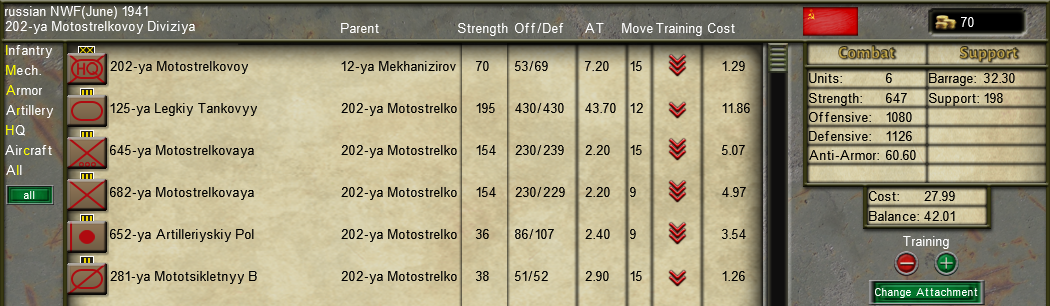

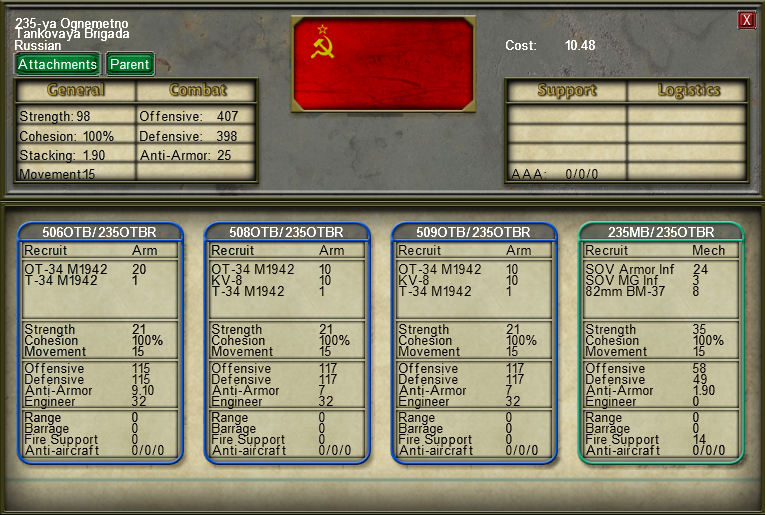 The 235th Flame Tank Brigade in all of its napalm-fueled glory.