
"Silk & Silver" Dev Diary #6 - Merchants, Republics, & the Silk Road
Hello everyone, It is time for us to give another update on all things that are happening on Silk & Silver. As Joachim mentioned during the last Dev Diary, we are currently deep in the Iteration phase of the project. Lots of progress has been made so far, and we want to share
Hello everyone,
It is time for us to give another update on all things that are happening on Silk & Silver. As Joachim mentioned during the last Dev Diary, we are currently deep in the Iteration phase of the project. Lots of progress has been made so far, and we want to share some of the recent developments when it comes to our two new Government types for the expansion: Merchants and Republics.
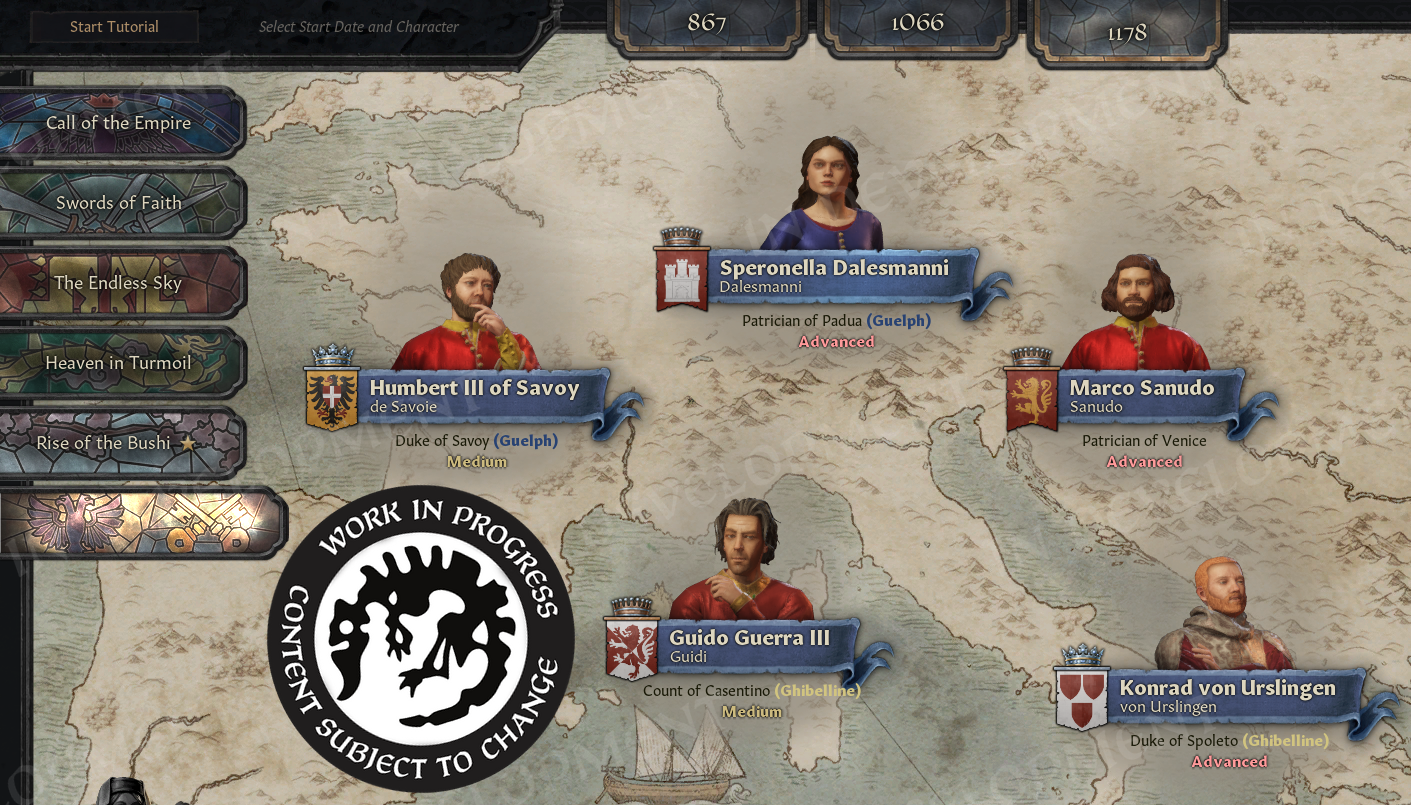
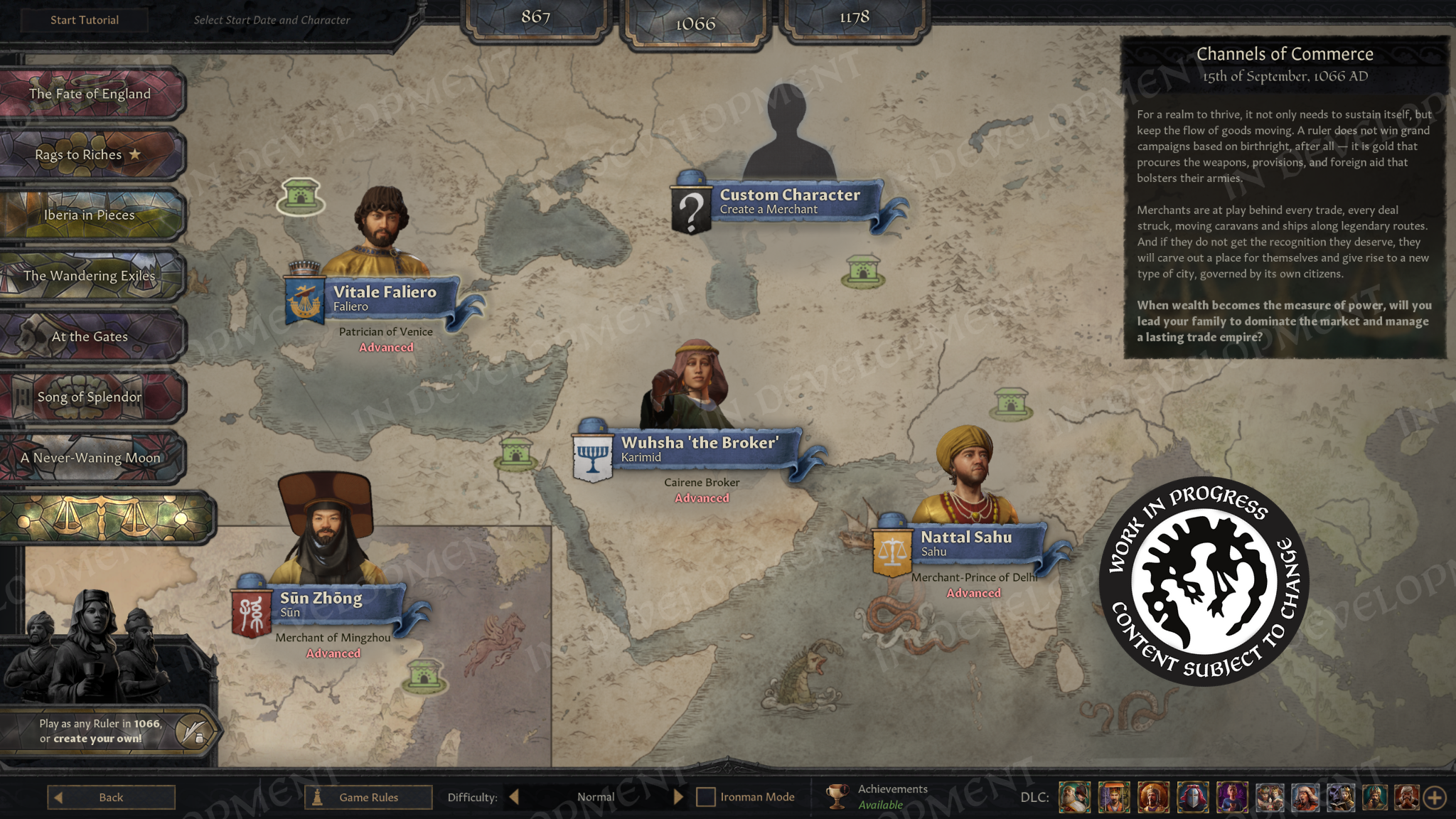 [1066 Merchant-focused bookmark screen]
In the third Silk & Silver Dev Diary, Profit Above All: Merchants Vision, we covered the Merchant player experience in a broader sense: who they are, what matters to them, as well as the tools and connections they have access to in order to achieve their goals. If you haven’t already, you can read this first to get a better understanding of Merchant Monopolies, Trade Expertise, Trade Contracts, Company Domicile, and the Merchant relationship to their Patron.
Today, we will mainly focus on what the current state of the Merchant gameplay looks like, what has changed from last time we wrote on this topic, as well as diving a little deeper into the interplay between competing Merchant Families.
With this context in mind, let’s dive into some features we’ve been working on that we want to highlight!

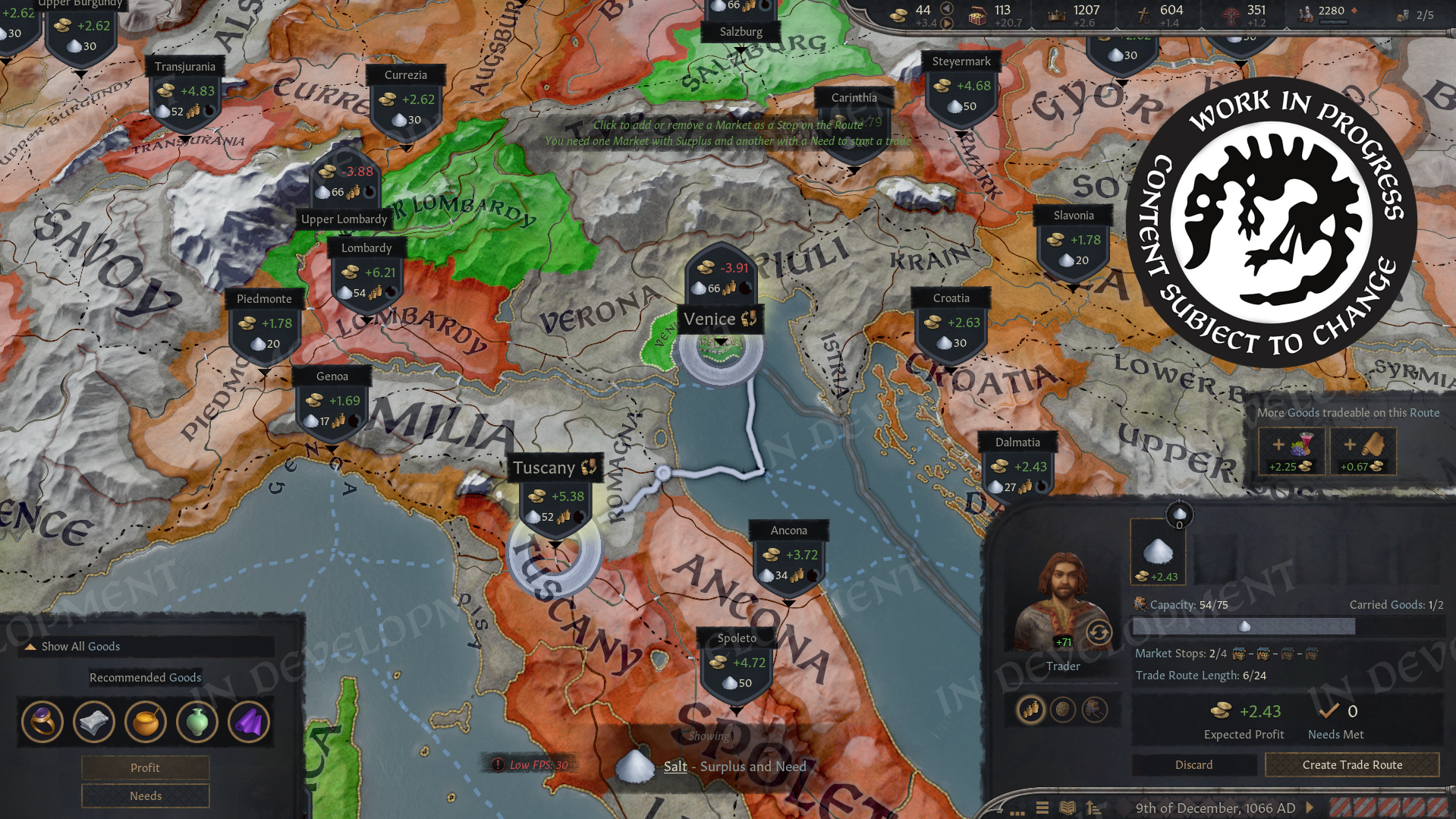
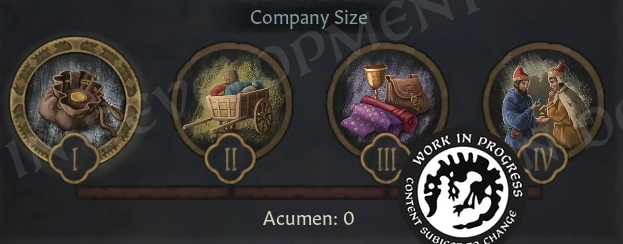
In addition to their profit-motivated Trade Routes, we have added Commission Routes for Merchants, who will regularly receive offers from landed rulers to meet needs between markets. Merchants can have up to 4 of these Commission Routes, depending on their Company Size level. The Merchant receives an upfront lump sum for starting these routes, but acts only as a middleman for the transport of these goods. They can’t assign traders or make any changes to the route. They don’t get Trade Expertise or monthly income from Trade while the route is active.
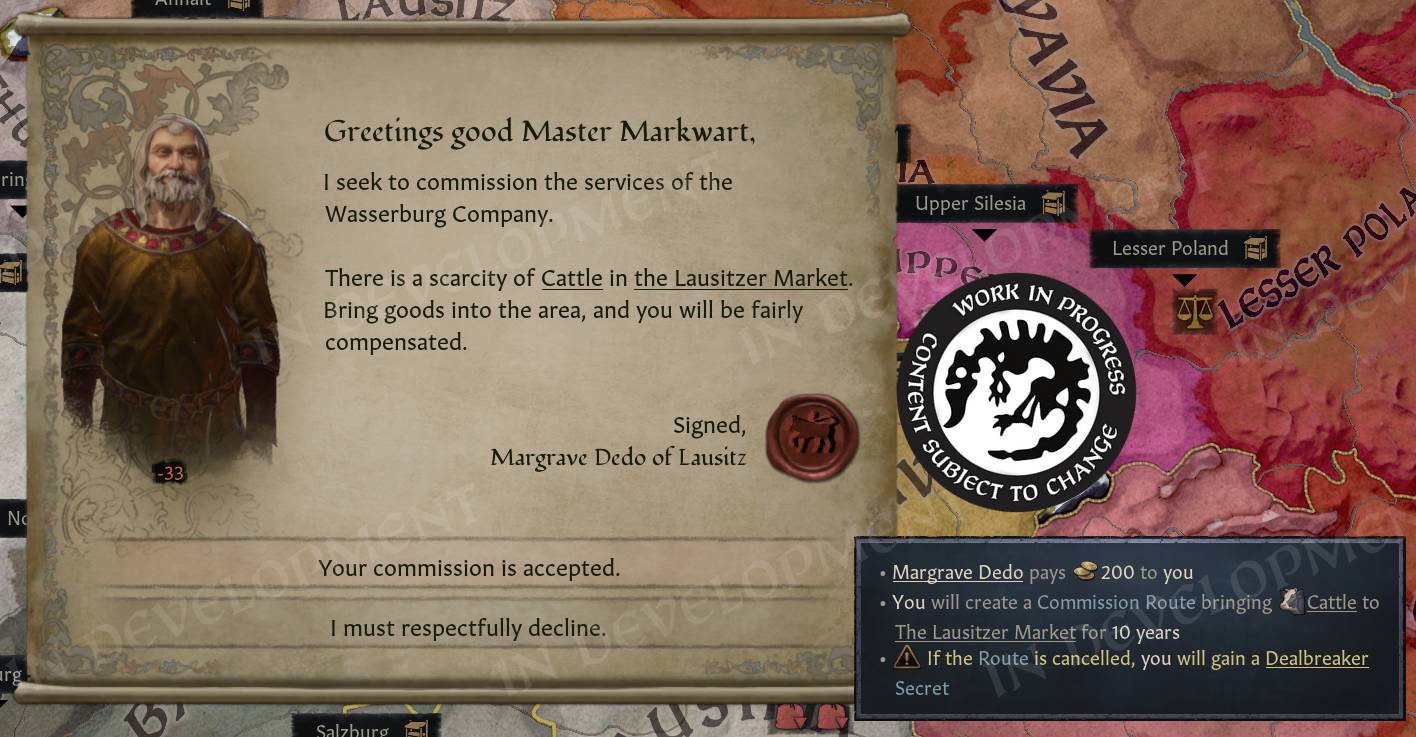 [Commission Route Request]
Commission Routes last for 10 years, but Merchants can also cancel them in case more attractive offers (or more interesting rulers to work for) come around. Using this action comes at the cost of having to refund some of the money and will also give the merchant a secret for a new fame trait: the Dealbreaker.
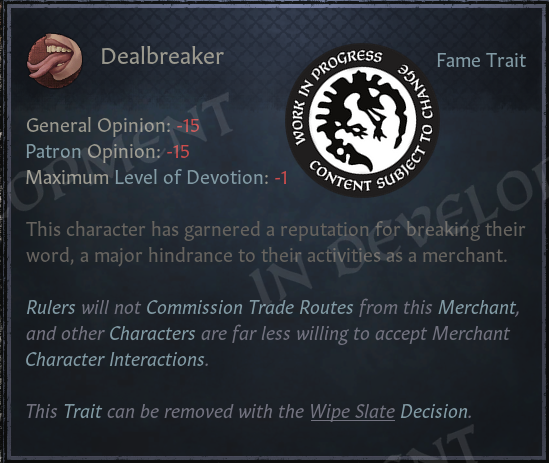
[Dealbreaker Trait]

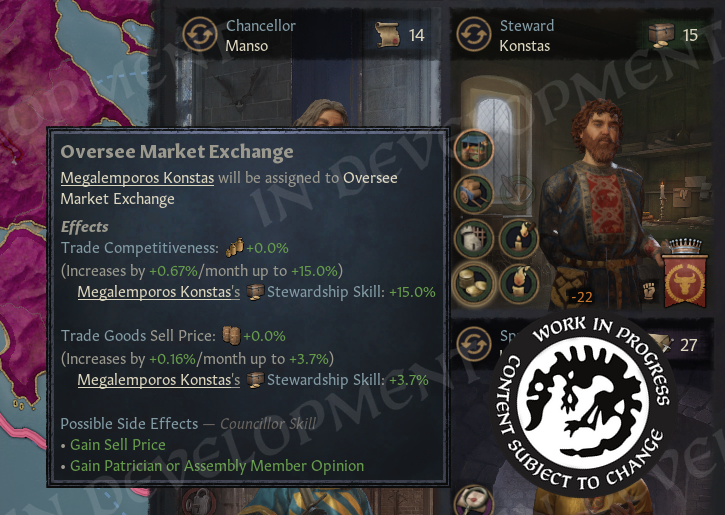
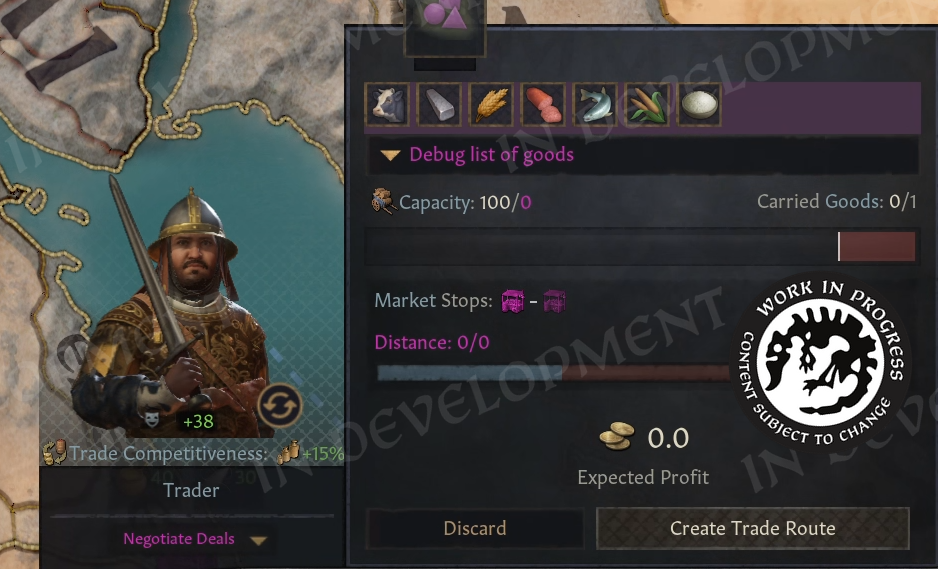
As the head of a Company, it will be very important to have access to a big roster of highly skilled Traders. They are the lifeblood of your trade routes and can make a substantial difference in how well the routes perform. The performance of the trader for this job will be tied to their skills and to their aptitude for the job.
Every trade route can have one Trader assigned, and you are able to pick what said Trader will focus on:
Increase the competitiveness rating to gain the upper hand over other merchants
Gain more Trade Expertise for the primary trade good of the route
Increase the capacity of the route, allowing for more goods to be traded
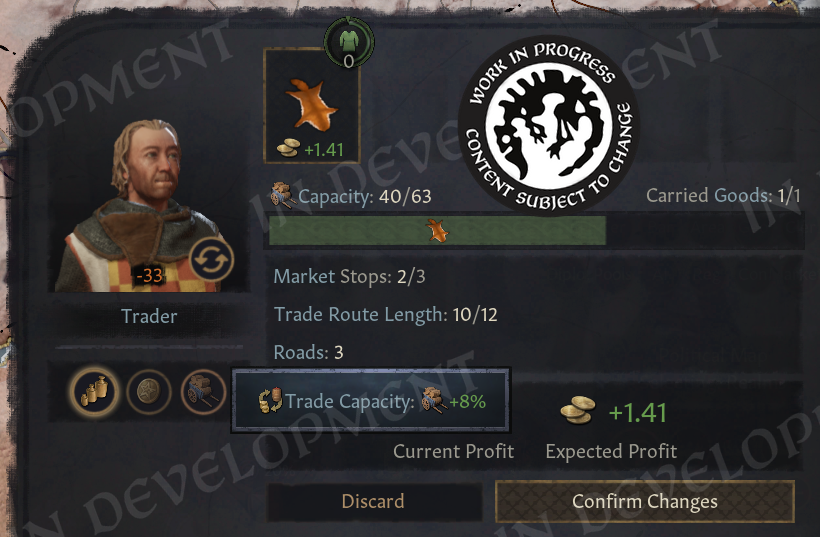
[Partner view in the Market window]
While a trade route is active, Traders will also travel to markets on it and carry out small schemes that boost several aspects of the route. We will show this activity on the map: in the examples below, you can see Mistress Biltrude attempting to secure a surplus in the Lombardia Market, which - if successful - will give the route a capacity bonus for several years. When completing these schemes, the Traders might also gain experience in the Merchant Trait, making them even stronger assets for the company.
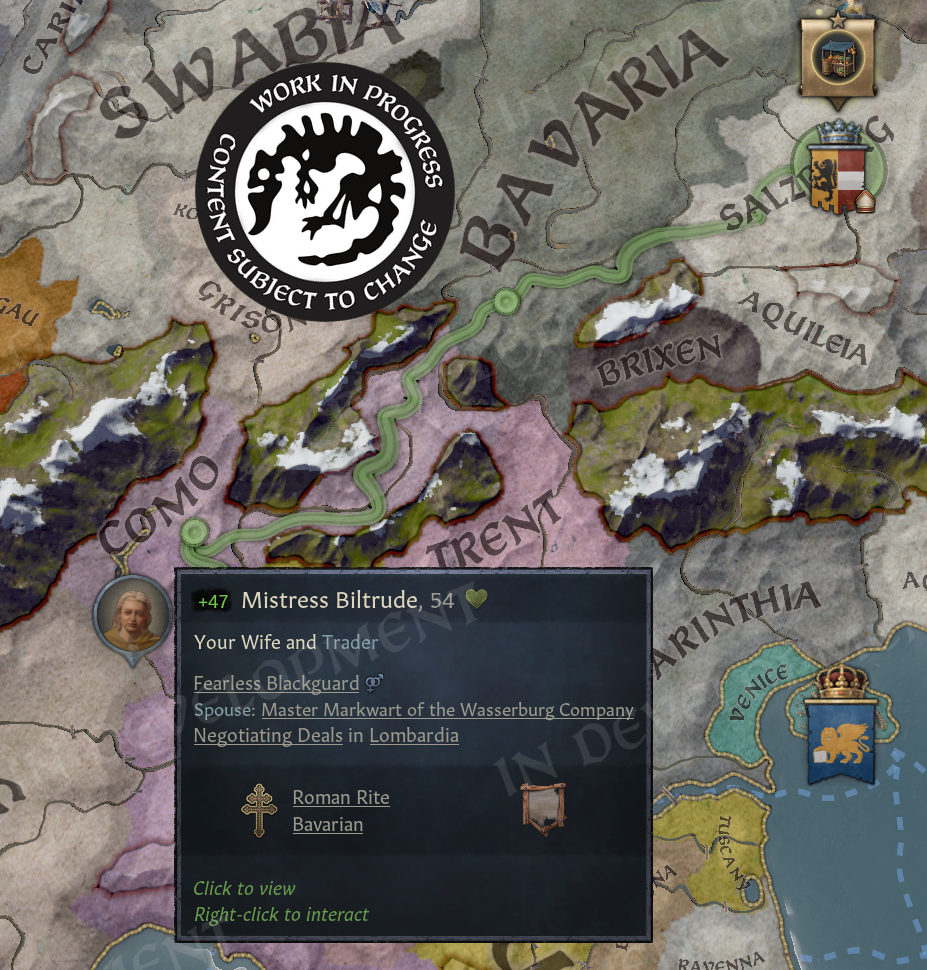 [Trader busy Negotiating Deals]
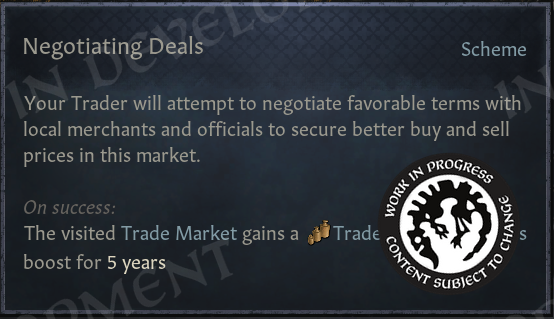
[Negotiating Deals Tooltip]
And - since this is CK3 after all - we of course have options for poaching experienced Traders from other merchant companies!

[Invite to Company Character Interaction]

We want to give some unique flavor to Merchants depending on where on the map you will play. While the basic mechanics of playing as a Merchant should, by and large, remain the same, we want the experience of playing as a European Merchant to be different from that of playing in Northern Africa or in Asia.
Cultural Traditions
Some of the changes we’re making are tied into Cultural Traditions that we’re both tweaking and adding to for our new Trade systems. Still on our to-do list is doing the same thing for Innovations and also hooking in Trade and Merchant-related modifiers into the new list of Tenets that we’re working on for By God Alone.
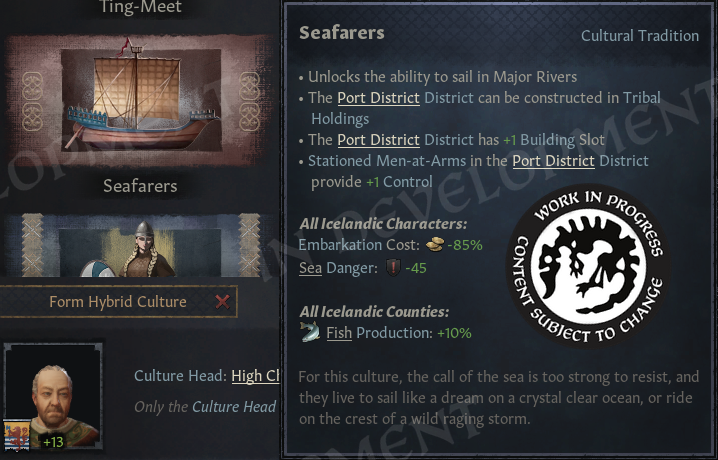
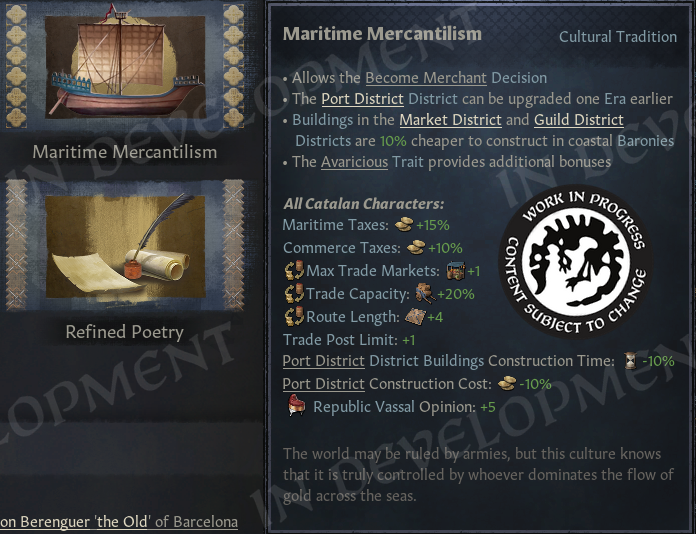
Examples of new Traditions:
Binding Oaths:
Being exposed as a Dealbreaker causes more opinion damage
Increased Merchant Opinion
Fortune Seekers:
Allows the Become Merchant Decision
Characters of the culture are more likely to become Merchants
Trade Goods Buy Price increases
Creditor Trait Experience gain increases
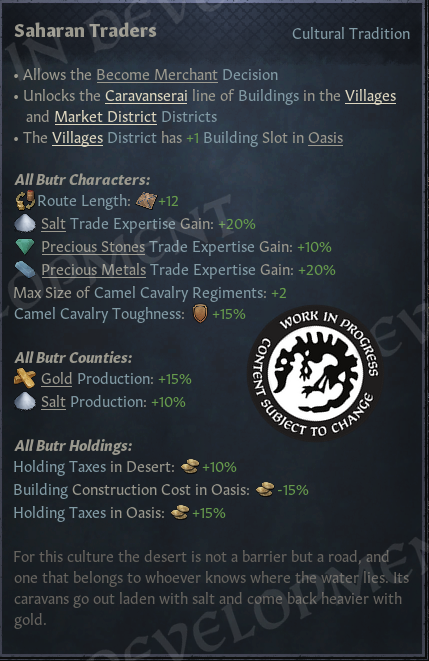
Saharan Traders:
Allows the Become Merchant Decision
Route Length has a flat increase
Salt Expertise bonus
Precious Stones Expertise bonus
Precious Metals Expertise bonus
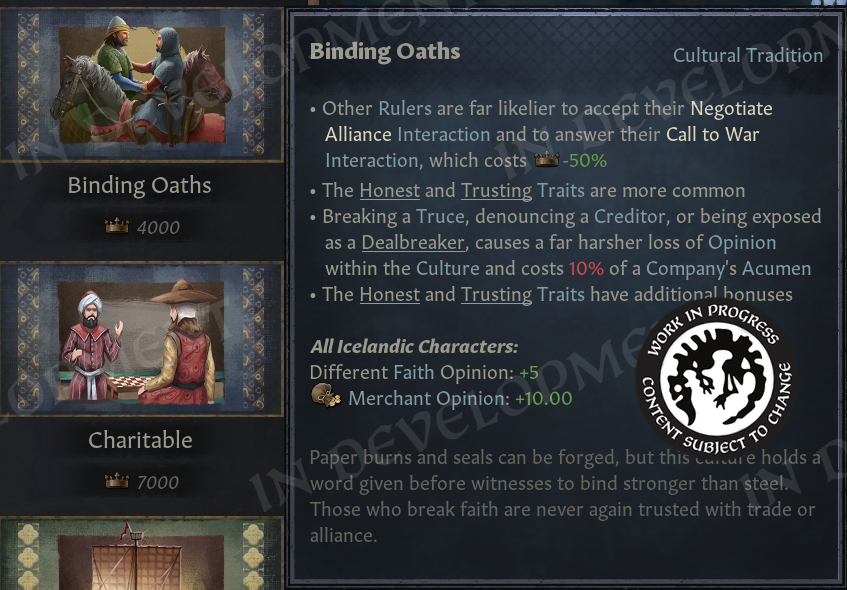
[Cultural Tradition - Binding Oaths]
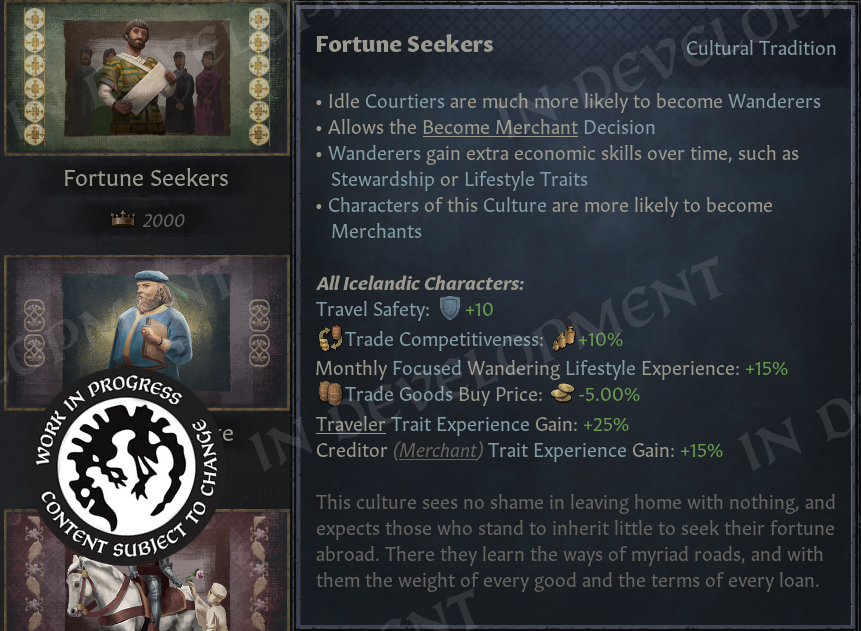
[Cultural Tradition - Fortune Seekers]
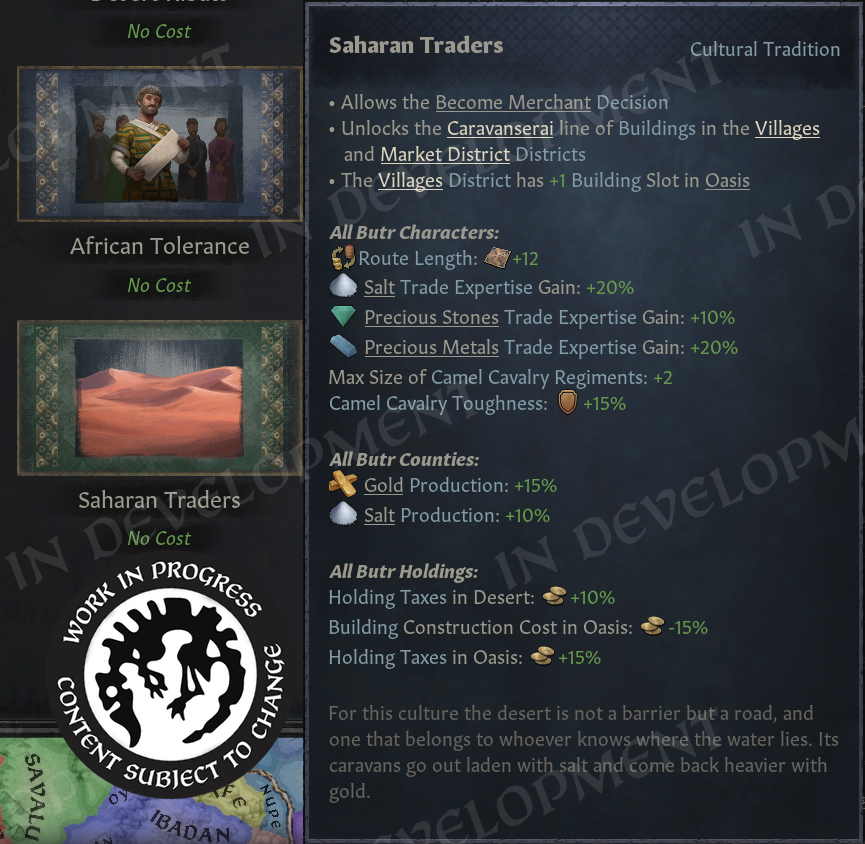
[Cultural Tradition - Saharan Traders]
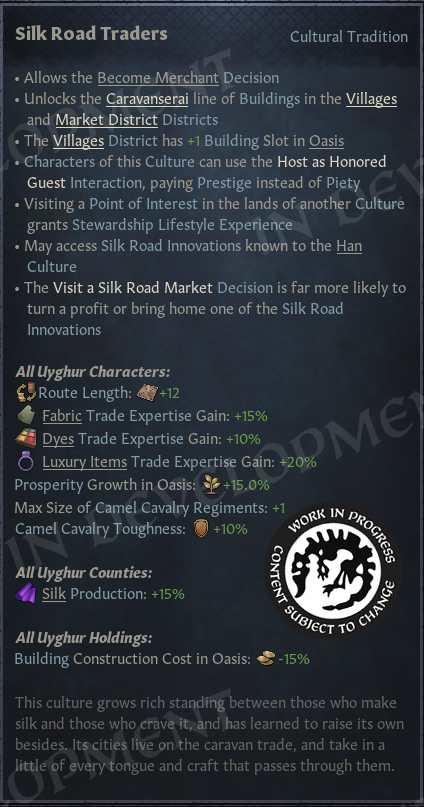
Silk Road Merchants
Merchants that are within the Silk Road region will be part of a new Participant Group, granting bonuses to maximum Route Length, Route Capacity, and Expertise decay, depending on the active Phase in their geographical sub-region.
Since we’re tying Merchants to the Silk Road, we’re also going to make this feature available to all players who own Silk & Silver, even though its effects on the Dynastic Cycle will of course only be relevant to those of you who also own All Under Heaven.
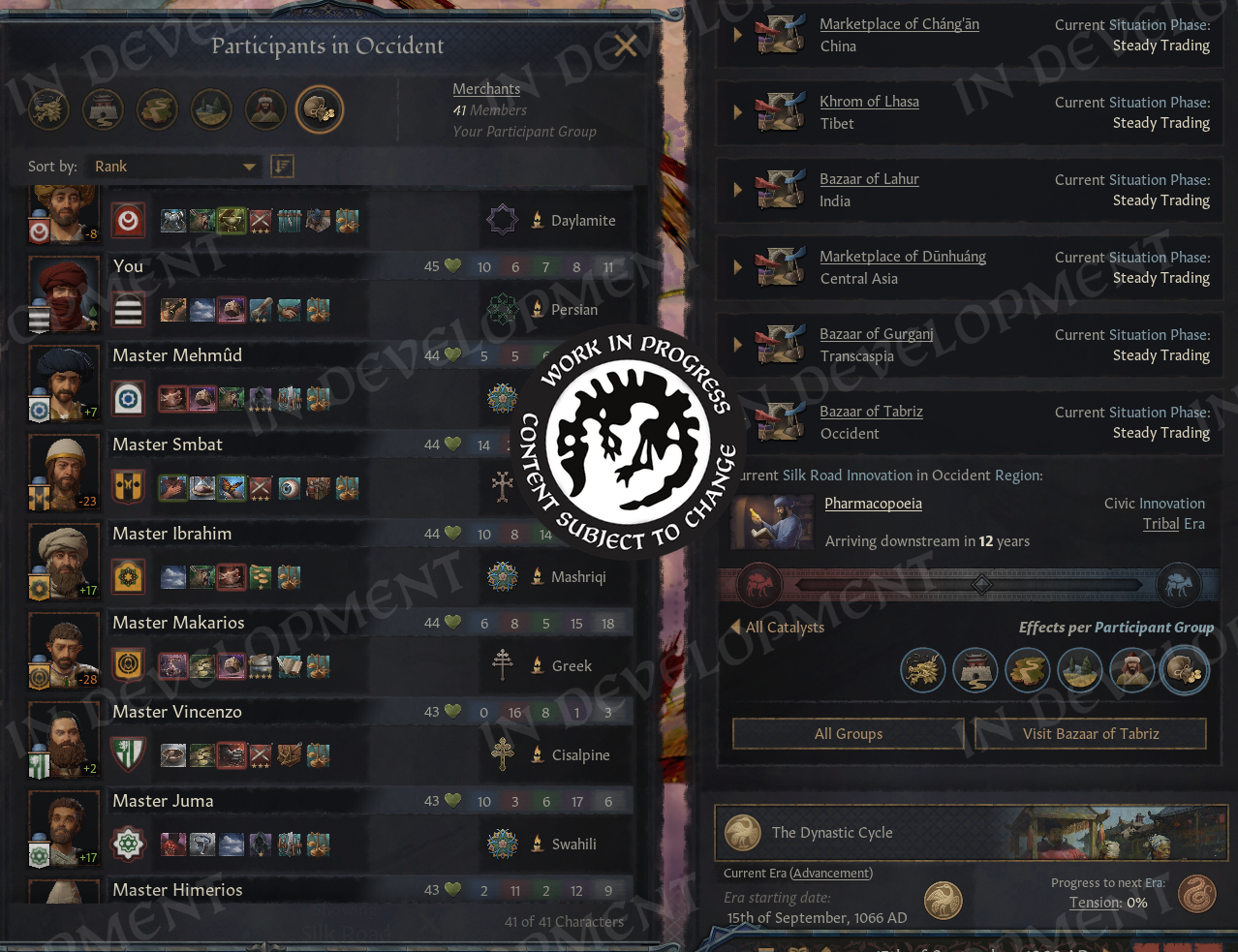 [Silk Road Situation Participant list]
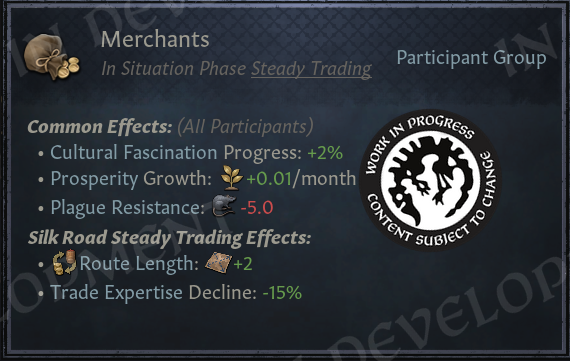
[Silk Road Merchant Participant Group]
Usury
We have added Usury as a Doctrine, so faiths will have a different way of handling the act of lending money and profiting from it.
Any Merchant will be able to Loan Gold. Having the Creditor focus makes moneylending the thing you are, rather than something you occasionally do when a neighboring ruler is desperate. You as the Merchant offer a landed ruler a substantial sum, scaled to their income, and in return you take a Strong Hook that lasts for as long as the debt does.
The loan comes in different forms:
Lend at Open Interest: The recipient gets gold and owes 25% more back. If their Faith condemns Usury, they may later have the debt struck down rather than repaid. More on that in a moment.
Disguise the Interest: The extra gold is folded into fees and gifts; they owe 15% more, and there is nothing for a priest to point at. Slightly less lucrative. Considerably harder to denounce.
Lend Without Interest: The recipient owes exactly what they received, they think rather better of you, and if your Faith treats charity as a virtue, you even come out of it Pious.
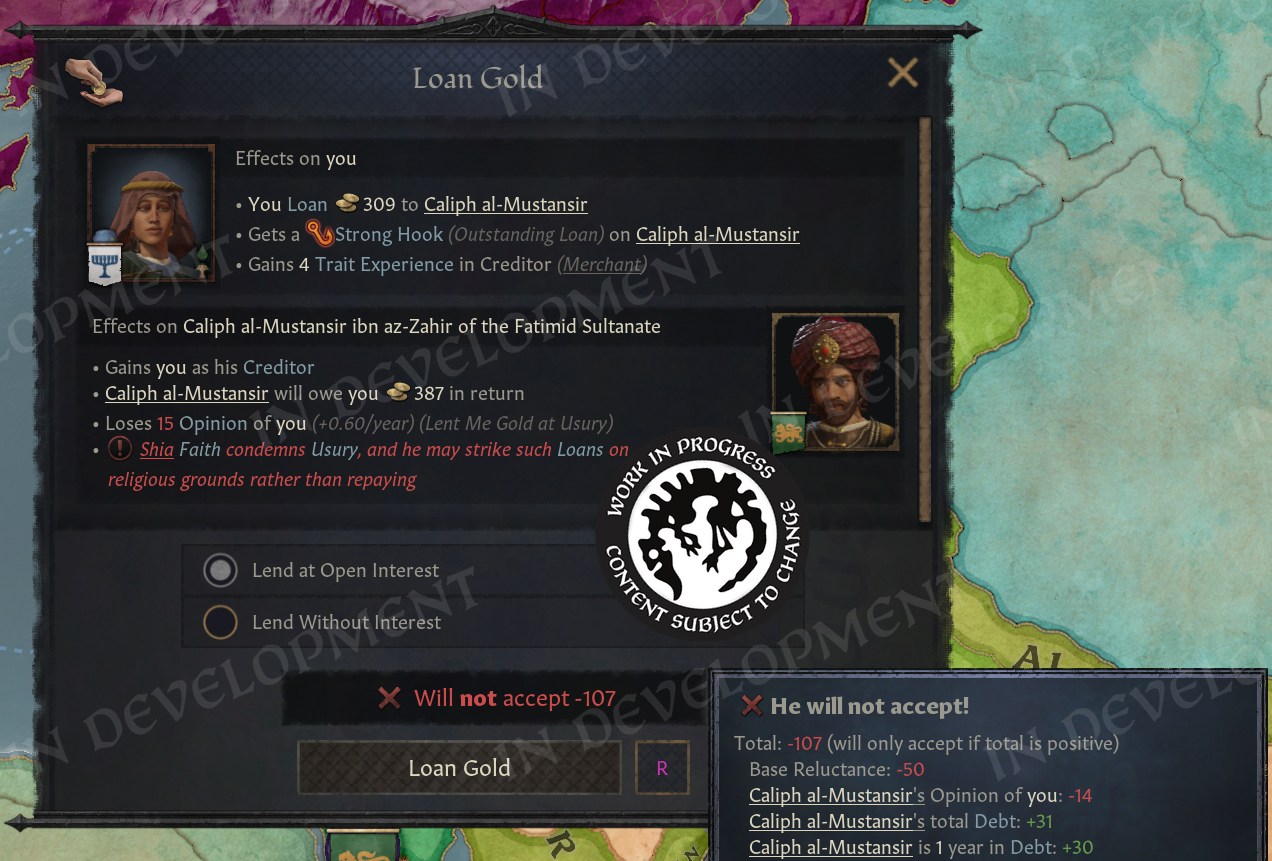 [Loan Gold Interaction - choosing terms]
We are adding a Usury Doctrine to Rites. Some Faiths condemn lending gold with interest altogether, some accept interest applied to people outside of the Faith, while others may treat it as honest business. A borrower whose Faith condemns Usury can take the Denounce a Usurious Loan Decision, have their clergy void an openly written bond, and keep the gold.
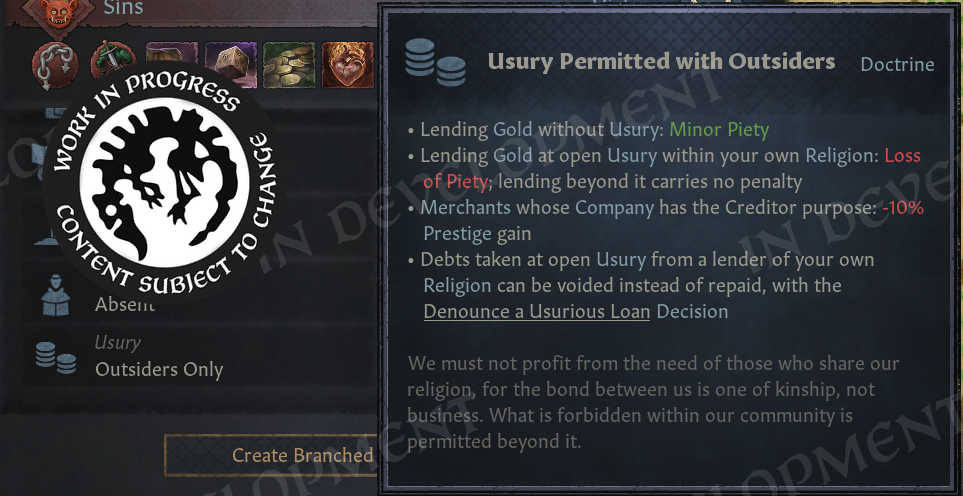 [Doctrine - Usury Permitted with Outsiders]
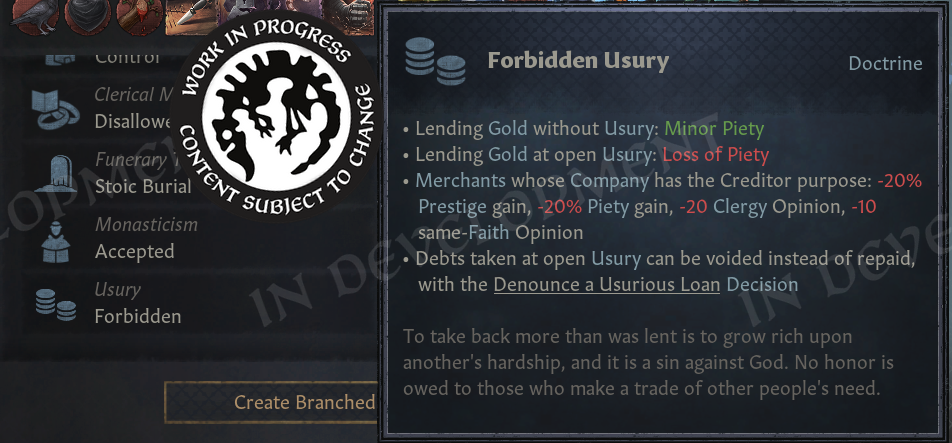 [Doctrine - Forbidden Usury]
The debtor can use a Repay Loan Interaction whenever they can actually afford it. If they refuse, they lose Prestige, your Houses grow colder toward each other, and repeated refusals will make Rivals of you. The gold, however, is still owed. Death is no escape either, since loans are inheritable.
A Merchant can have as many Debtors as they can fund. A ruler can also owe more than one Creditor at a time. Being the person everyone owes is, as it turns out, a kind of power.
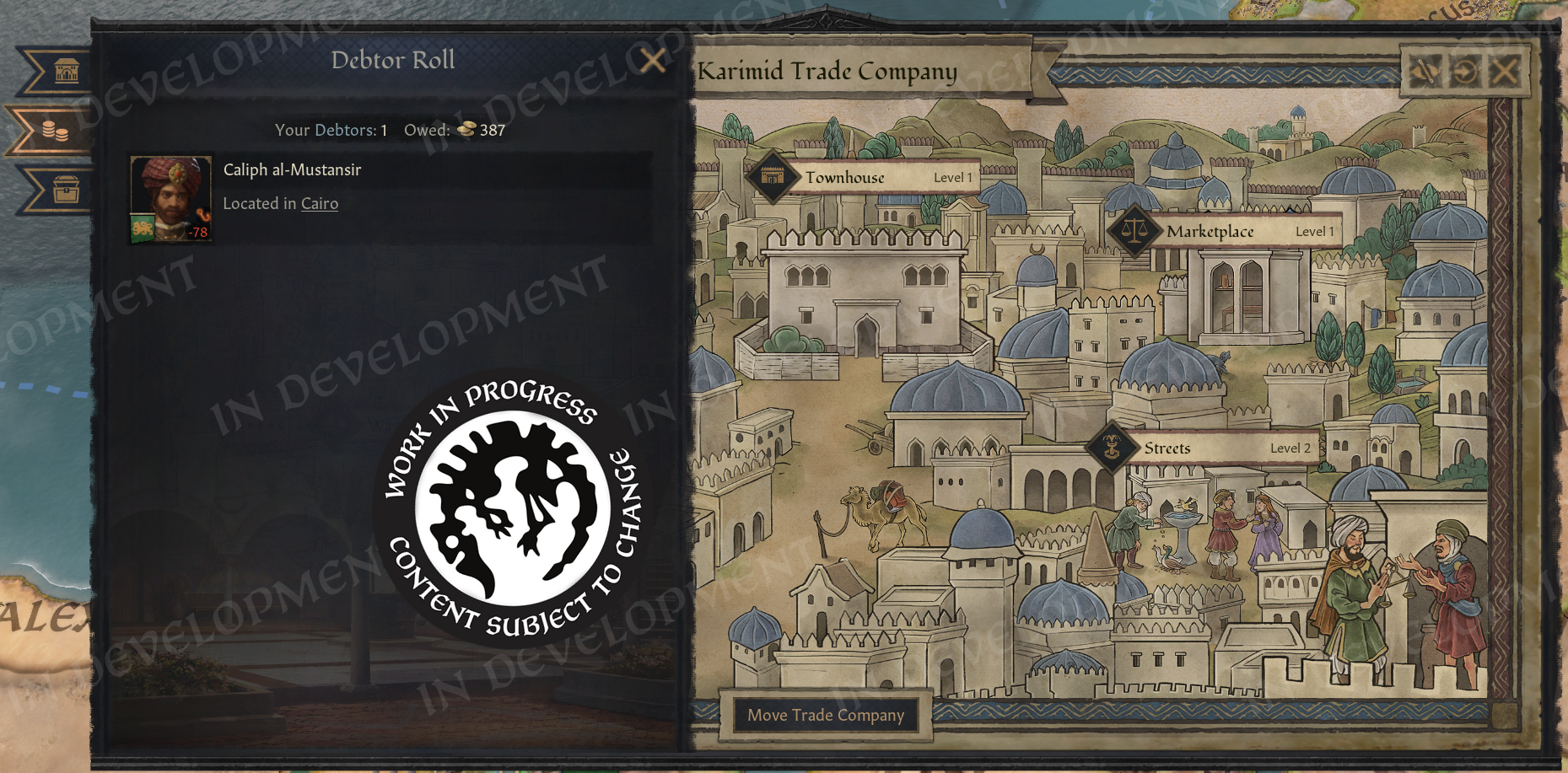 [Debtor Roll]

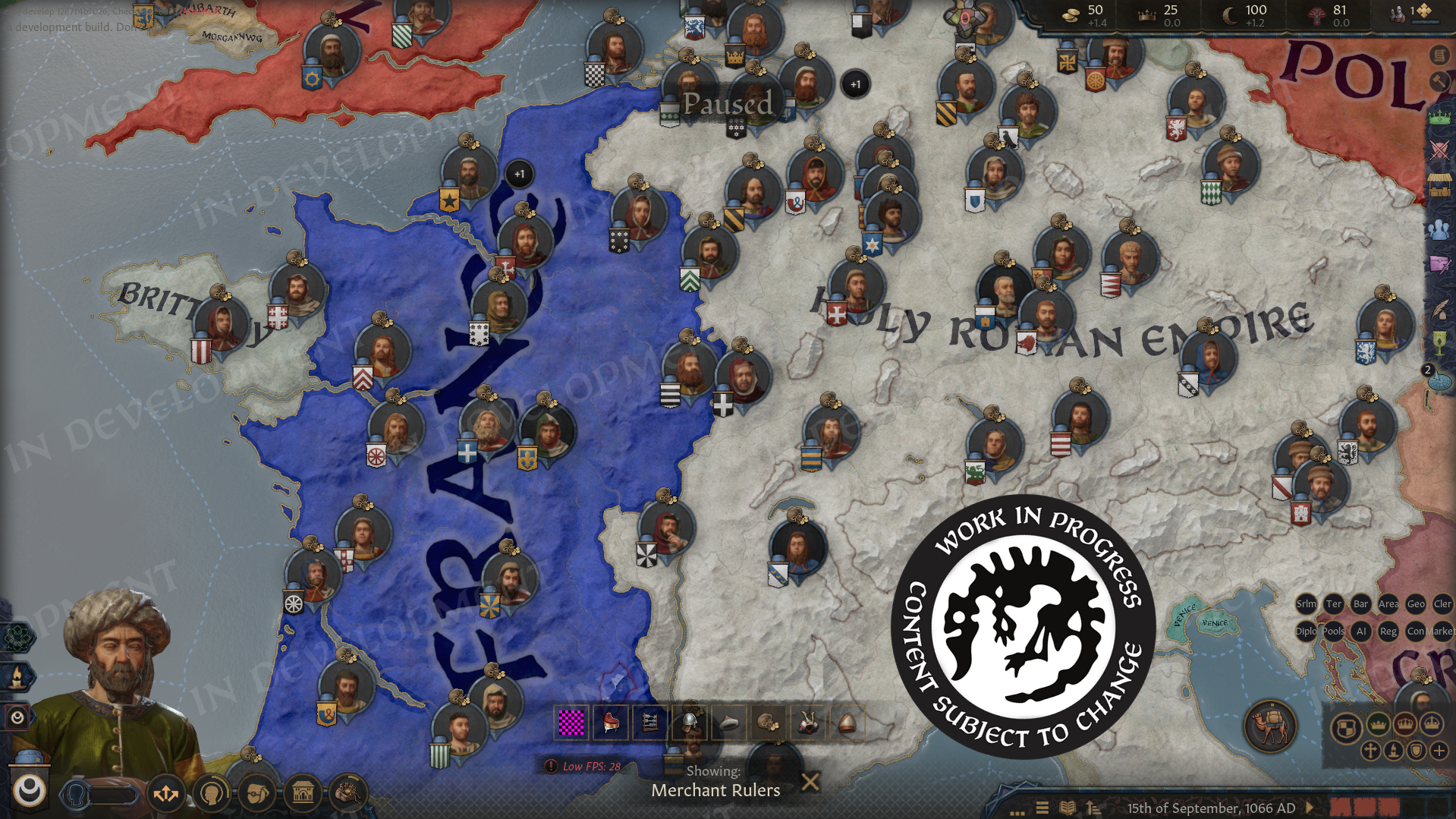
The moment you start moving goods through a market, your House Relation decreases with every other Merchant already selling those same goods. Since our latest Merchant Development Diary, the interplay between two competing Merchant Houses has been a focus of our implementation.
Firstly, we have two new angles for increasing our Trade Expertise. You can either share your experience in trading a good with another character through a Character Interaction, or use a hostile scheme to steal their trade secrets.
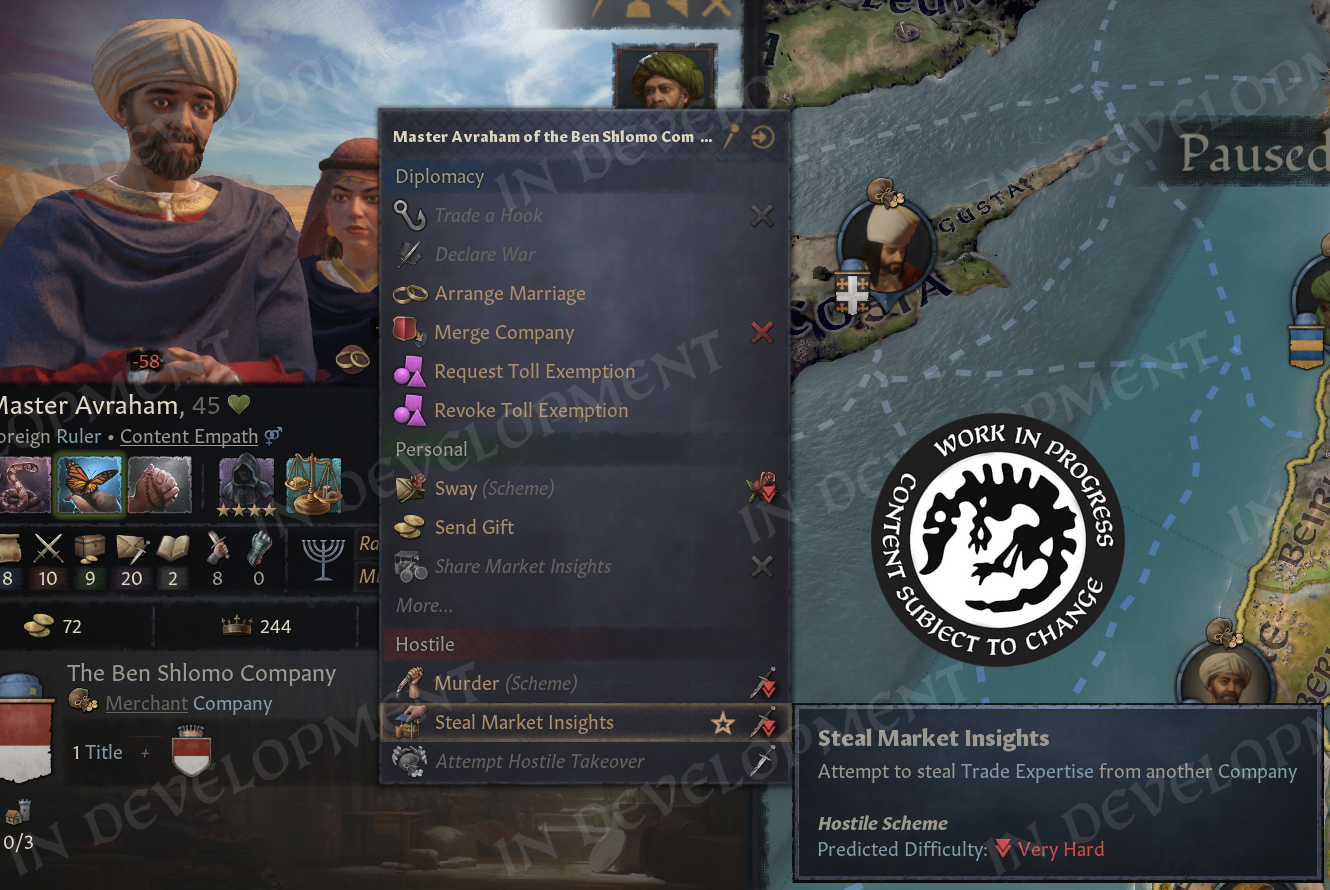 [Steal Market Insights Character Interaction]
We also have additional Trade Opportunities. These are:
Challenge Competitor: Contest their position of your competitor in a market you both deal in.
Sabotage Competitor: Dent the Competitiveness of a competitor directly and brutally.
Disrupt Charter: Make your Patron take back the charter given to a competitor.
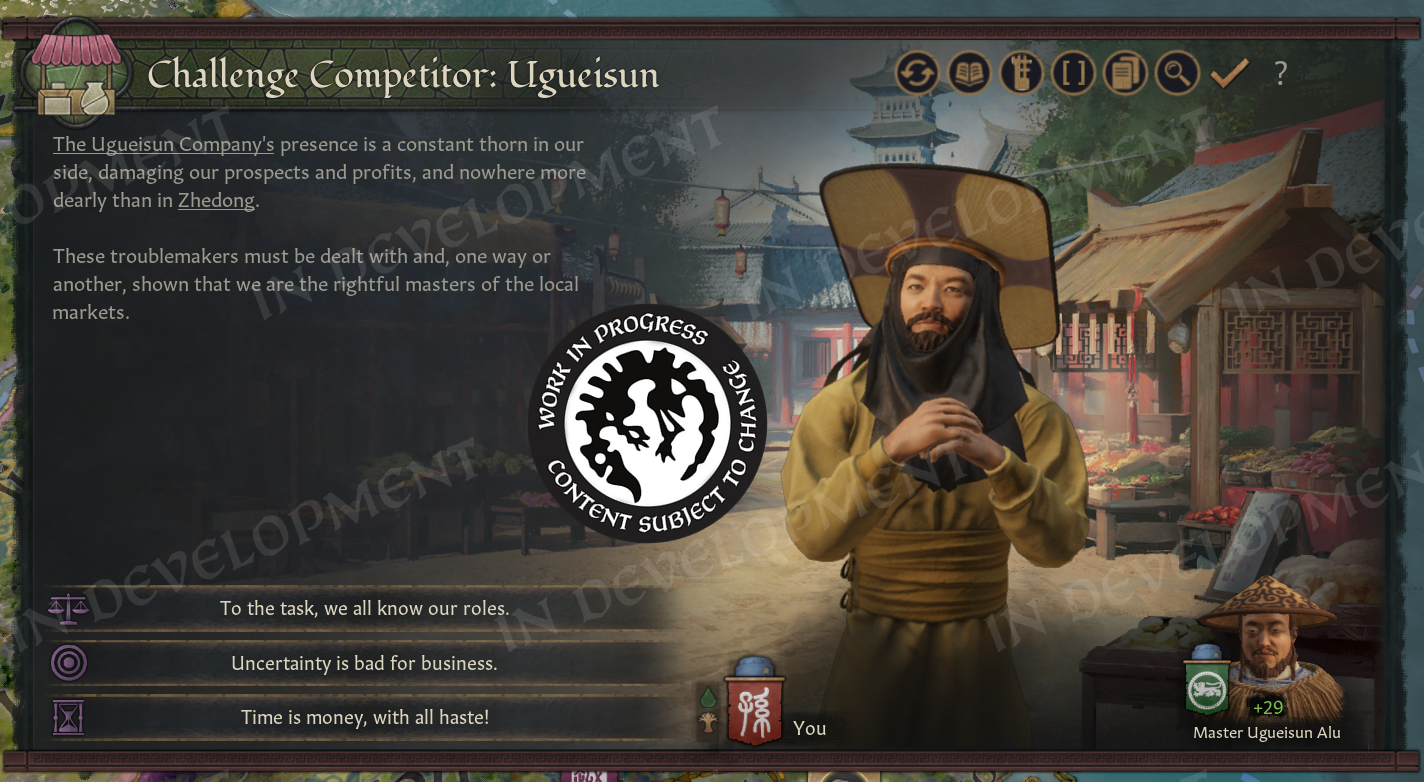 [Challenge Competitor Opening Event]
Successful Trade Opportunities can grant Competitive Pressure, which can be a springboard to further advantages.
Organize the Venture to hurry a scheme you already have running.
Put on Notice lets you stop waiting for the right Opportunity to appear, and start one against a specific rival in a market you share.
Undercut the Competition is the other direction: you cut your own selling prices, accept thinner margins, and force them onto uncertain ground.
And if beating them on the stall is no longer the point, you can attempt to end the Company.
Merge Company is the peaceful merger, presented as a Character Interaction. The target surrenders their network, their family joins yours as Associates, and you become the Dominant Trader in their former markets.
Attempt Hostile Takeover is a hidden scheme. You will need a Company at least as large as theirs, and a Hook somewhere in the arrangement — on them, on their Patron, or on someone inside their walls. With that, you’ll be ready to start taking your opponent apart.
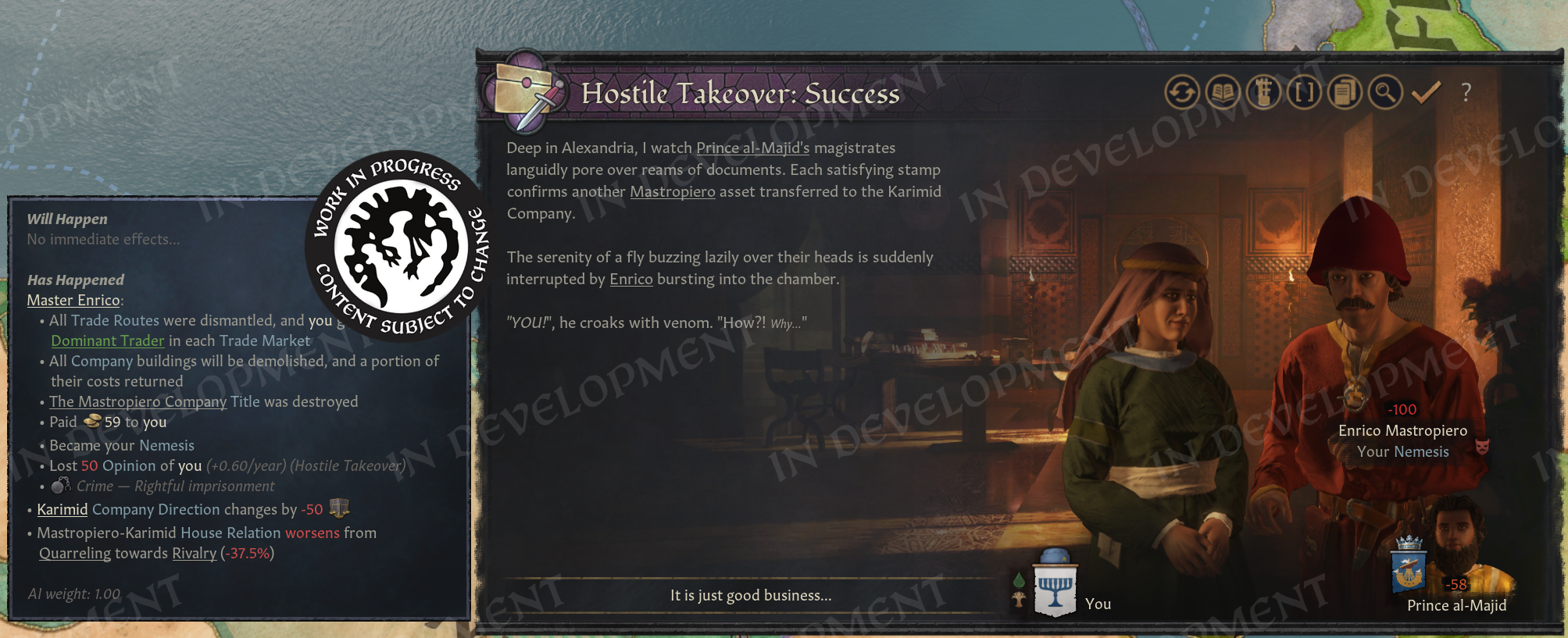 [Hostile Takeover Success]

To wrap things up for Merchants, we also want to highlight some of the additions and changes we’ve made over the last few months:
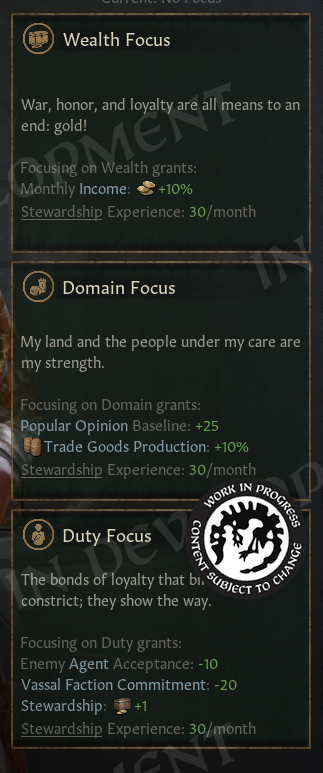
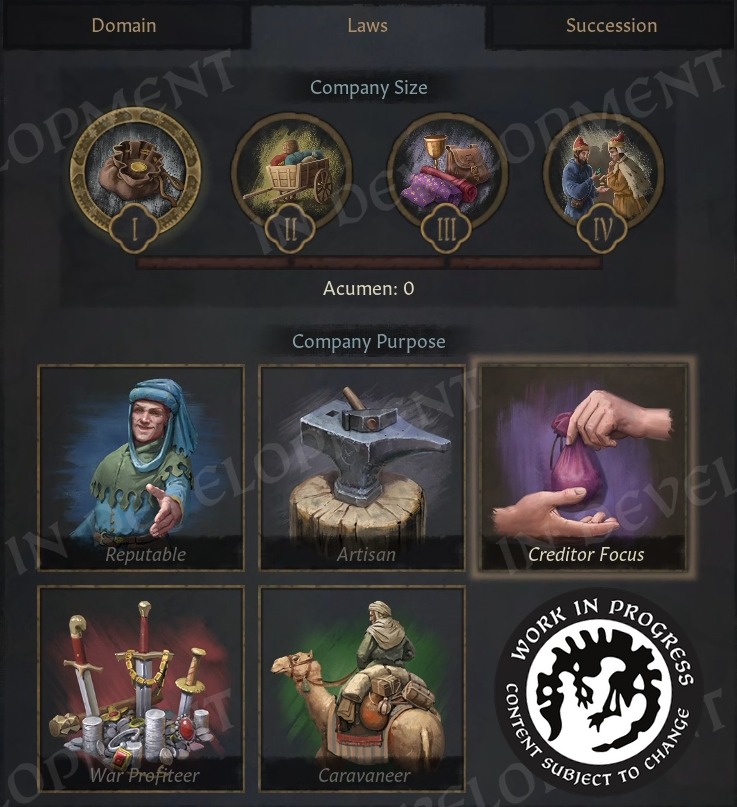
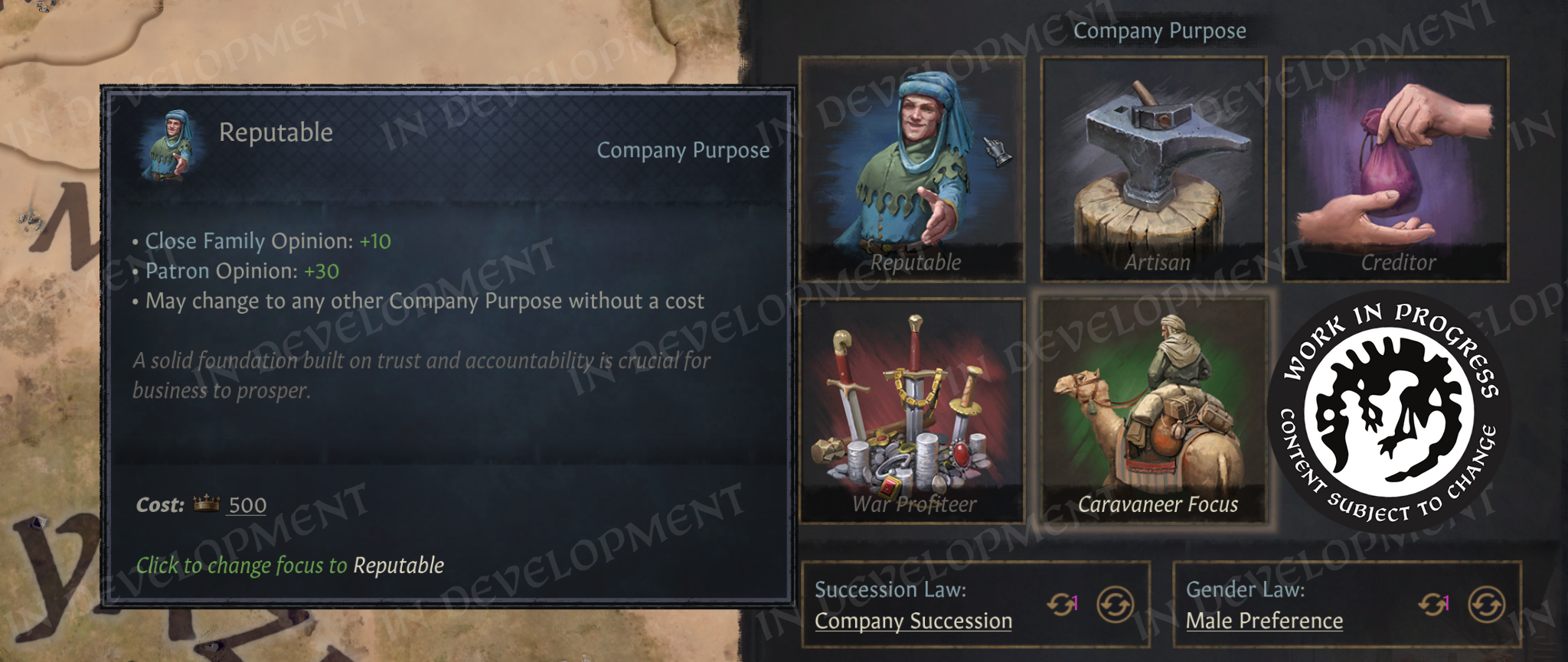
We have honed in on 4 Company Purposes for Merchants now: Reputable, Artisan, Creditor, and Caravaneer. Most of the effects of the previously shown War Profiteer purpose have been rolled into Creditor since there was too much of an overlap between those two.
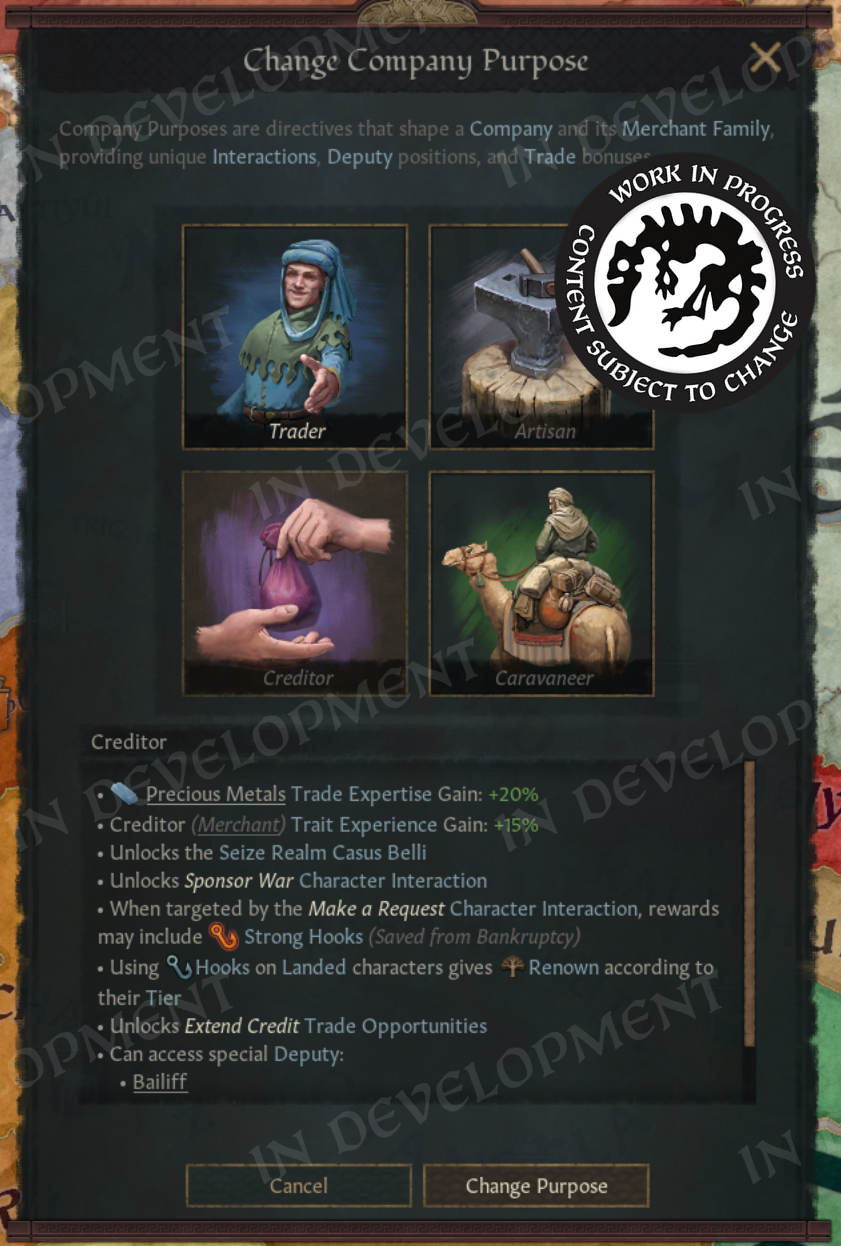
[Company Purpose selection screen]
We have also implemented capstone decisions for Merchants, one for each Company Purpose, which unlock a unique domicile upgrade along with other benefits.
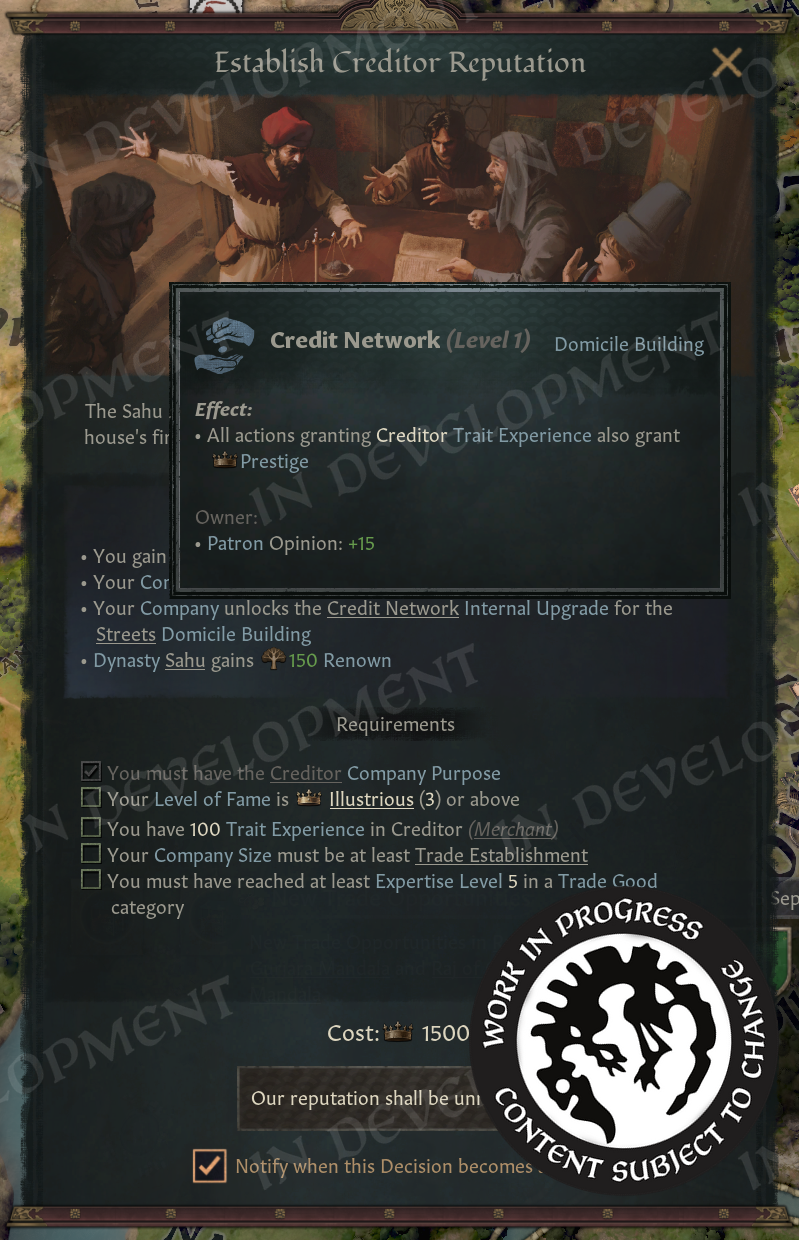
[Establish Creditor Reputation Decision]
On top of that, we have two new interactions that target rulers, allowing you as a Merchant more levers to pull against other characters. One is to pay a ransom to put the prisoner in your pocket, the other is to reinvest funds into a character’s realm to bolster your own position.
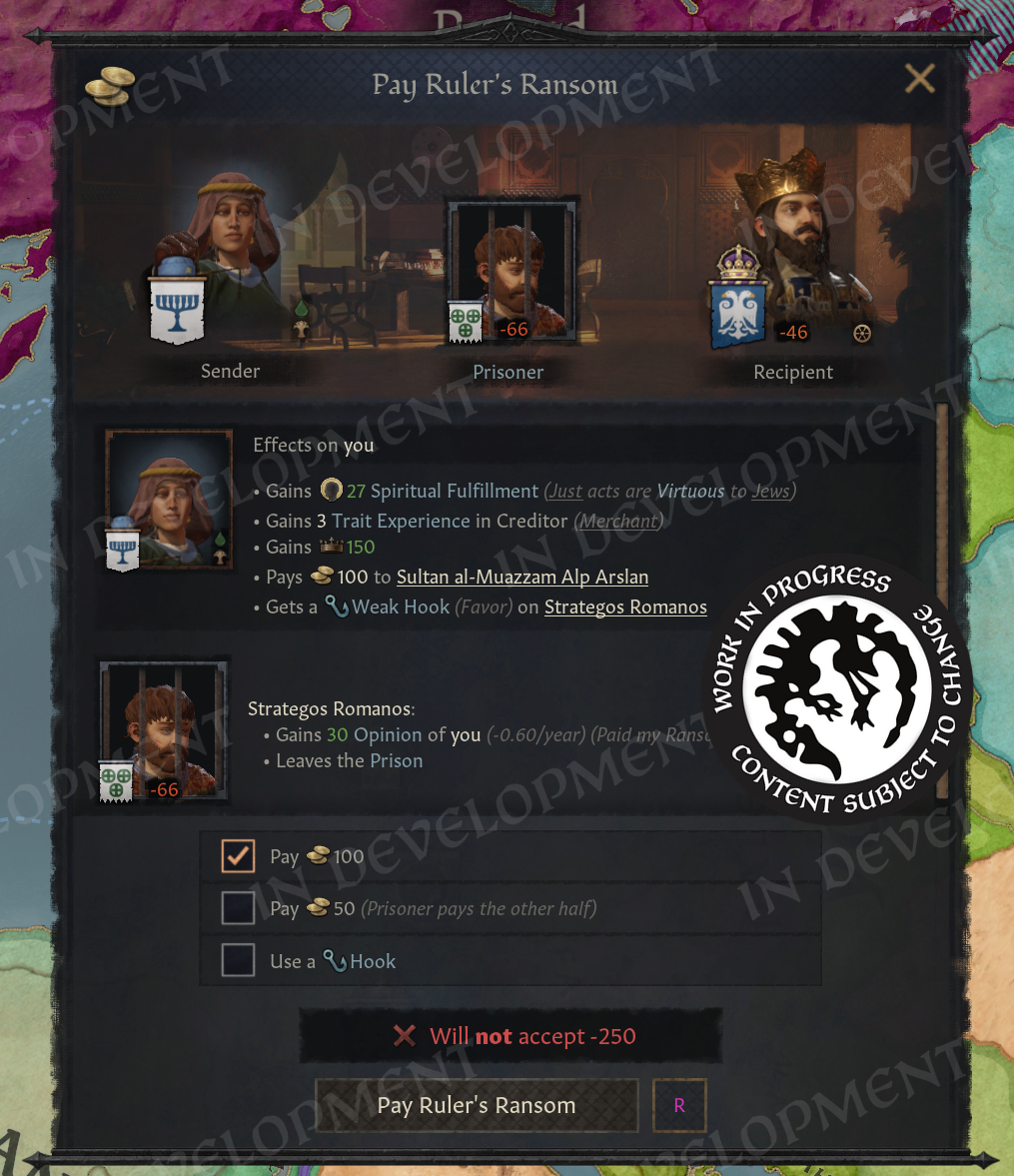 [Character Interaction - Pay Ruler’s Ransom]
 [Character Interaction - Sponsor Construction]

Here you have the Merchant experience as it stands today: a Company that lives and dies by its Traders, a web of routes other families will fight you for, and a growing set of ways to turn gold into leverage over both rivals and landed rulers.
The core fantasy has not changed: profit above all, and a family Company trying to outlast everyone else who wants the same.
Which is a good moment to look at their more settled cousins. Merchants can, after all, choose to join or form a Republic — so let’s talk about what that experience of playing as a Republic actually looks like.

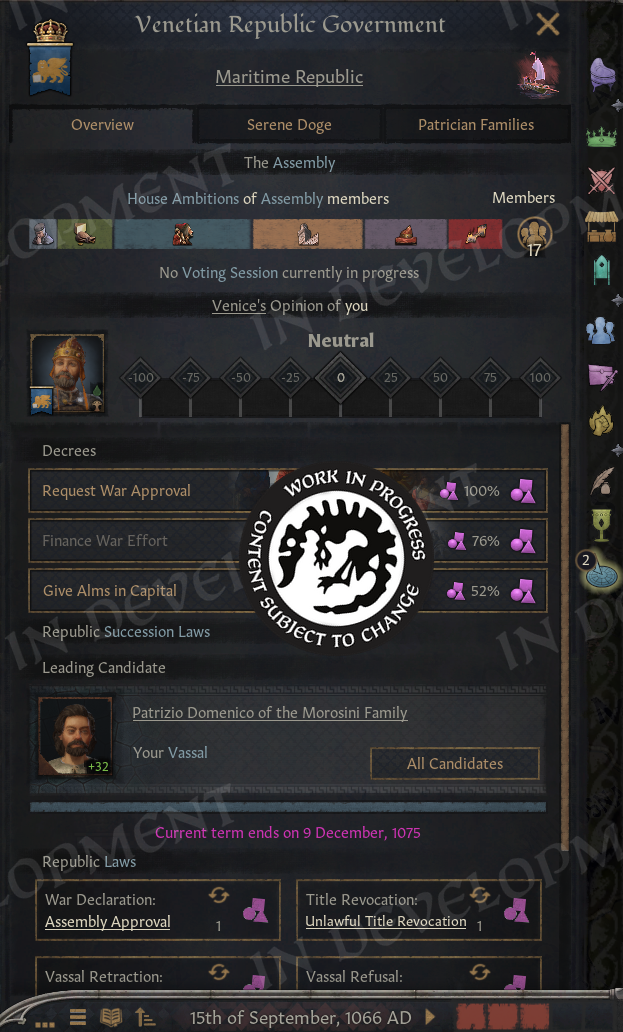
We’ve already covered the core vision of Republics in a previous Dev Diary, and we’ve come a long way since then. First things first: we’ve made some changes to the main Republic tab since we showed it last time. You’ll notice a few new additions and that it has been reorganized to group everything together to give you a better overview at a glance, while everything related to the Assembly has been moved to its own focused tab.
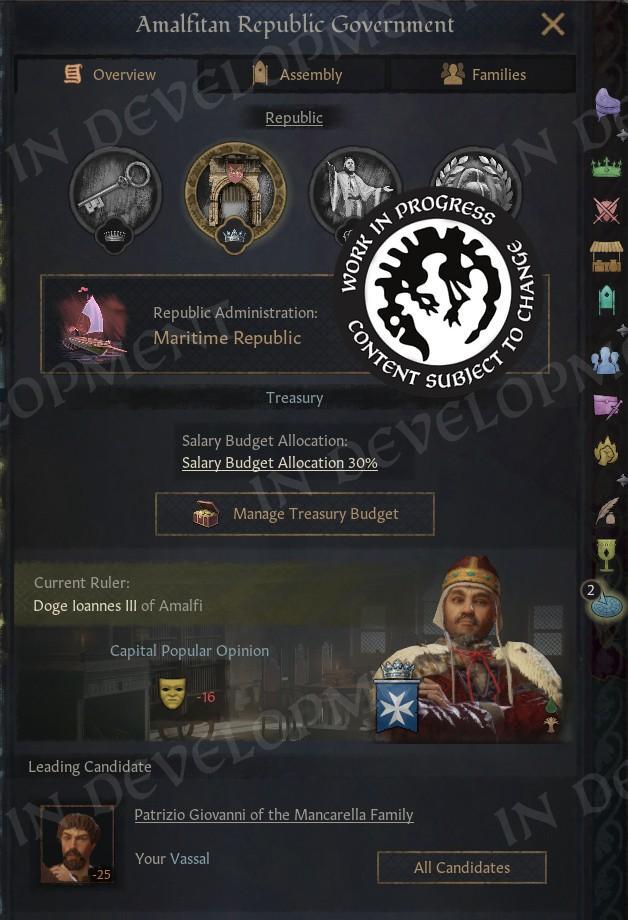
[Republic Government screen]

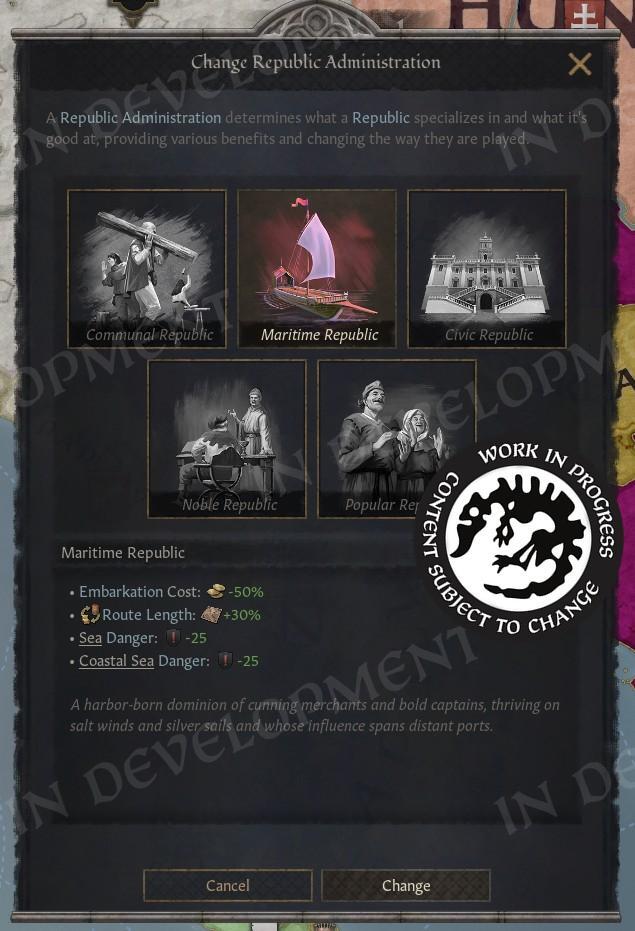
All Republics belong to the same shared Government Type, making sure that all Republics will have access to the same array of features and mechanics, regardless of where you’re playing. However, that doesn’t mean they’re identical; Republics have a designated Administration Type, allowing them to specialize in different ways and shift their primary focus. Venice, for example, quite naturally starts as a Maritime Republic, which is a type that can trade much further away than the others. You may change your Administration, but it’s rather costly to do so.
[Change Republic Administration window]
A worthwhile mention here is that County-tier Republics are limited to Communal Administration, which is a more basic type that provides fewer benefits than its siblings. Such County-tier Republics are subject to several other restrictions, such as a very constrained Domain Limit and their sole Patrician Family being that of the ruler. A Republic’s potential must be unlocked through growth, and the true extent of its power will become apparent only once it has reached the Duchy tier.
Which brings us to a Republic’s main type of progression. Republics don’t expand and create new titles like other Governments. They are meant to build tall rather than wide, and build tall well. They typically won’t be able to simply grab enough land to create new titles; instead, they dedicate their time and focus on their capital, focusing on making it grow and prosper.
As the capital increases in size, you’ll unlock the possibility to increase the tier of your Republic and gain new bonuses through a dedicated law in the Republic tab. This will directly affect how large your Republic can be by increasing Domain and Vassal Limits, expanding your trade capabilities, and more.
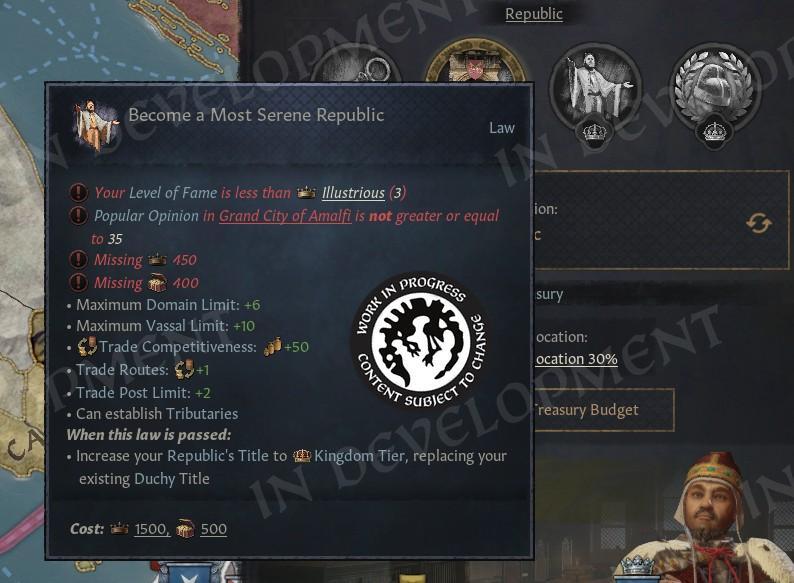
[Kingdom Tier Republic law tooltip]
Patricians do, of course, also have their Domicile. Which, unlike their capital and their realm, focuses on their personal progression. They make use of the same Company Domicile as their traveling Merchant counterparts, and will largely have the same upgrades available. Though there will be some Republic-specific upgrades that tie in to the other features that are unique to Republics, such as the Assembly.
Importantly, since they share the same Domicile type, they can transition seamlessly from one government to the other, without losing any progress or converting their Domicile into something else. We very much wanted to ensure that a Merchant has the option to fluidly and naturally join a Republic without suffering adverse effects for doing so. And, indeed, the opposite path is also valid: if you should grow tired of your Republic, you can choose to leave it and embark on the path of a Merchant instead, and your hard-won assets and upgrades will go with you.

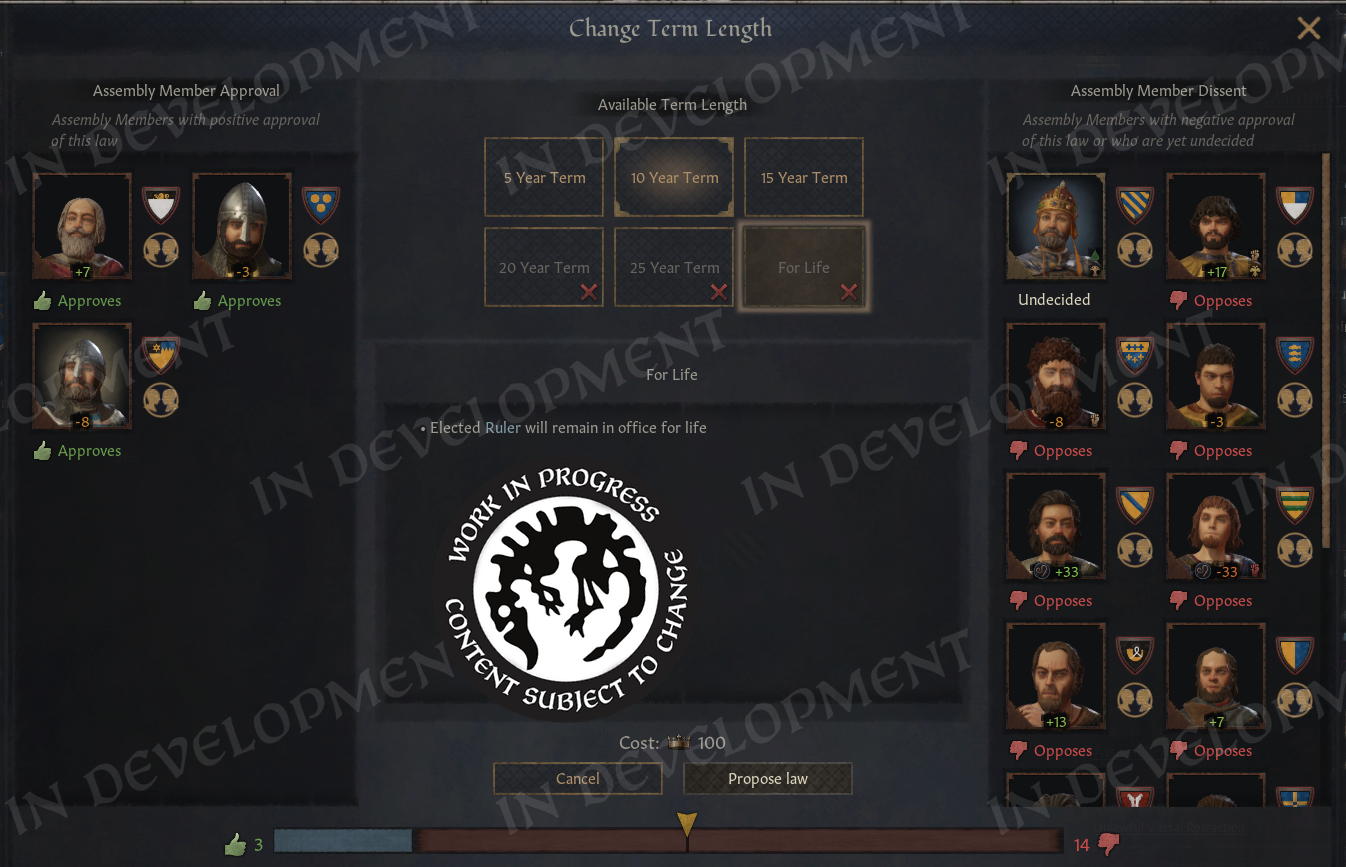
Republics are all about laws and bureaucracy, giving attention to minute details. They change more gradually over time than other government types. As such, they don’t make use of Crown Authority; but rather modify themselves through the different types of Administration and Tier laws, but most of the traditional unlocks, and effects you’d typically expect from Crown Authority are here spread out across a variety of granular laws. Want to be able to revoke titles from vassals? Gather enough votes and pass the law for that. Want to make revoking titles easier? Pass the law to make refusal treasonous.
We also have new laws. Several are attached to the Assembly, dictating who gets to be an Assembly member, what responsibilities the Assembly has, and how large a majority of votes is needed to pass Laws and Decrees. It wouldn’t be very republican if we also didn’t include laws pertaining to trade: one such example is the Subsidized Trade Goods law, which boosts the Expertise gained from trading in a particular set of goods.
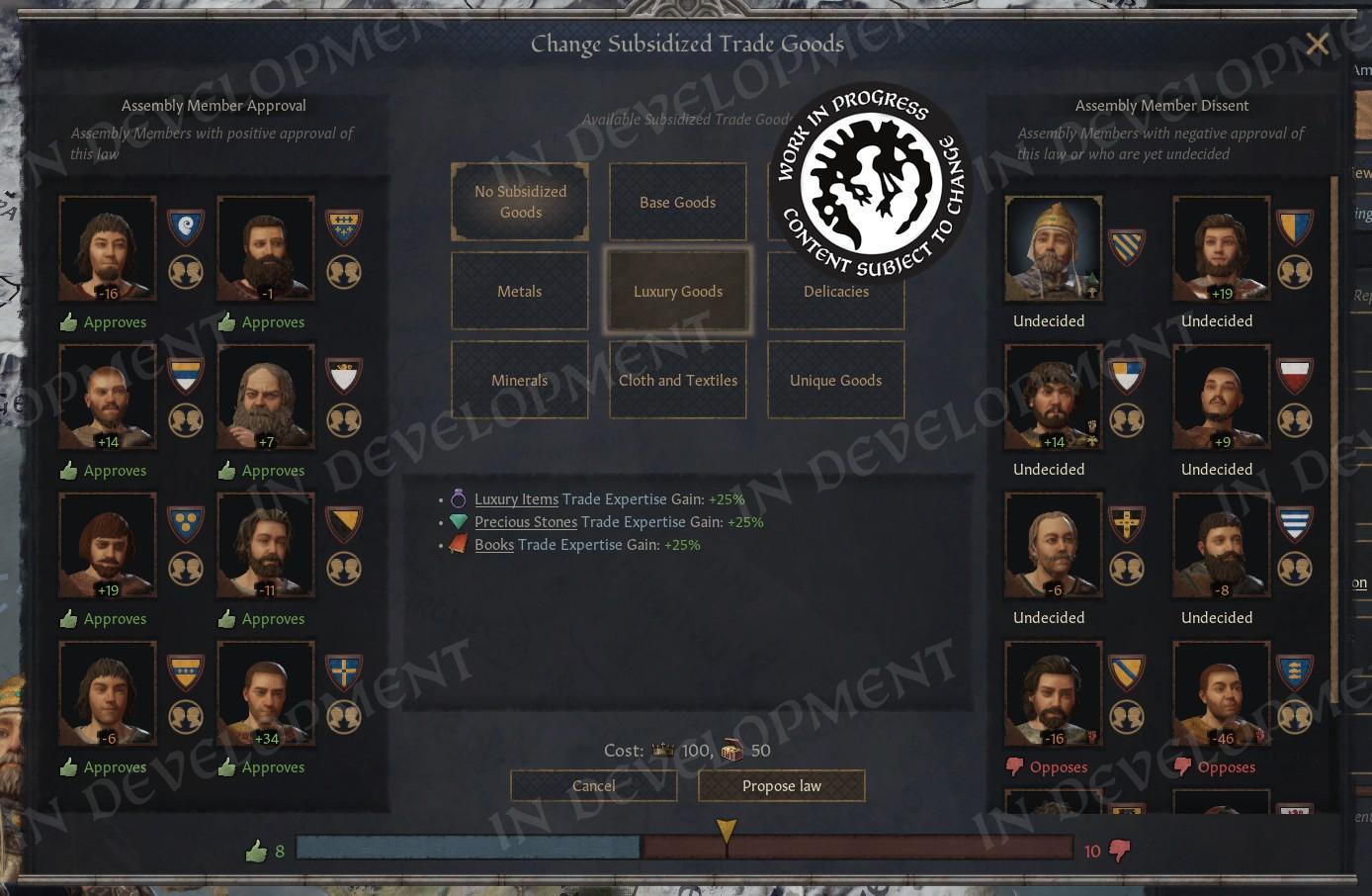 [Change law window with Assembly]
How an Assembly member votes will largely depend on their personality: what House Ambition they have, what goods they are trading in, as well as their opinion and House Relation of whoever started the vote (no sane citizen would obviously approve anything suggested by the Dandalo family…).
A final note about laws: a small, yet very flavorful, addition is that a ruler’s title is very much based on what type of laws the Republic has enacted. Adopt laws that steer the Republic towards a despotic realm, where you and your family alone may rule, and your title will change accordingly. You’ll no longer be called Doge (for example), but Prince.

For those of you who read the previous Dev Diary about Republics, you may recall that House Ambitions are a type of attribute that expresses how a House wants the Republic to be governed. It is what the House considers important in the grand scheme of things. They are reminiscent of Aspirations in Japan and China, or Mandala Aspects, but there are several key differences.
Unlike their counterparts, Ambitions are heavily tied to the House’s Patrician Rating. Essentially their standing within the Republic decides how powerful an Ambition is. The greater the Rating, the higher the level your Ambition can reach. When you have the requisite Rating, you won’t have to worry about purchasing the next level. Ambitions automatically increase (or decrease) in level in response to your Rating.
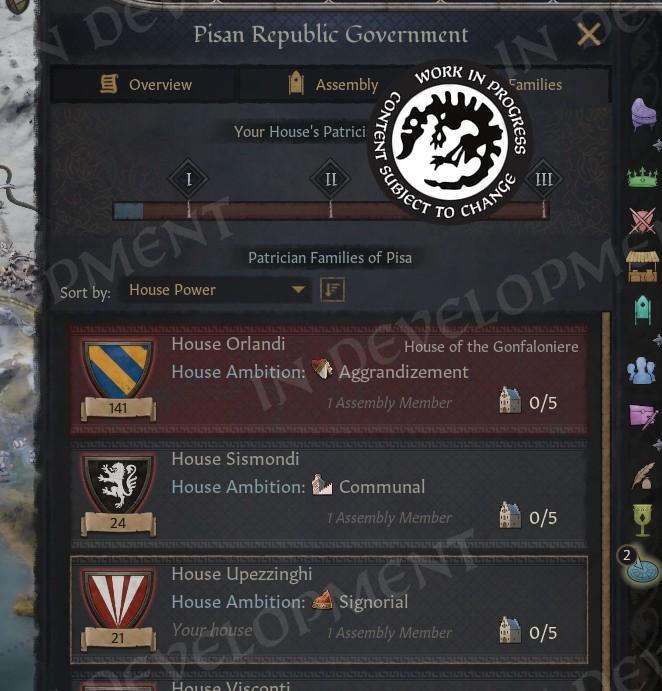
[Patrician Family screen - Showing Patrician Rating and Patrician Houses]
Better Ambitions are not the only benefit you’ll receive. A high Rating provides improved salaries, increased acceptance in interactions, unlocks decisions, and more.
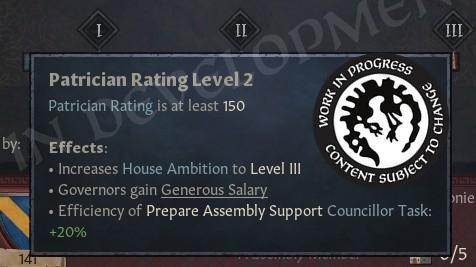
[Patrician Rating Level 2 tooltip]
Engaging with politics is the main way to improve your Rating, such as securing Council Positions or becoming an Assembly member. Trade income is another important source. Some interactions will even let you bargain your Rating, to give or receive support from another Patrician. This shifts some of their score to the other House in favor of making the supported Patrician accept the interaction. Very handy when you need to secure that final vote to have a law approved by the Assembly.
There are five of them to choose from: all provide a set of thematic benefits, and you may change your Ambition at any time.
Commerce - The family focus (and that of the Republic) should be all on trade, bringing prosperity and well-being
Aggrandizement - Family glory and self-fulfillment, holding key positions within the Republic is important to this House
Communal - Governing a Republic is not a privilege, it’s a responsibility these Houses take very seriously
Signorial - A Republic should be ruled by the elite few, and will do anything to move the Republic towards despotic rule (under their benevolent leadership, of course)
Agitation - These are the disgruntled Houses, whether it’s because of them disliking the current ruler or greatly dislike enacted laws, they’ll use any means necessary to bring about change
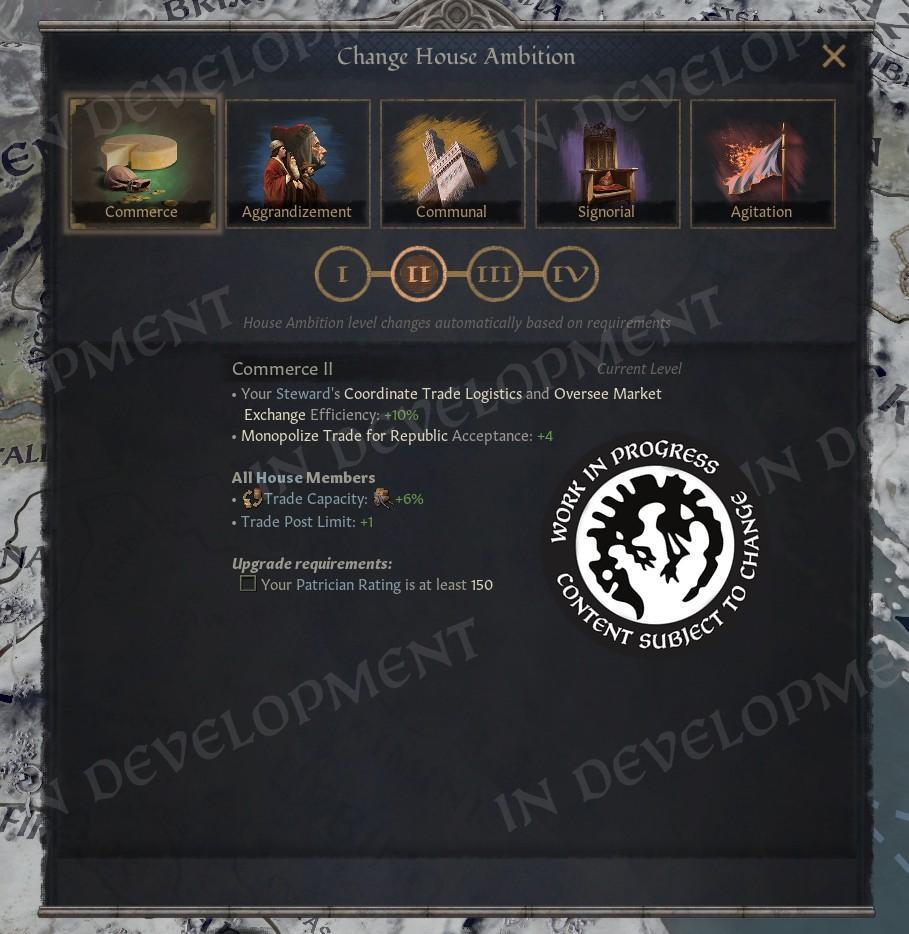 [Change House Ambition window - Commerce Ambition]

A capital ought to feel special for Republics. It’s where the government and the patricians and their domiciles reside. As such, being the wealthy and magnificent patricians that they are, it only makes sense to have more ways to improve the capital, spending some of that gold for the greater good of the Republic. Patricians might compete with each other, but they should also have a sense of cooperation.
One such tool is the new Civic Works Great Project. Which is a repeatable project that allows you to spend any excess gold to splurge on the capital. It provides a great deal of Popular Opinion and Prosperity Growth. Depending on which optional contributions are funded, the capital will also enjoy additional county modifiers for the next decade, greatly increasing Settlement Size, Control gain, and more.
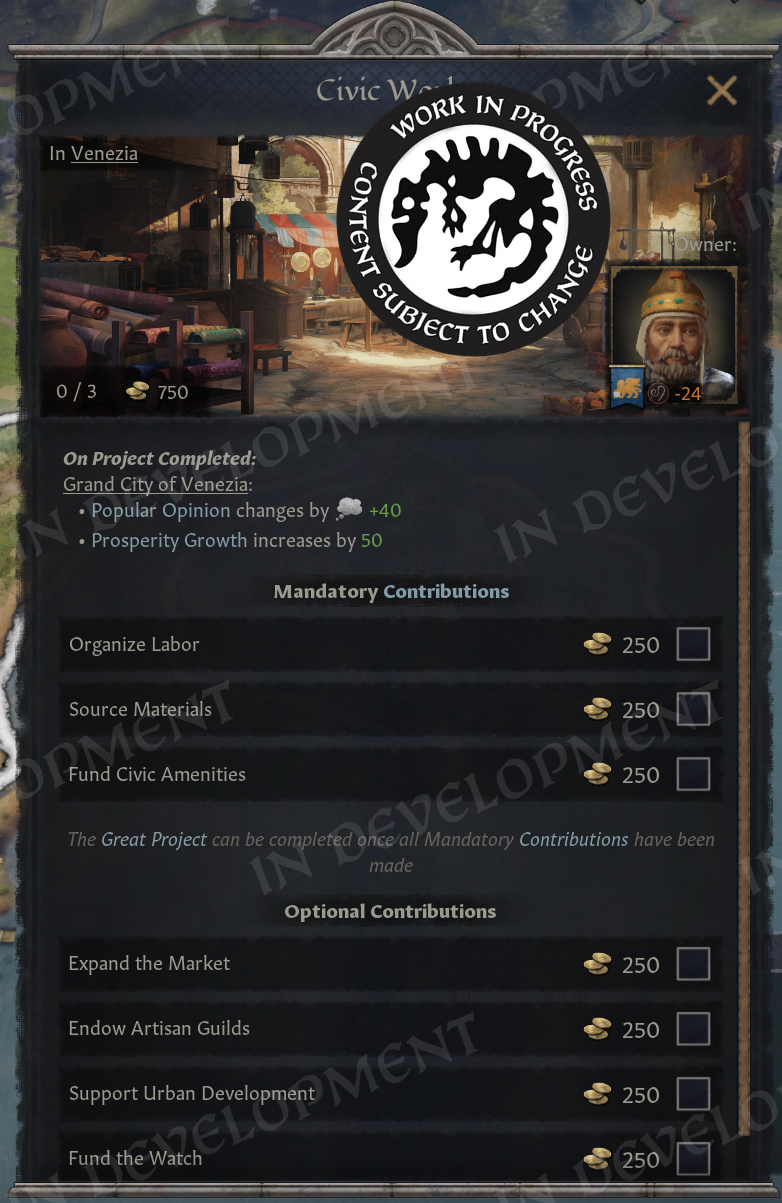
[Civic Works Great Project window]

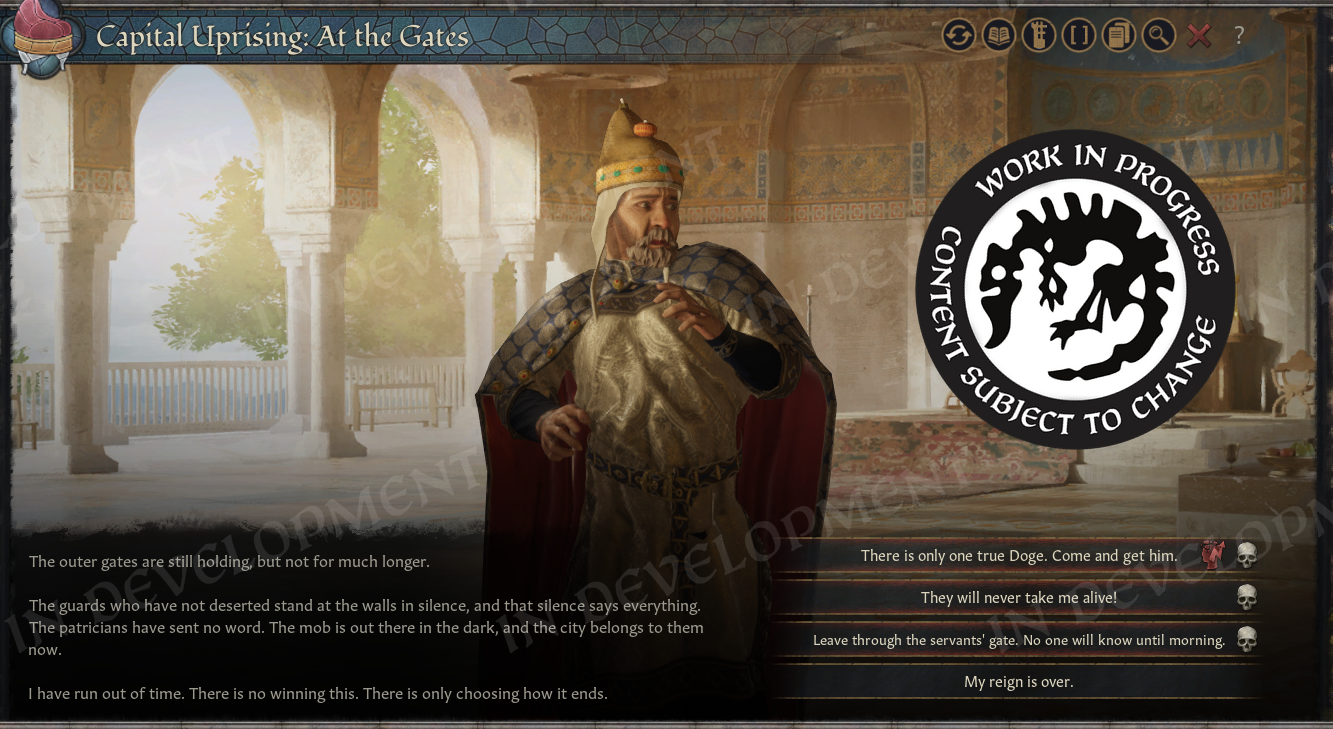
Your capital’s Popular Opinion in particular is of significant importance. When the capital has low Opinion, a new faction may appear, called Capital Uprising. Its discontent scales with current Opinion, making it go up faster when the level is lower. It can be offset, to some extent, by making sure the capital has a high level of Control. Nevertheless, once the faction forms it will act as a sort of looming doomsday clock, constantly ticking progress towards sending demands unless Opinion should rise and become positive.
When sending an ultimatum, the faction will not immediately go to war. Instead, you’ll be greeted by an event. The exact situation itself can vary (the mob is unpredictable), but will typically present different options to appease the disgruntled populace.
Success might increase Popular Opinion a bit while reducing the faction’s discontent, buying you time to increase Opinion further. The event is less an ultimatum and more akin to the citizenry reaching a boiling point where something happens. The severity of the event scales with the capital’s Popular Opinion. If Opinion is really low, expect the consequences of the event to reflect that in their severity.
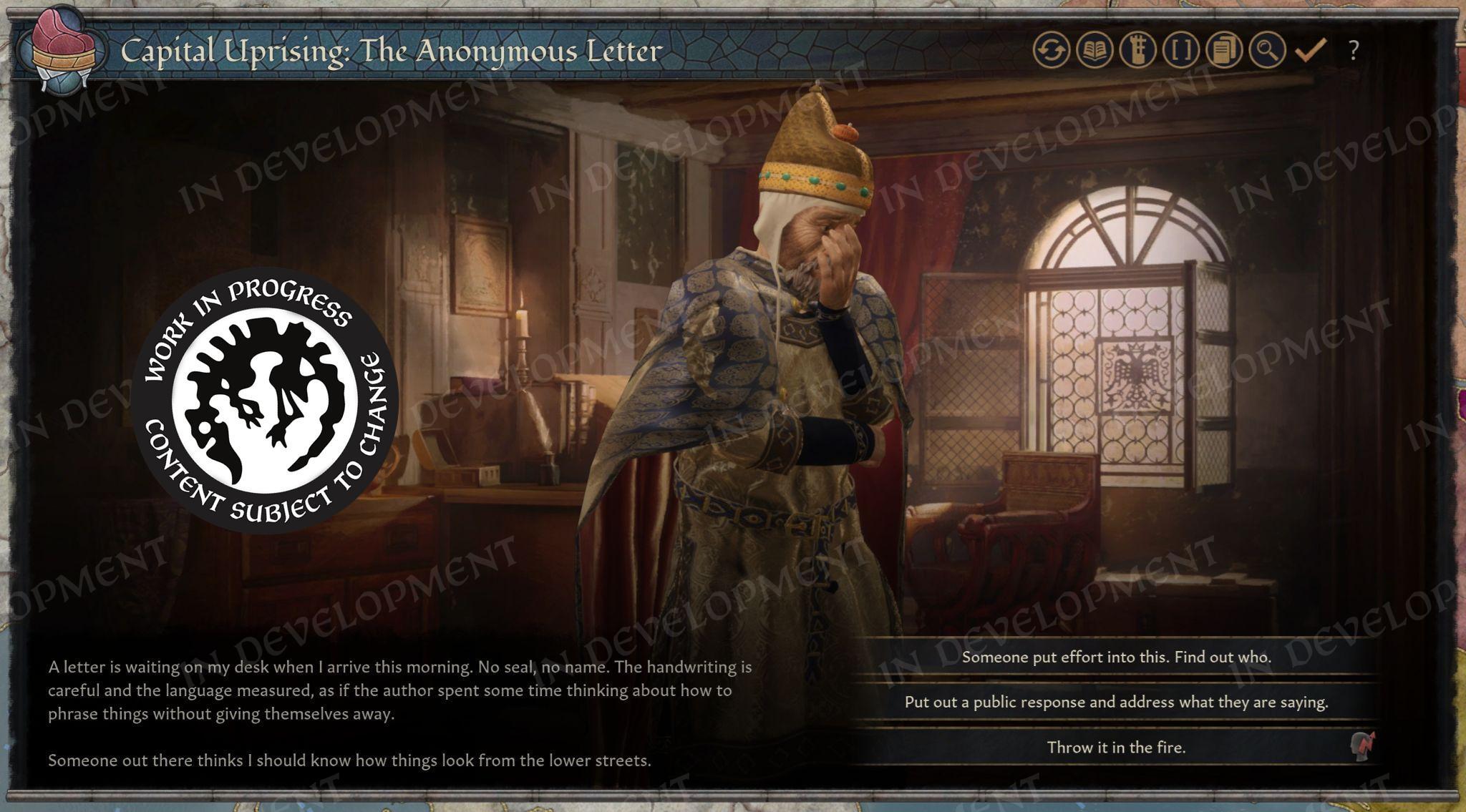 [Capital Uprising faction demand event - The Anonymous Letter]
As long as Popular Opinion remains low, the faction will persist, and discontent will continue to grow and repeatedly present various situations until Opinion once again becomes positive.
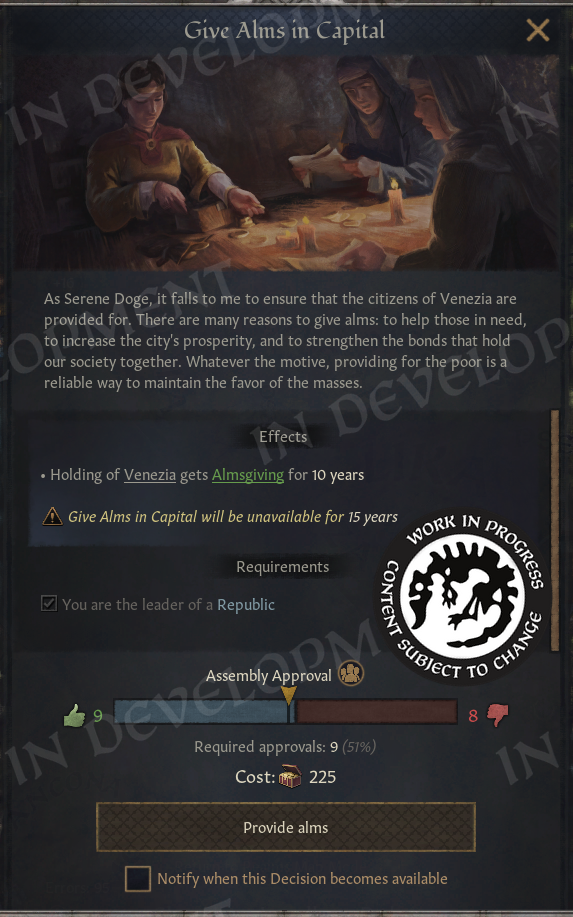
To combat low Popular Opinion, several tools are available to you. Some buildings exist that will increase Opinion, as well as new decisions where you can spend your hard-earned currency to appease the capital’s populace. For example, if you can manage to get the approval of the Assembly, there are Decrees that will increase Opinion by spending the state Treasury.
Most laws will also have an impact on Popular Opinion. Moving towards despotic laws will lower it, while the opposite will have a positive effect (the people want to have their say, after all). How the Republic is governed has a direct impact on public perception.
Not all is doom and gloom, however. At higher levels of Popular Opinion, you’ll be rewarded with access to special decisions and may receive positive effects applied to the capital county, similar to the beneficial side effects of Council Tasks. The former may allow you to gain temporary boons in exchange for lowering Opinion, while the latter can provide a range of benefits to the capital, such as increasing Trade capabilities, providing Control, improving Prosperity, and more.
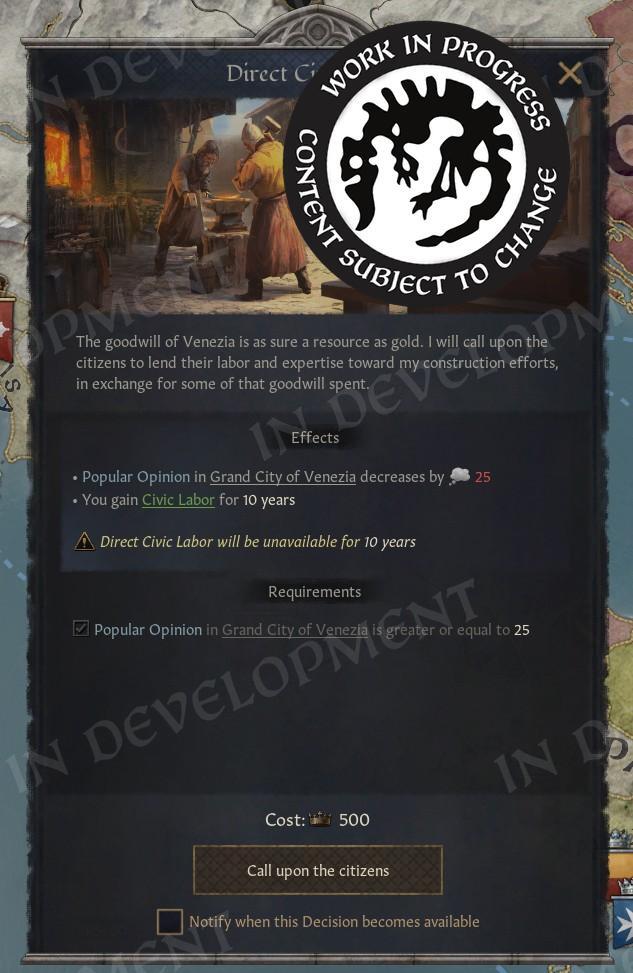
[Direct Civic Labour Decision]

As a quick refresher, Trade Posts are districts uniquely available to patricians that can be built in all counties, and not just the ones you control yourself. Depending on what your Trade Routes look like, you are likely better off constructing them in a county you don’t own, as long as they are connected to a market where you are trading. They allow you to manipulate the local trade in various ways, such as affecting buy and sell prices to your own benefit. Some buildings have considerably more material effects as well, such as unlocking the ability to recruit Cultural Men-at-Arms belonging to the local culture.
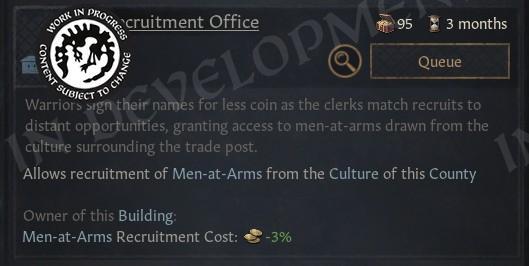
[Trade Post Building - Recruitment Office]
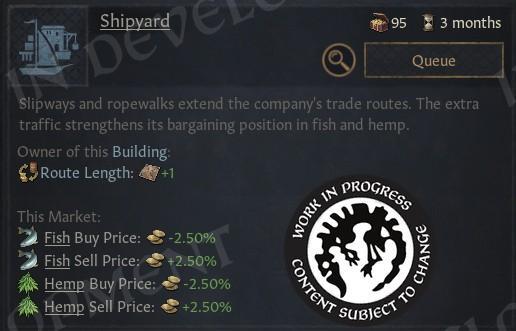
[Trade Post Building - Shipyard]
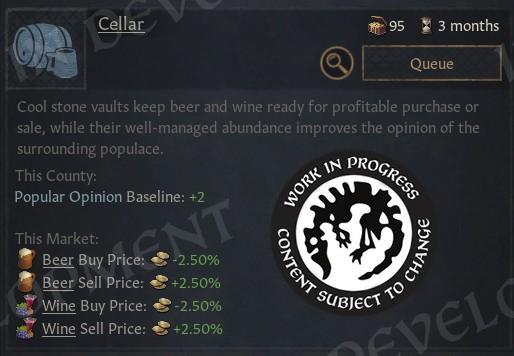
[Trade Post Building - Cellar]
Another interesting aspect that we’ve added recently is the ability for Trade Posts to act as a starting point for your Trade Routes. This gives patricians a significantly improved range and a greater distance at which they may engage in trade. Trade Posts can be constructed in counties that are within your diplomatic range, meaning that you can potentially have Routes ferrying goods back and forth across vast distances indeed.
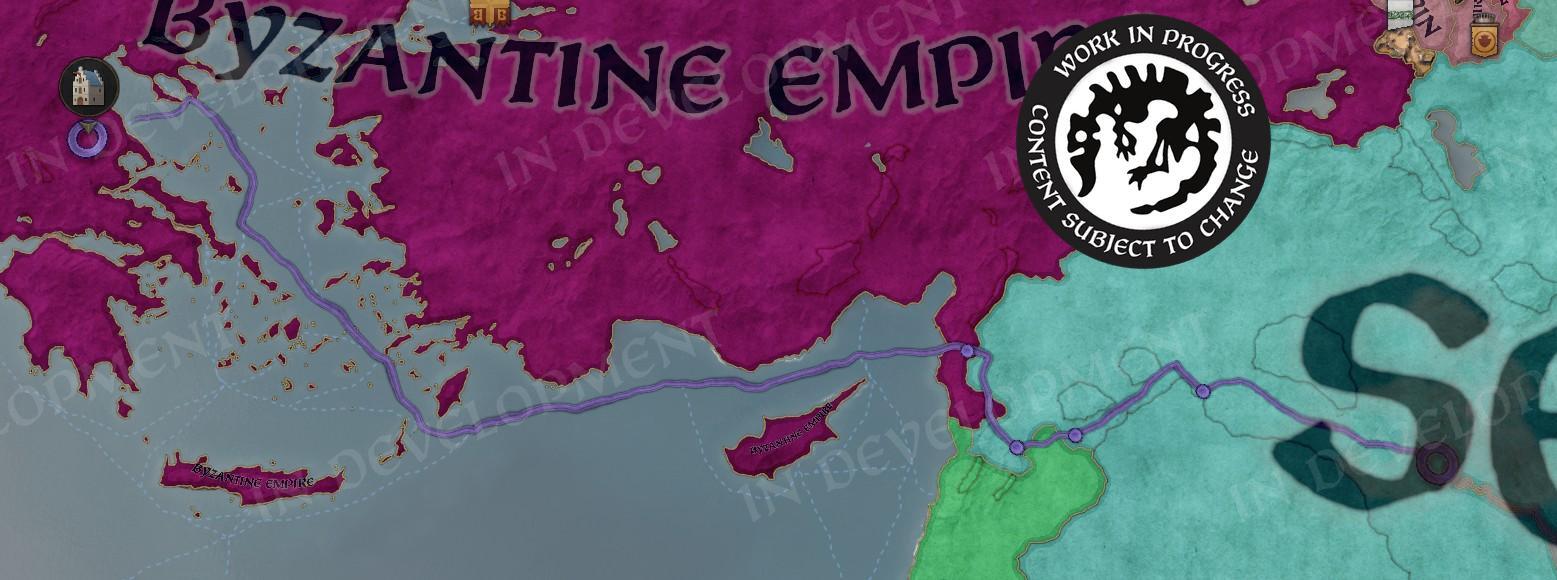 [Trade Route starting at a Trade Post in Thessalia running to Baghdad]
Counties can only have a single Trade Post. Does that mean it’s a race to get the ones you want, you ask? To some extent, yes. If you have the gold available, you can construct a new Trade Post in any available slot. Fortunately, there’s a number of tools available to make Trade Posts change hands. First and foremost, you can persuade a county holder to transfer a Trade Post directly to you: no strings attached. Opinion is an important factor here, but you can always spend any hook you might have or offer a bribe to make them see things your way.
Failing that, you can always put your Intrigue to good use and attempt to steal the Trade Post. Completing this scheme successfully will transfer ownership to you, granting you free rein to keep any buildings or replace them to better suit your own needs.
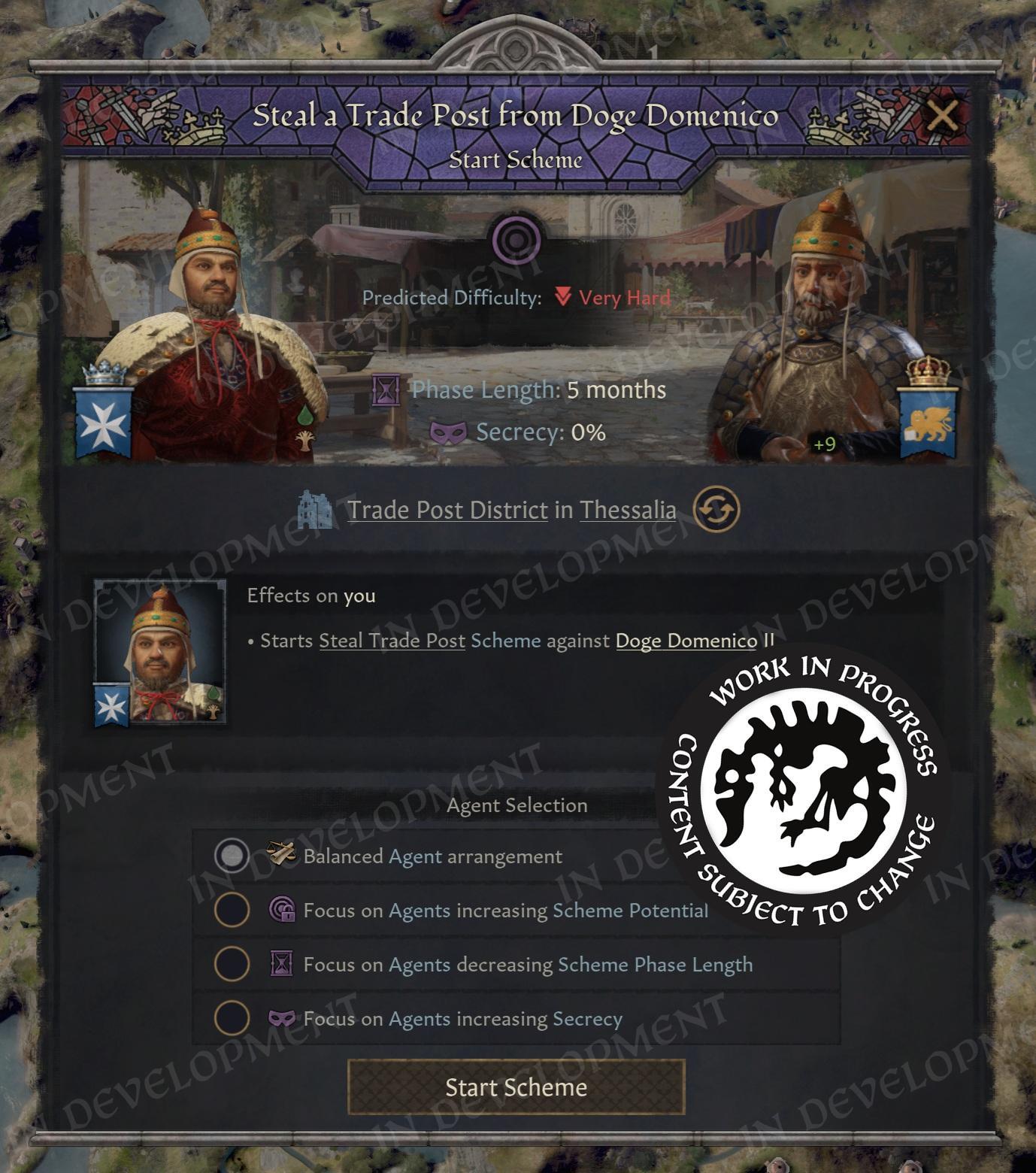 [Steal Trade Post Scheme]
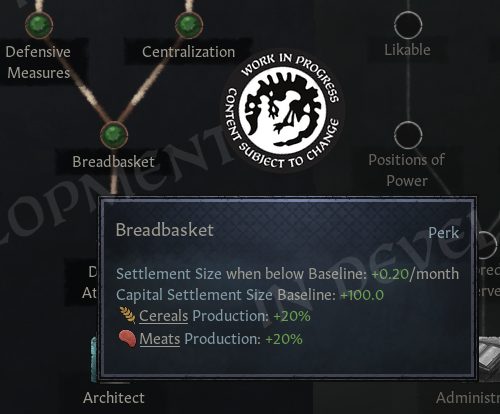
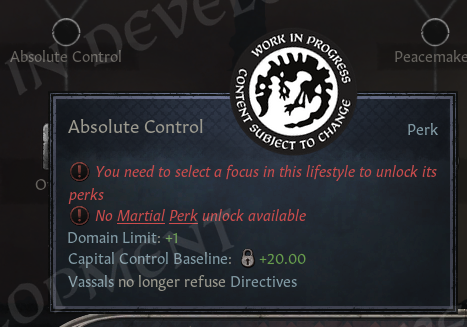
You do have a limit on how many Trade Posts you can own at any given time. Forcing you to consider where your Trade Posts will be the most useful, increasing your profit as much as possible. The limit will primarily increase with the aforementioned tier progression, but other sources include Cultural Traditions, Lifestyle Perks, and a new Dynasty Legacy. Similarly to Domain Limit, you can go above your Trade Post Limit, but doing so will incur penalties. Being at or above the limit will prevent you from actively acquiring more Trade Posts, but if you somehow manage to get an additional district, you’ll have the flexibility to choose which one to get rid of.
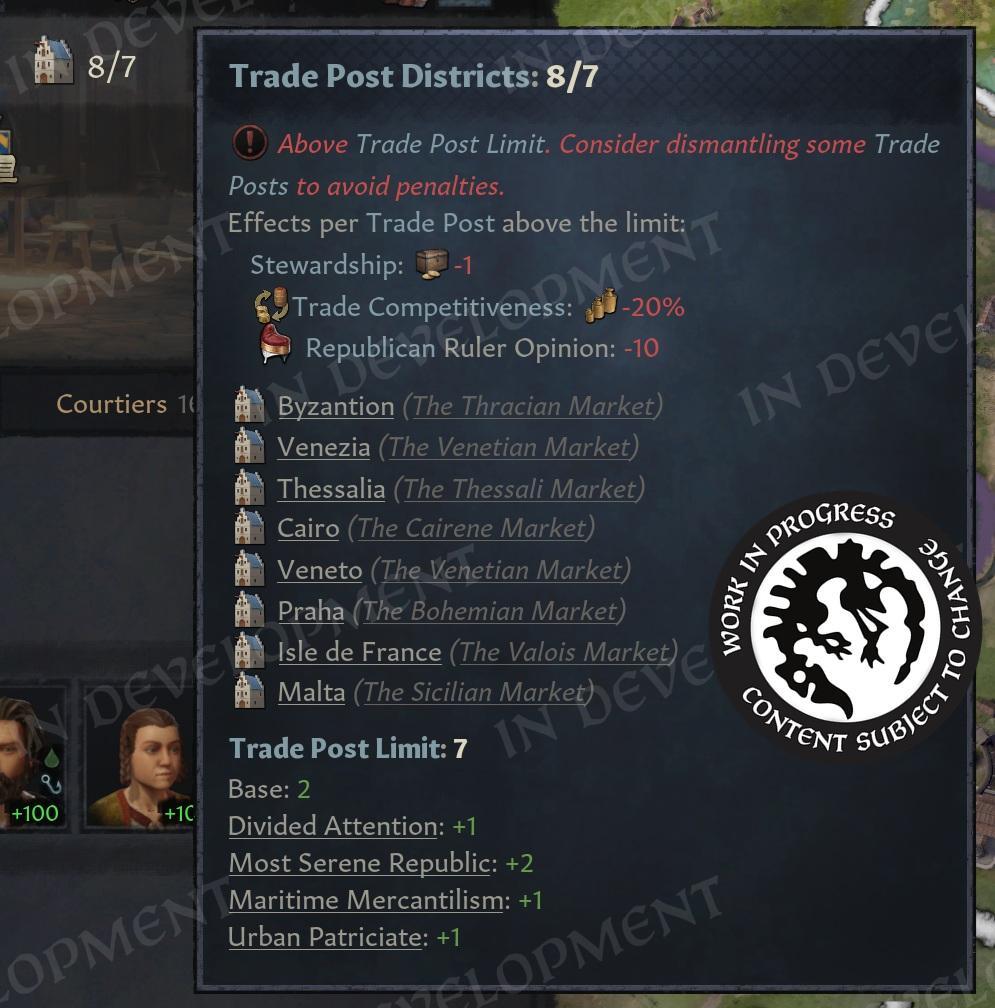 [Trade Post and Trade Post Limit tooltip breakdown]
As mentioned, Republics are less about expansion than other forms of Government. Trade Posts can, however, act as a means of acquiring more land. When a Republic owns a Trade Post (held by any of its patricians or the ruler), they gain access to a special CB — Conquer Trade County. While its range of potential targets is limited, being restricted to neighboring or coastal counties, it allows Republics to seize small strips of land in key locations, simulating historical expansion such as Venetians taking control of important Greek islands or the Genoese establishing a foothold in Crimea.
Trade Posts are not merely a trading tool. They are opportunities.

Thanks for taking the time to read through this slightly longer dev diary on merchants and republics. For the next 2 weeks, the Dev Diaries will focus on By God Alone, and then we will (most likely) be back in about 3 weeks, talking about Economy and Building Rework. If you have any questions, feel free to leave them down below, and we will see if we can get to them.
Have a nice week, everyone.


 [“Before” performance capture loading the game to the main menu in the current release at 84 seconds]
 [Average day duration by category over 100 years]




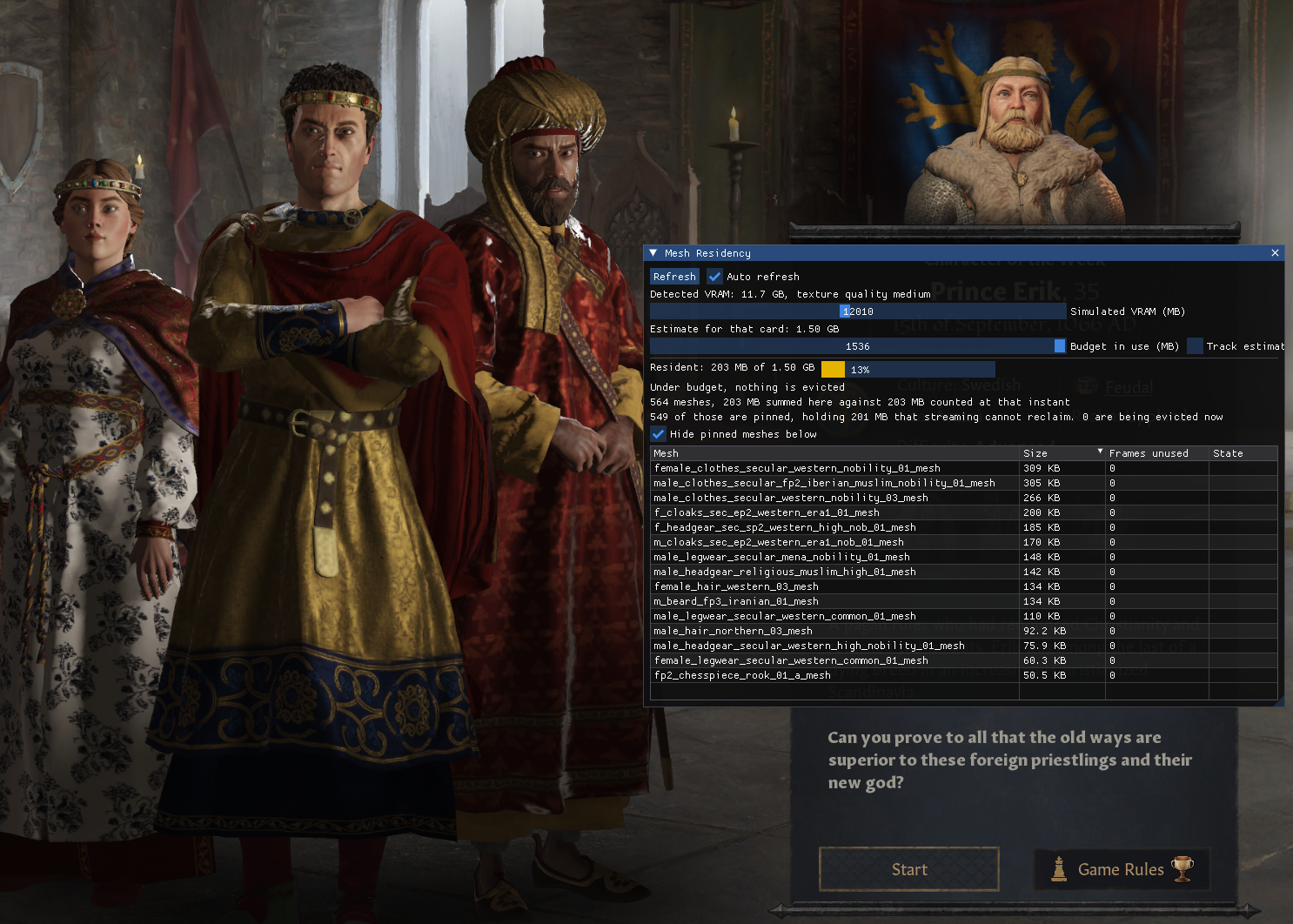 [The Mesh Streaming debugger: what is loaded, how long since it was last drawn. This is only for internal builds of the game.]
 [A visual video memory explorer we added to track down usage]

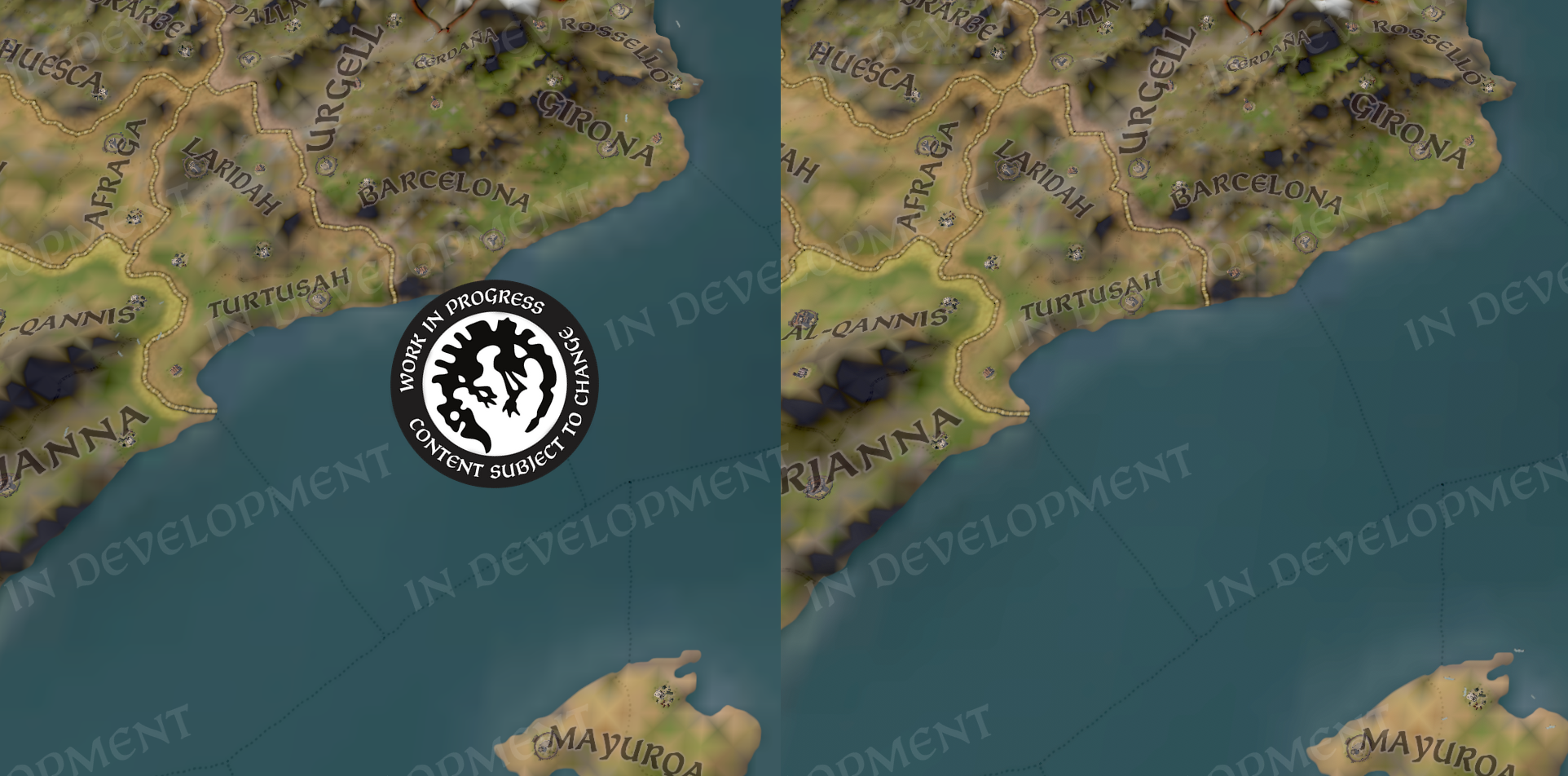 [Before and after: the map at the reduced memory footprint]








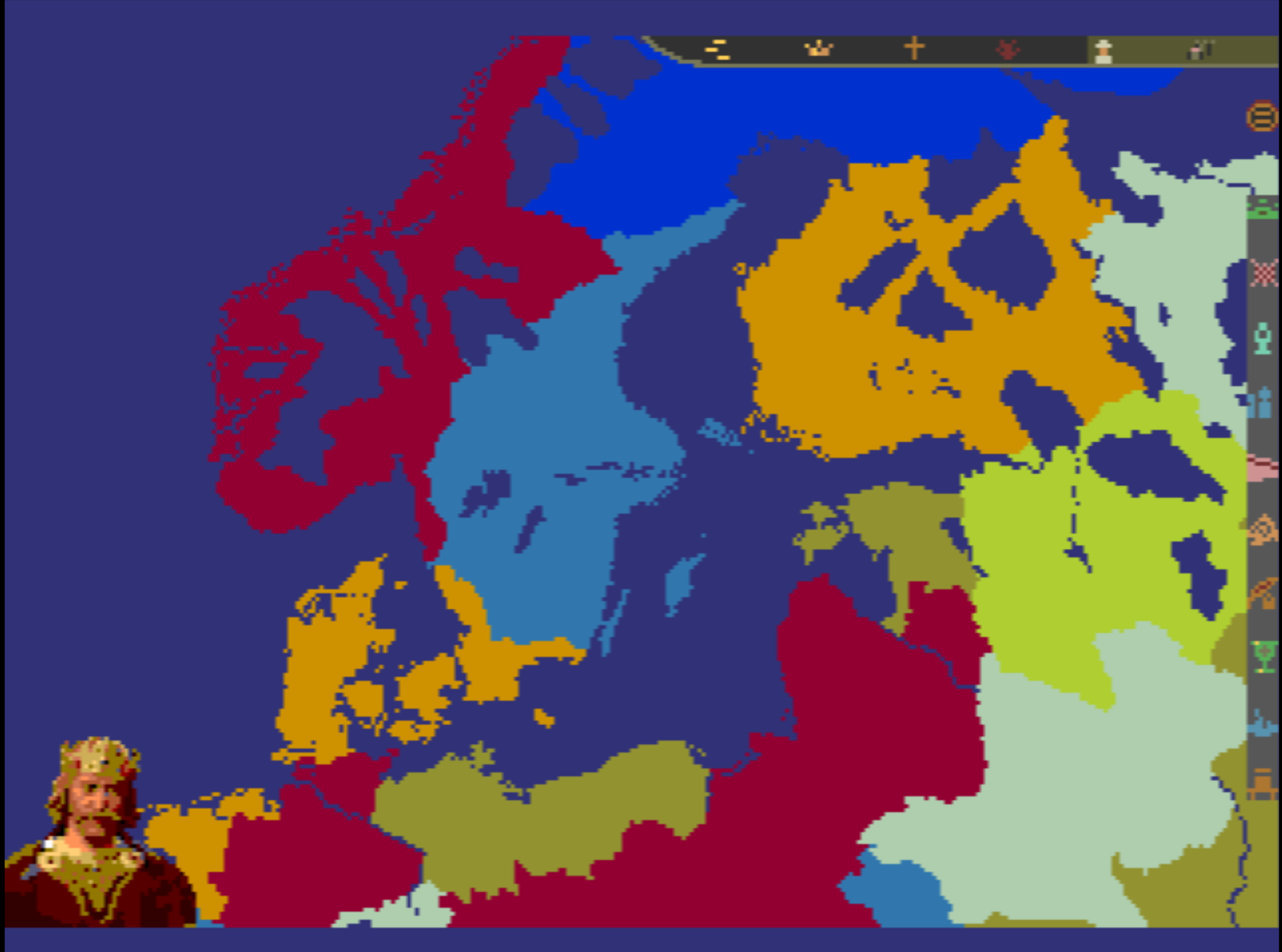 [Mega Crusader Kings, running in an emulator. The map is real CK3 data]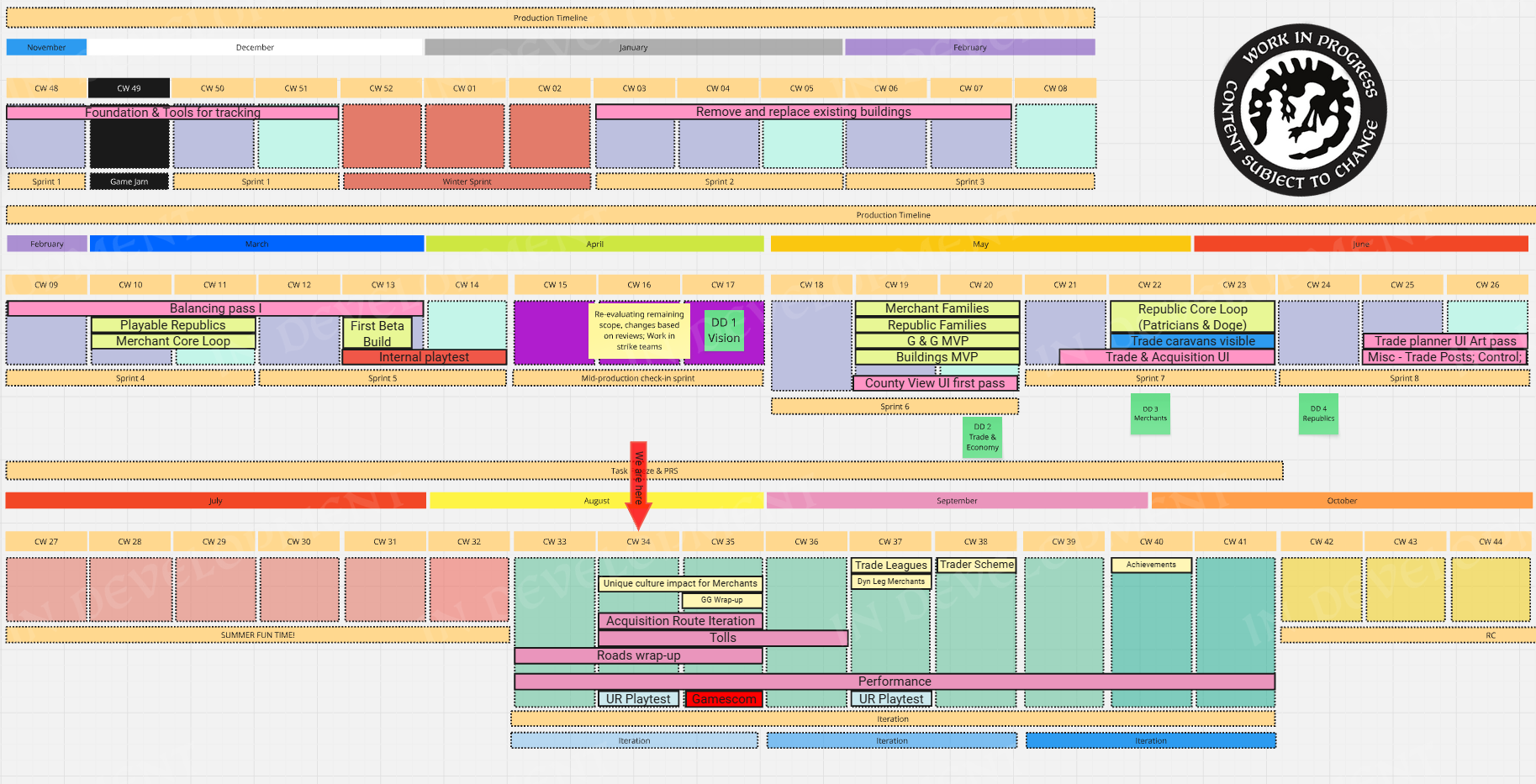








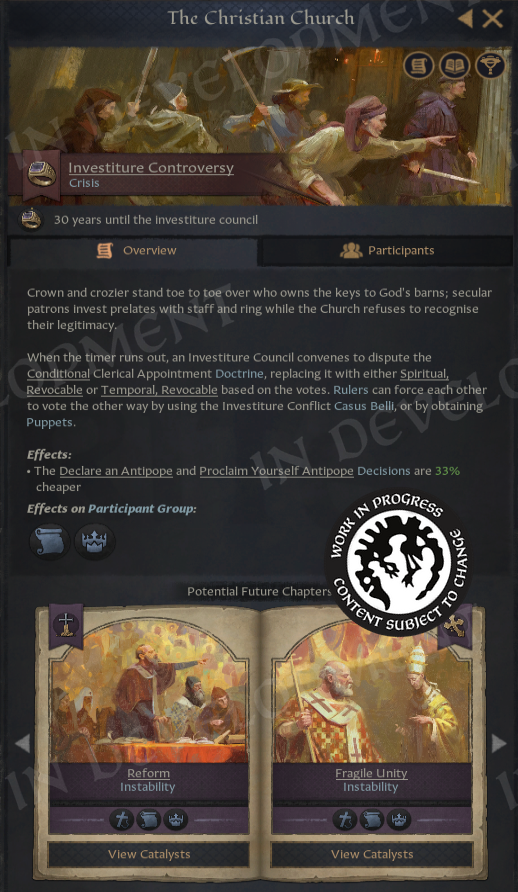
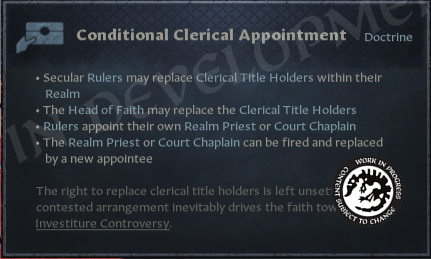
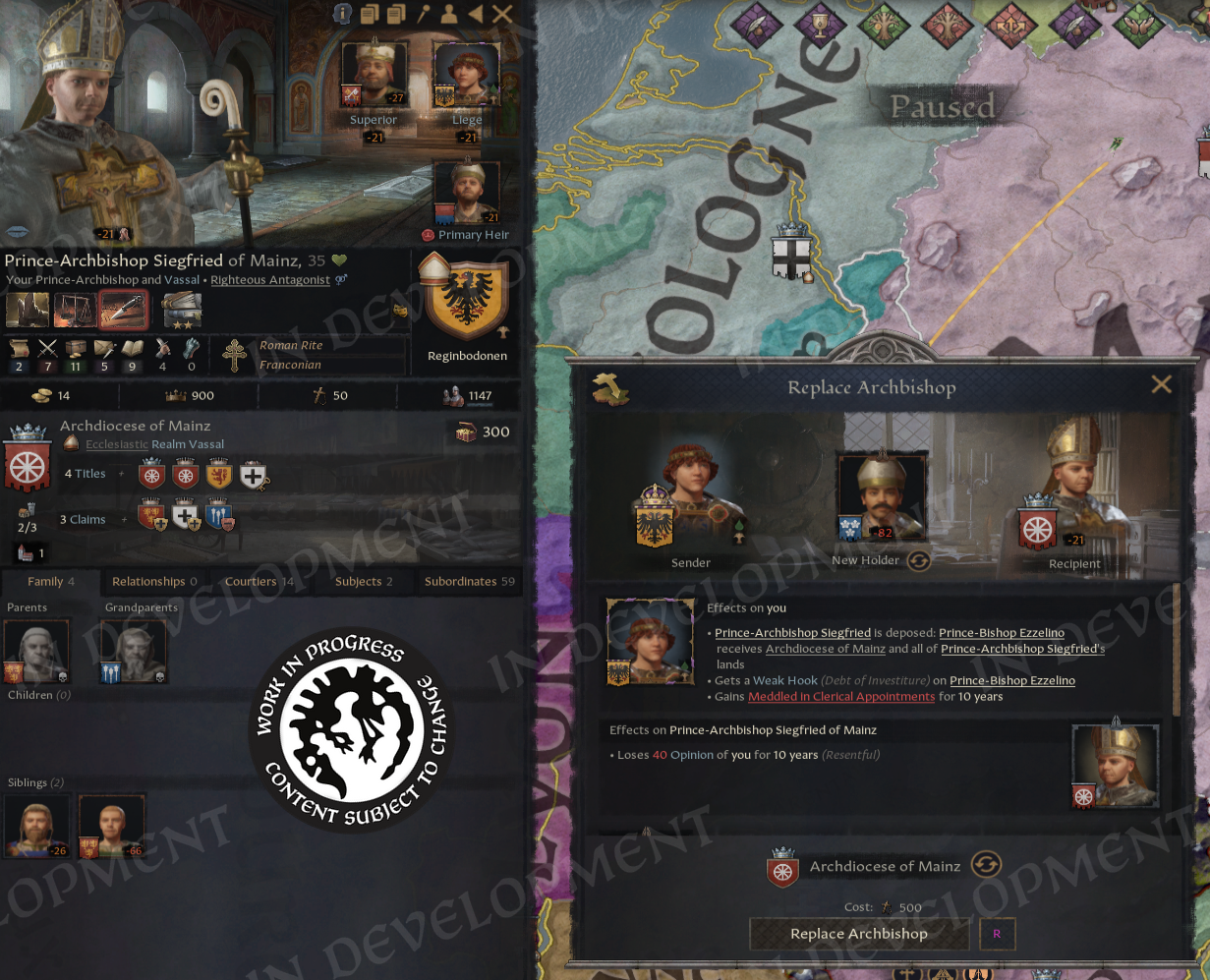
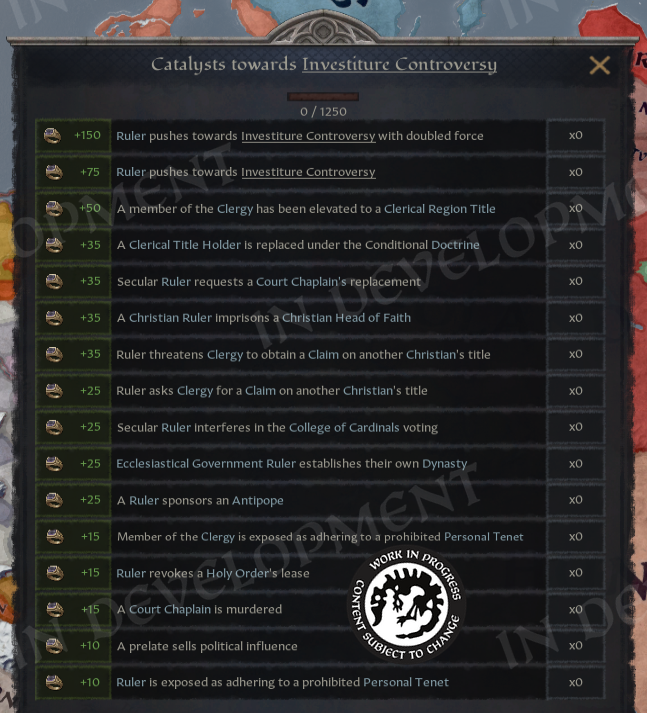

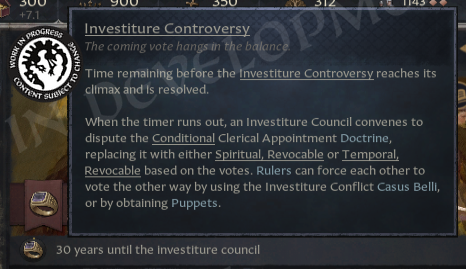
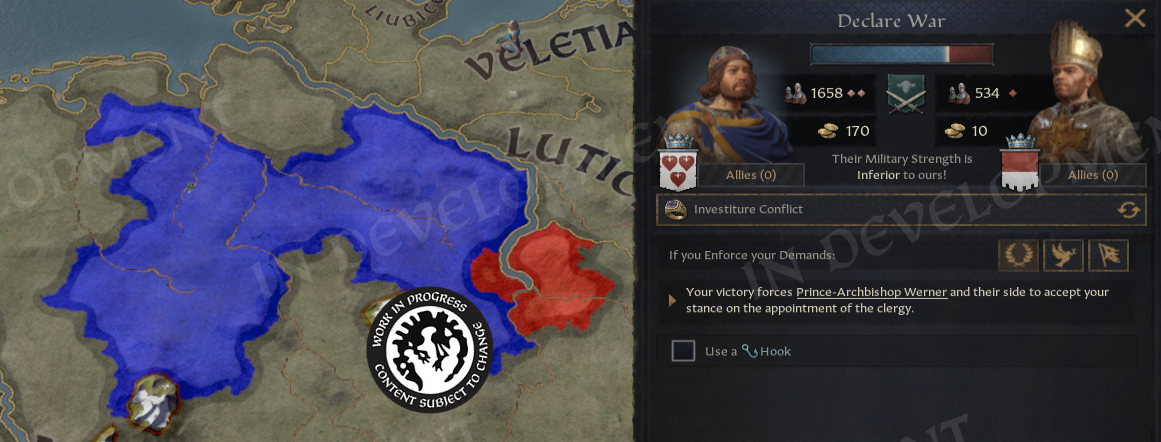
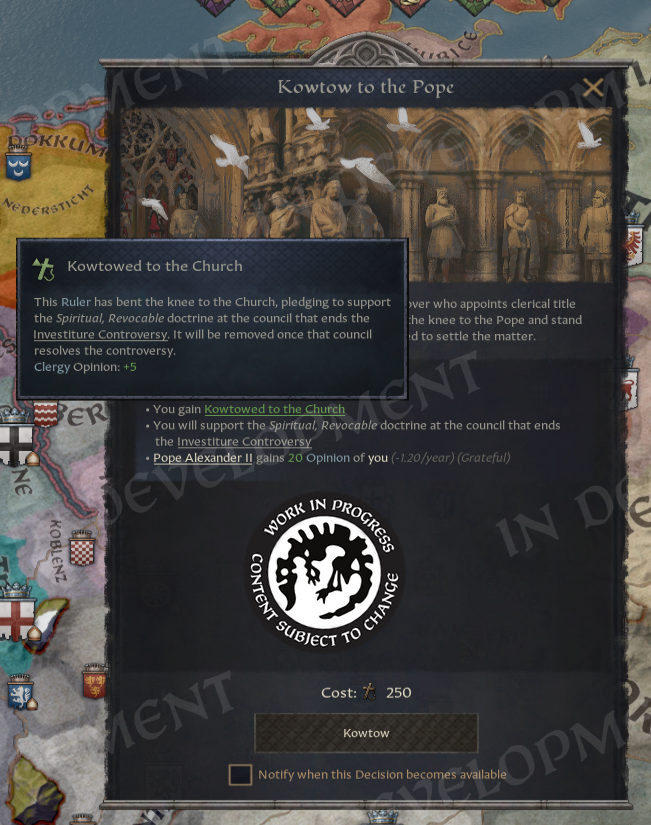
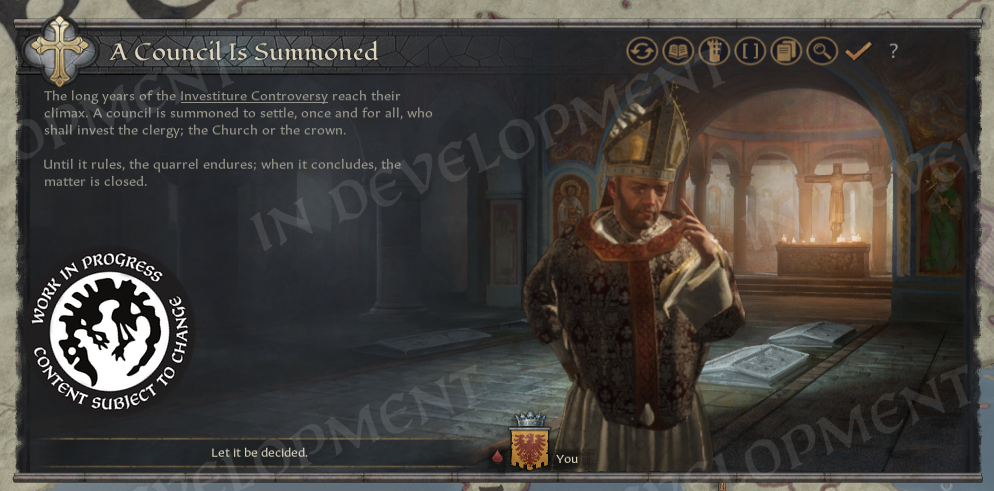
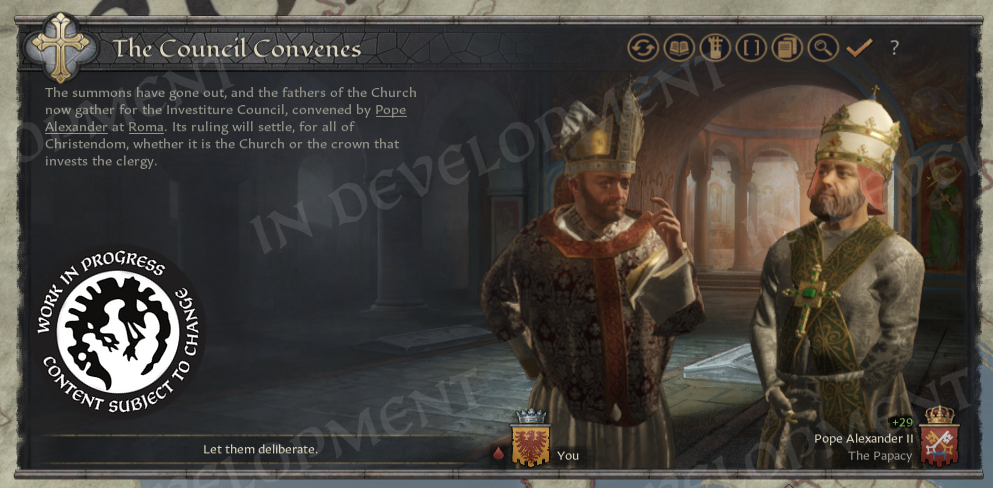
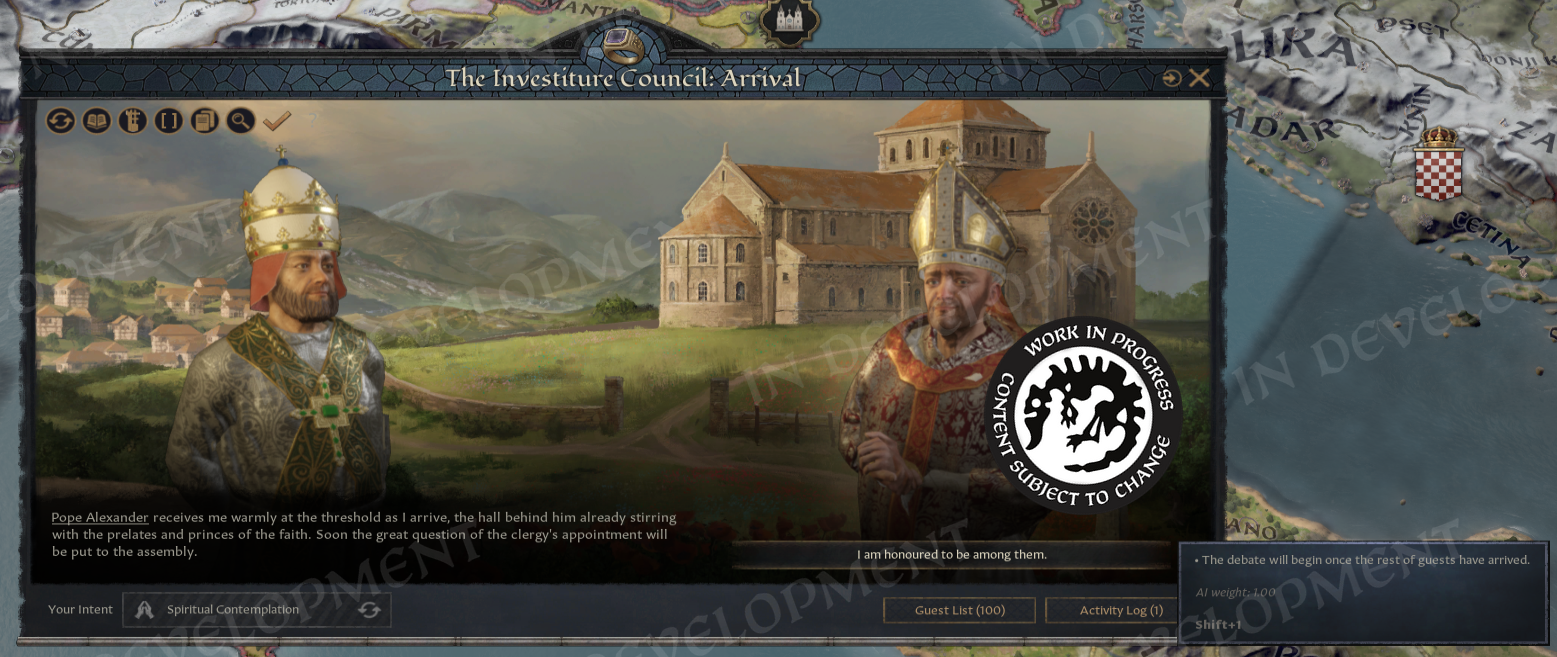
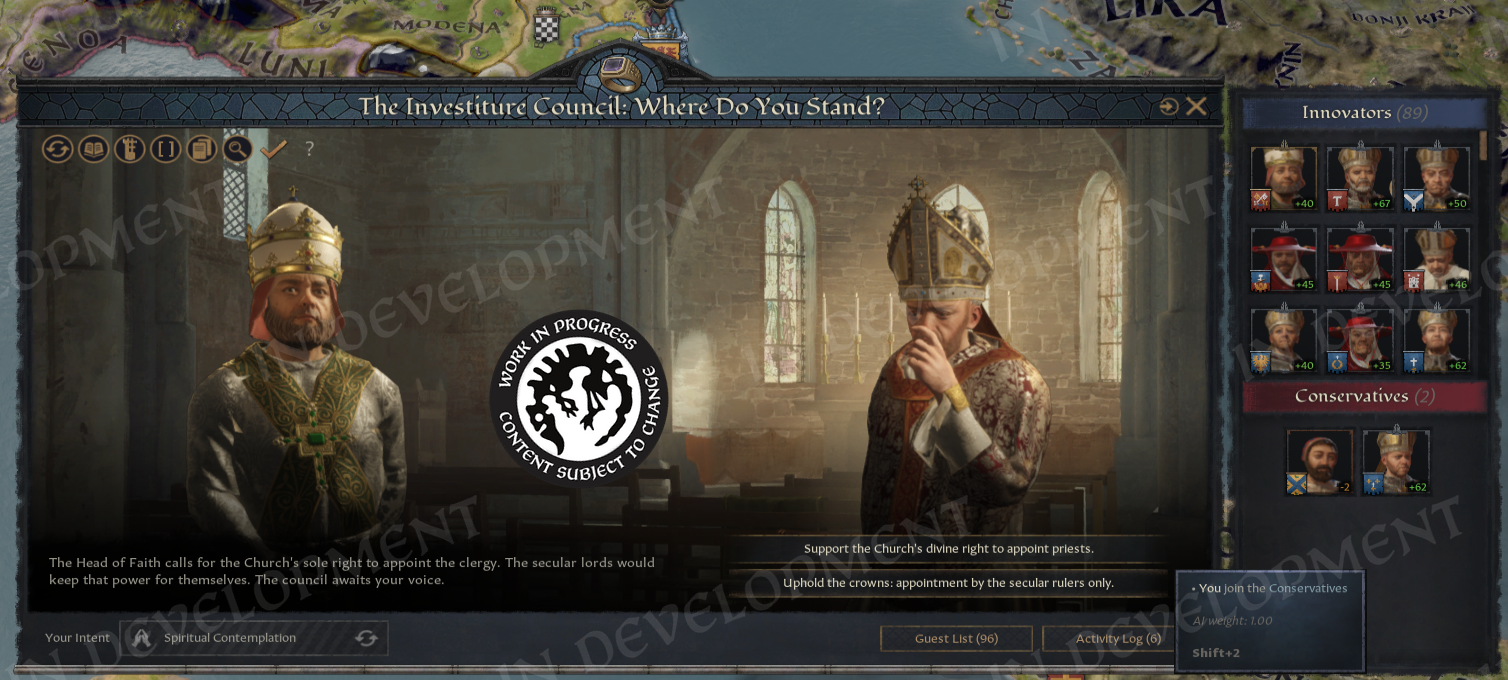
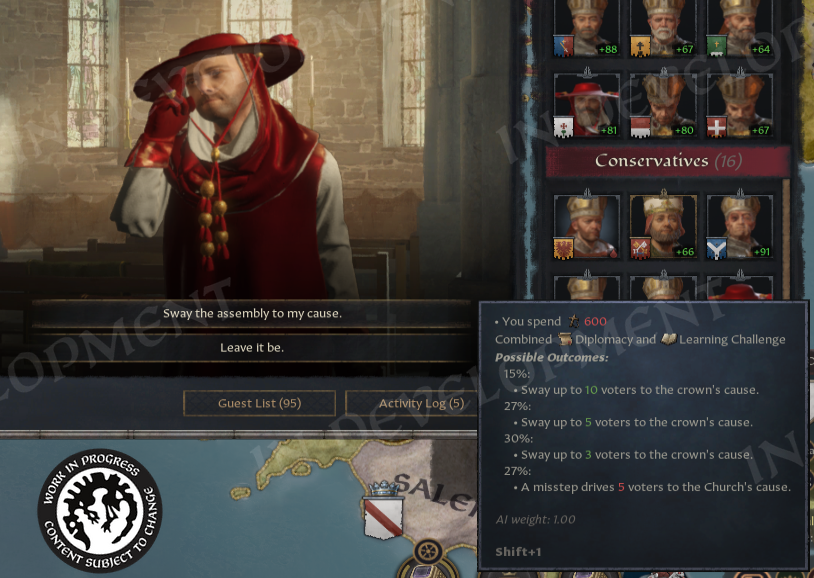

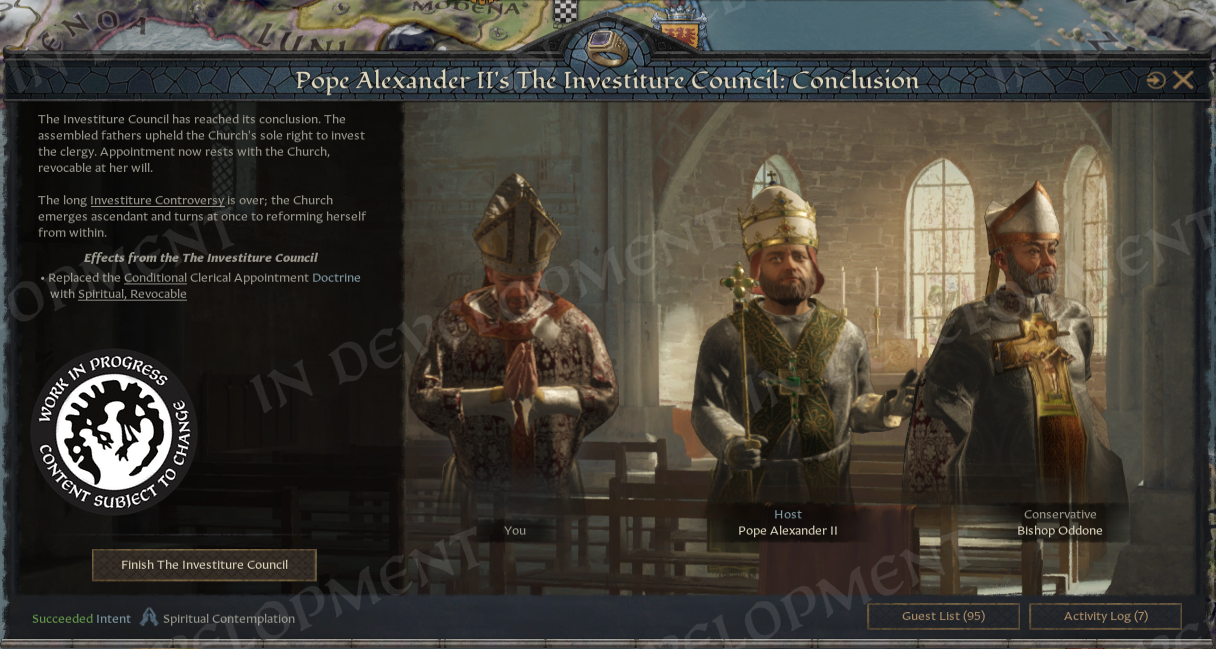

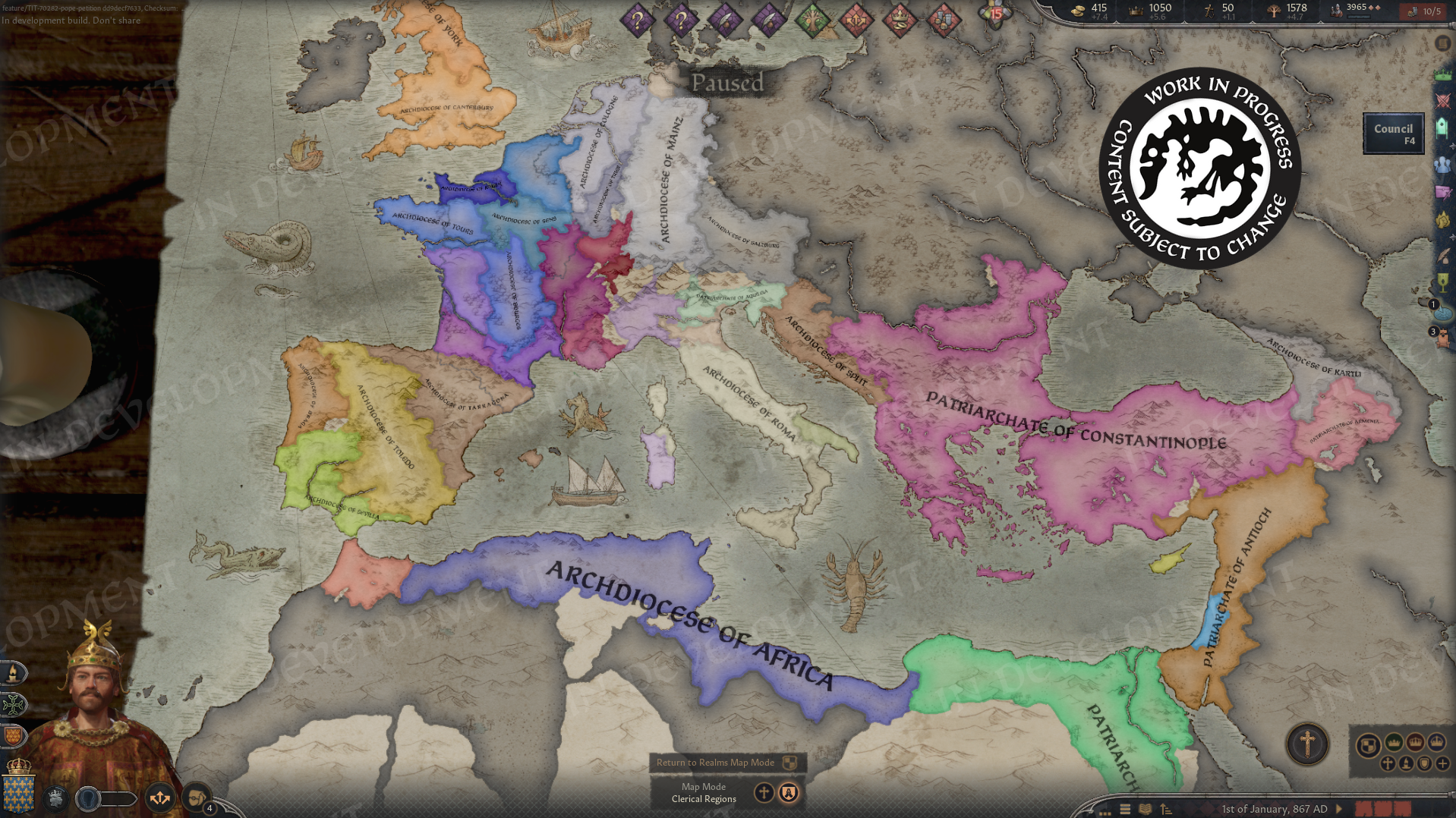
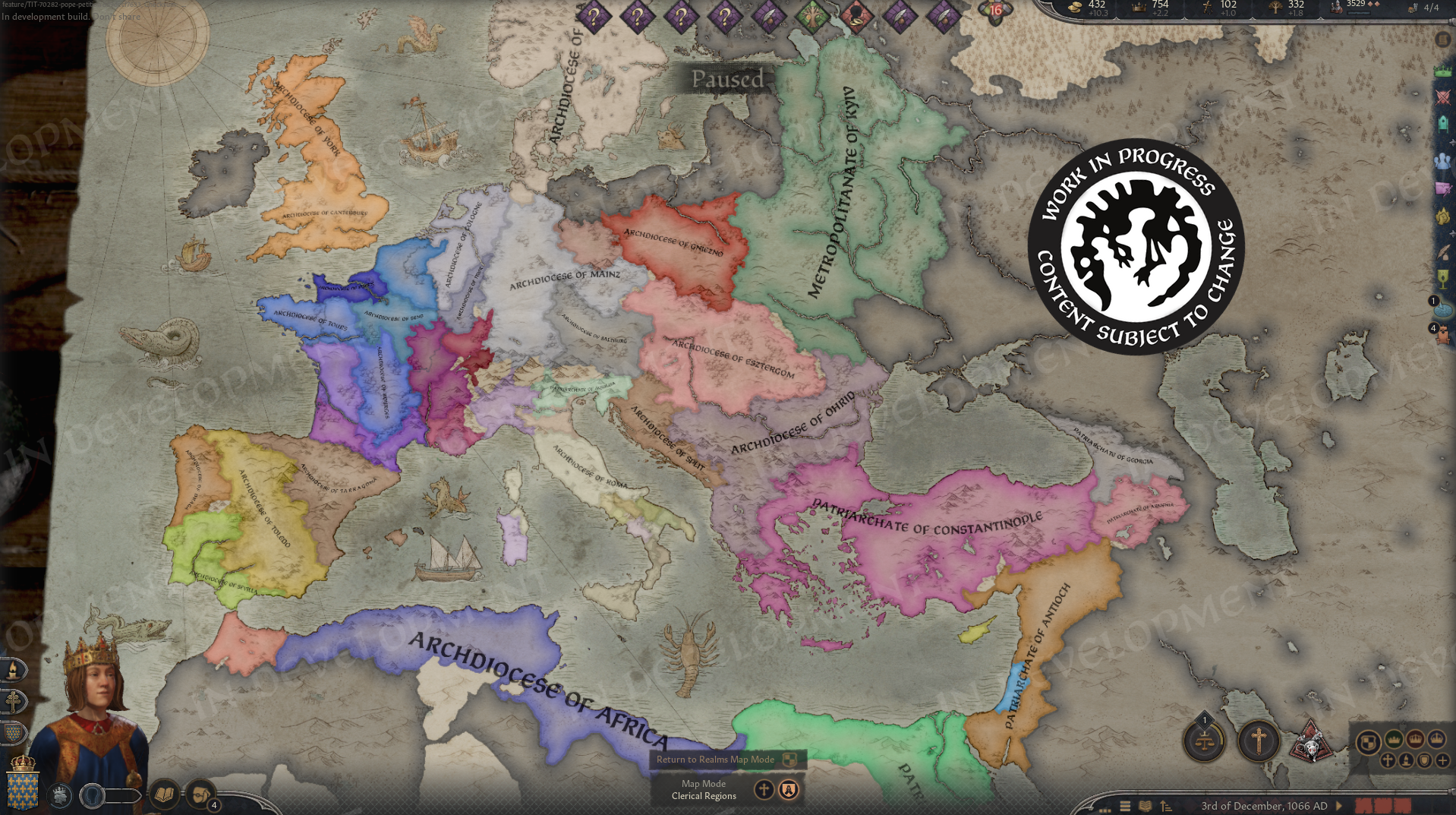
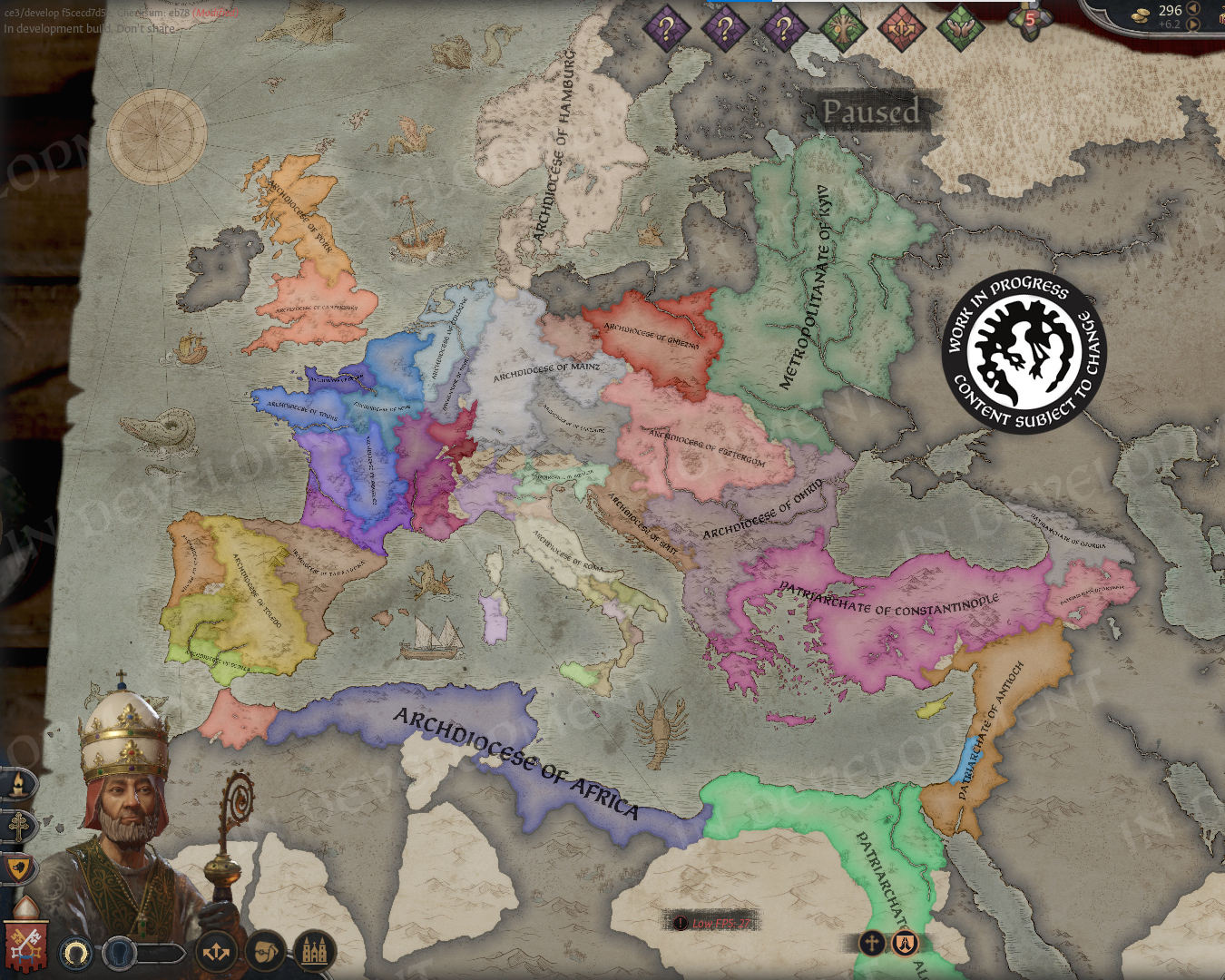 [A map of all Clerical Titles (archdioceses, patriarchates and metropolitanates) in 1066.]
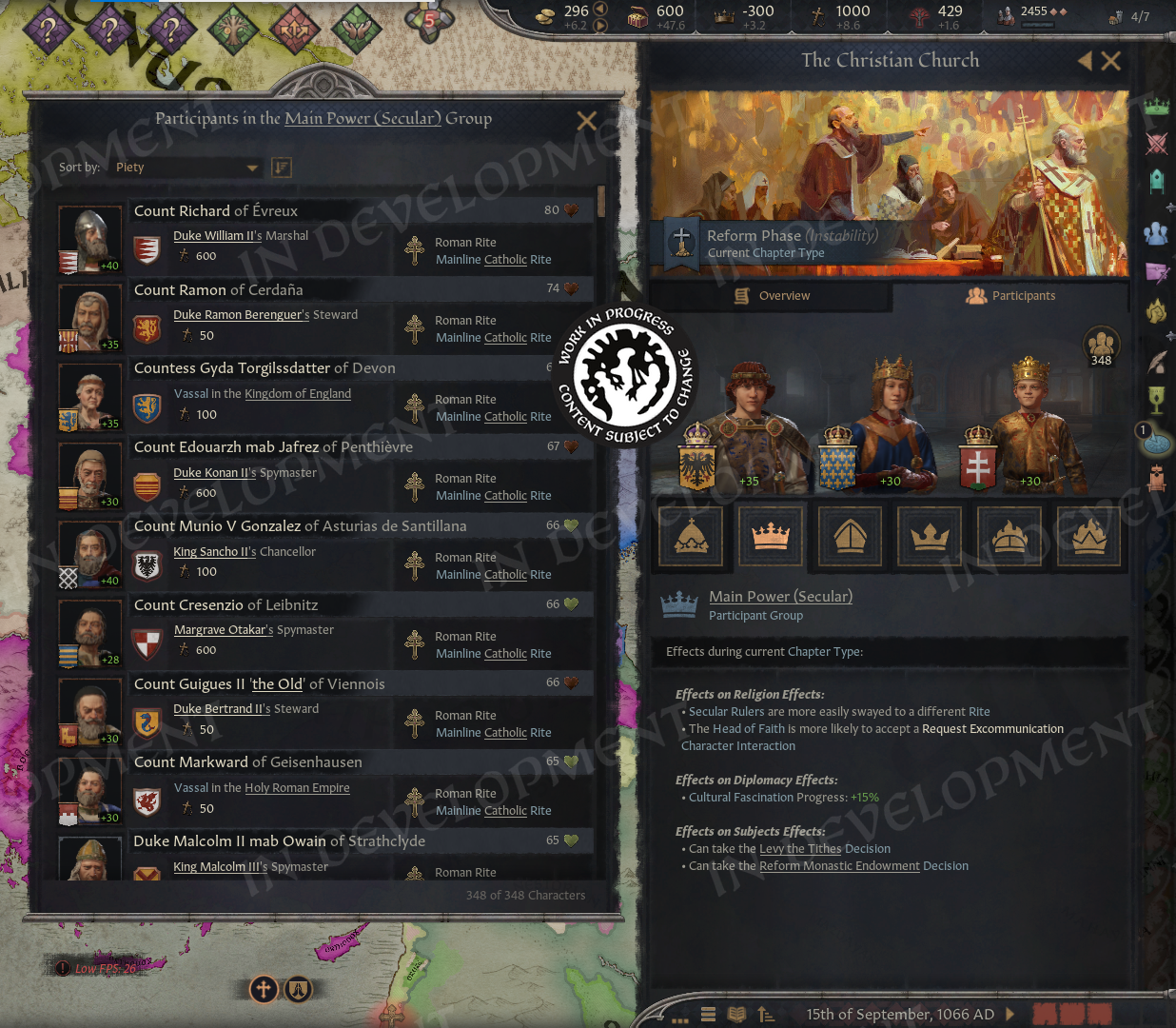
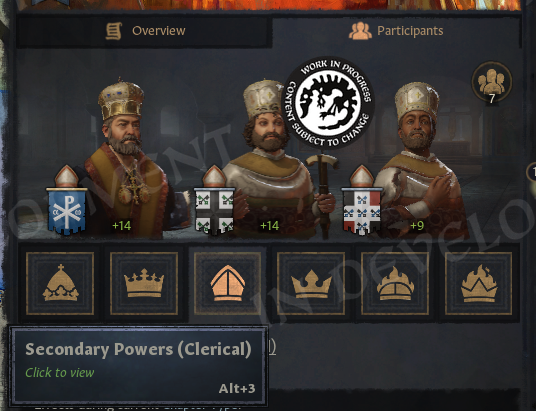
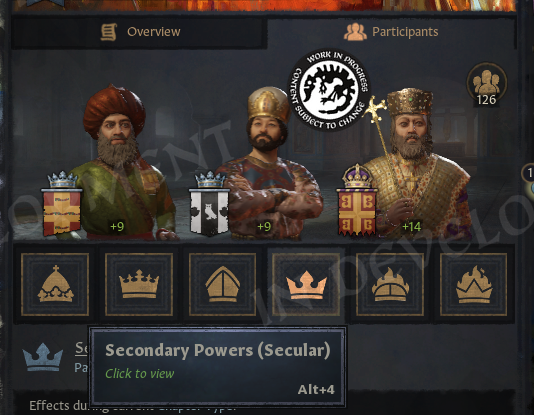


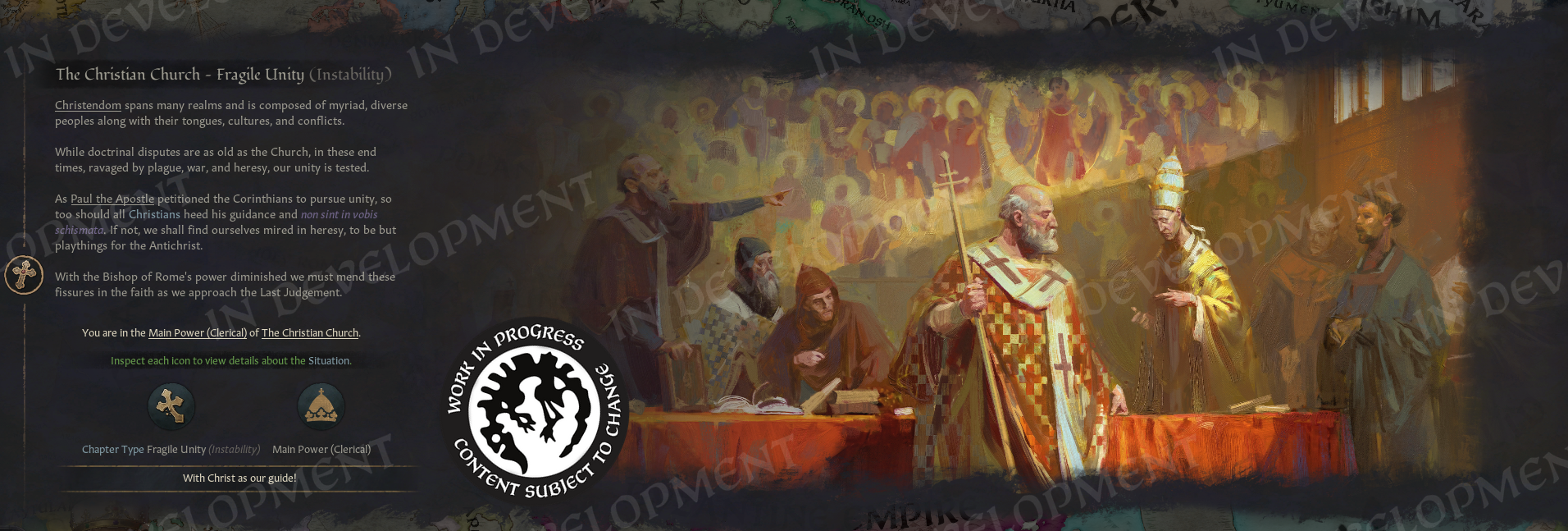

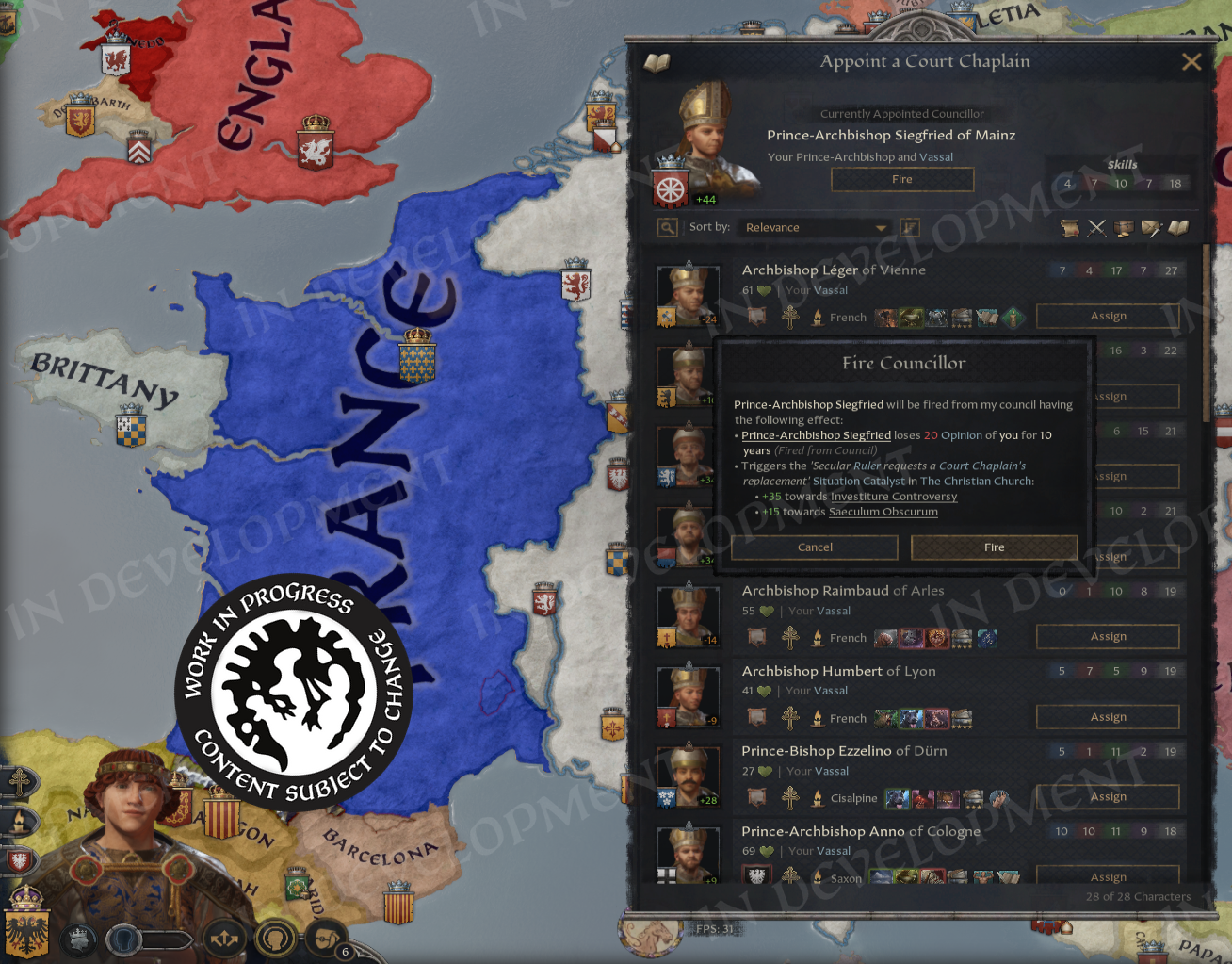
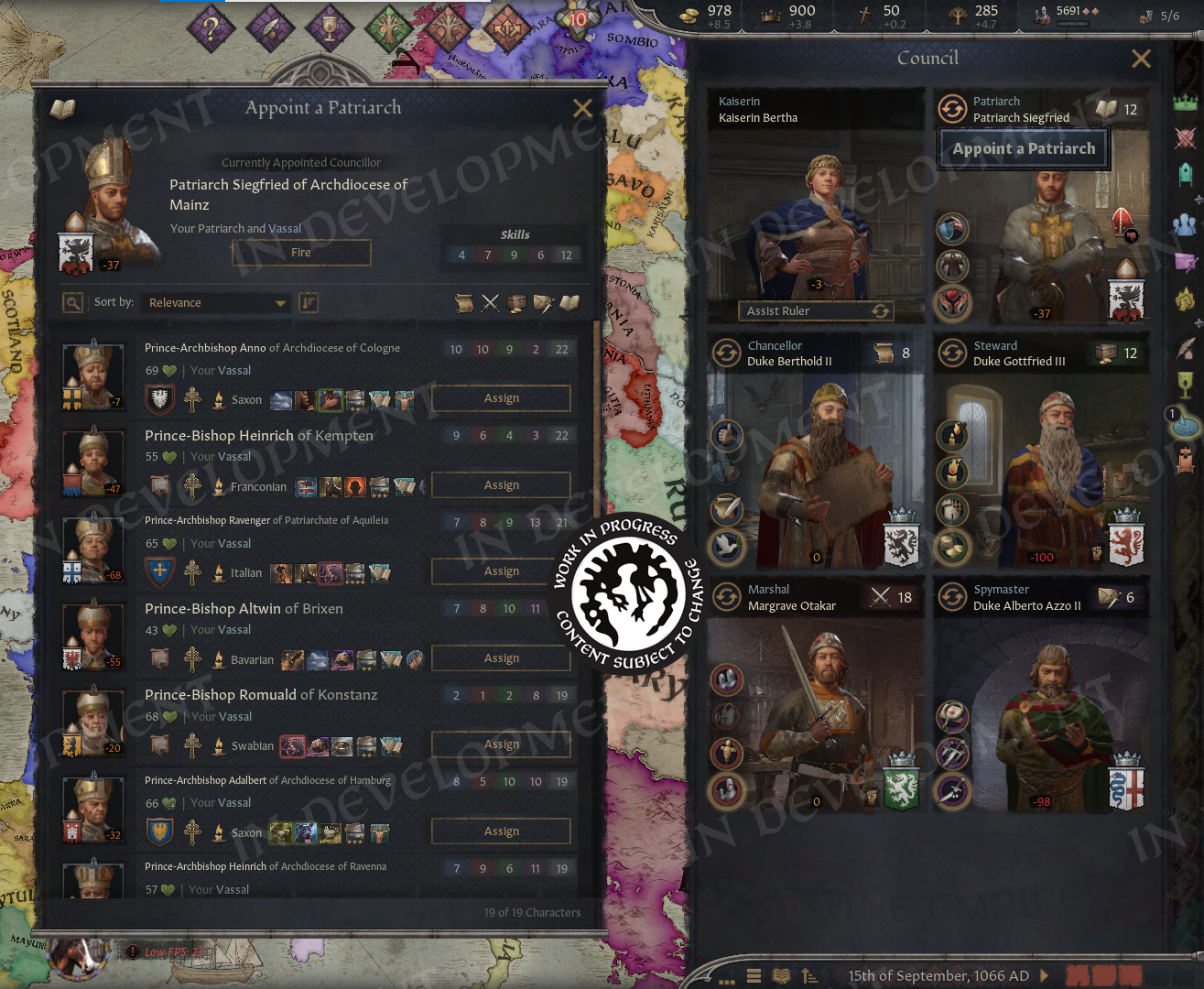 [Secular rulers can appoint their own Court Chaplains during Saeculum Obscurum.]
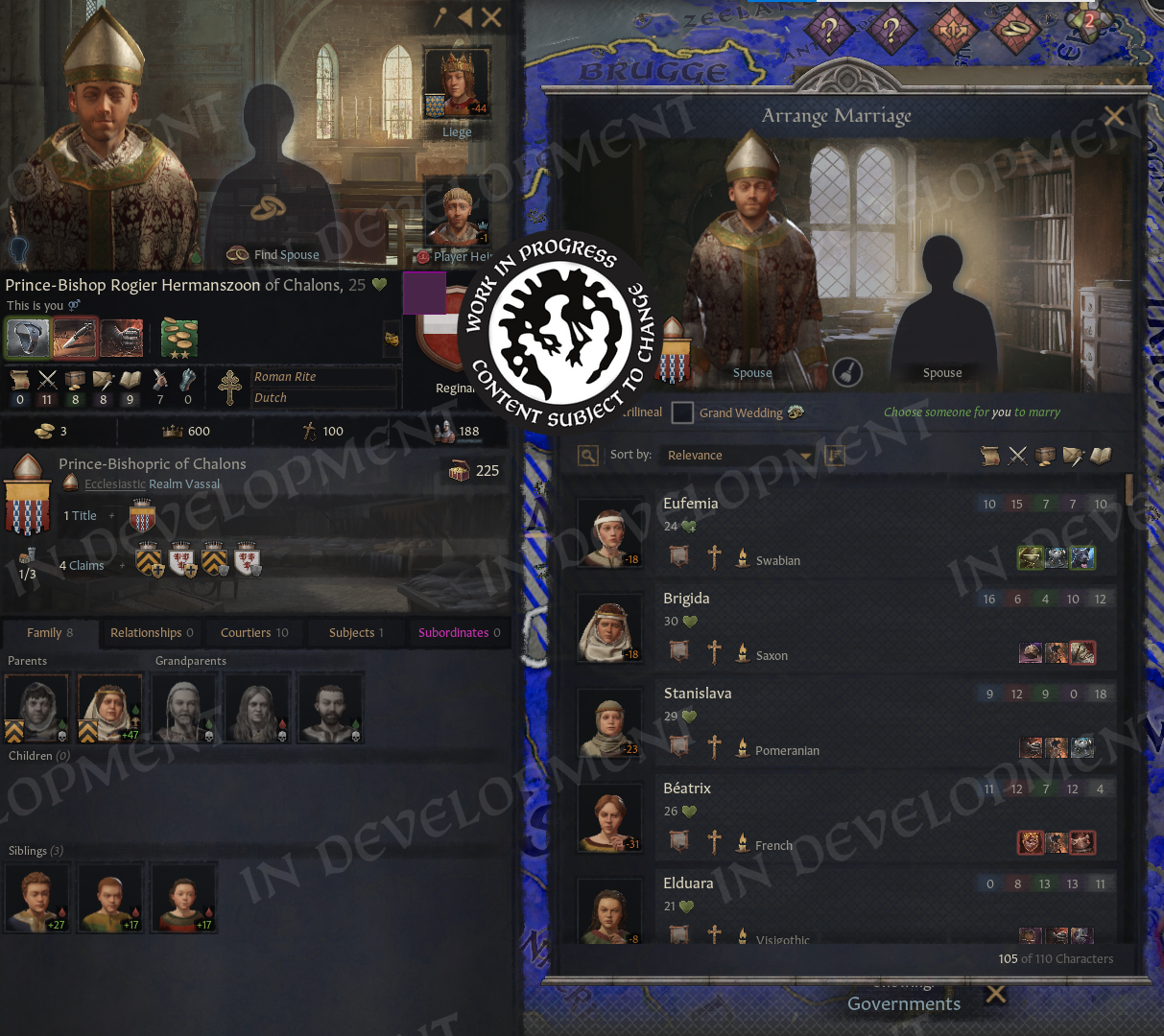 [Clergy may marry, and they even get a seduction scheme bonus during this phase.]
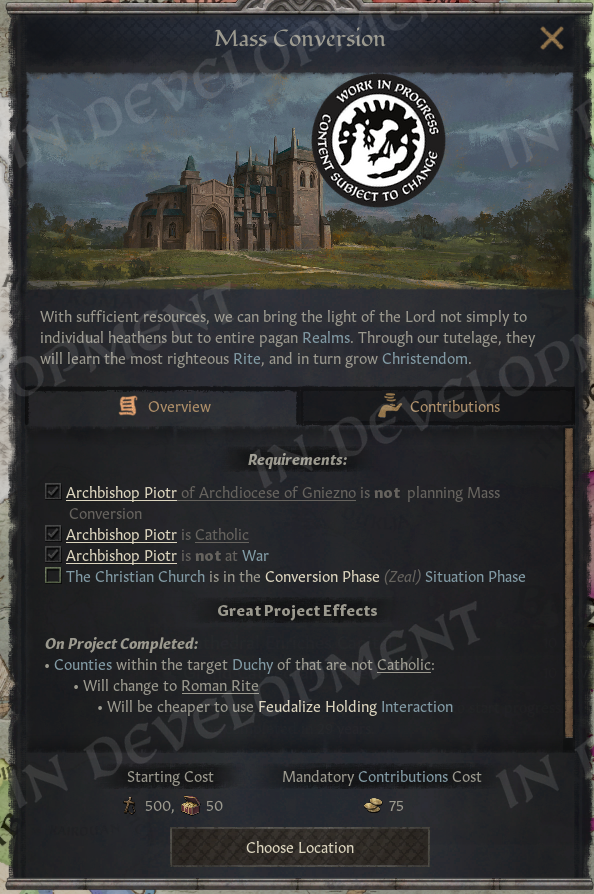

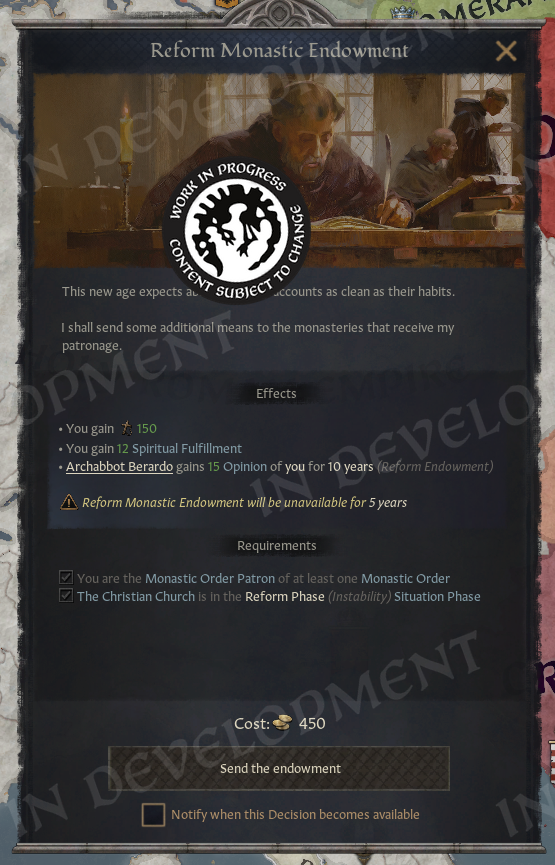
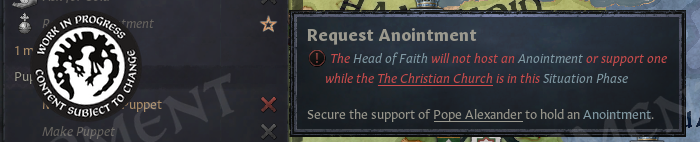

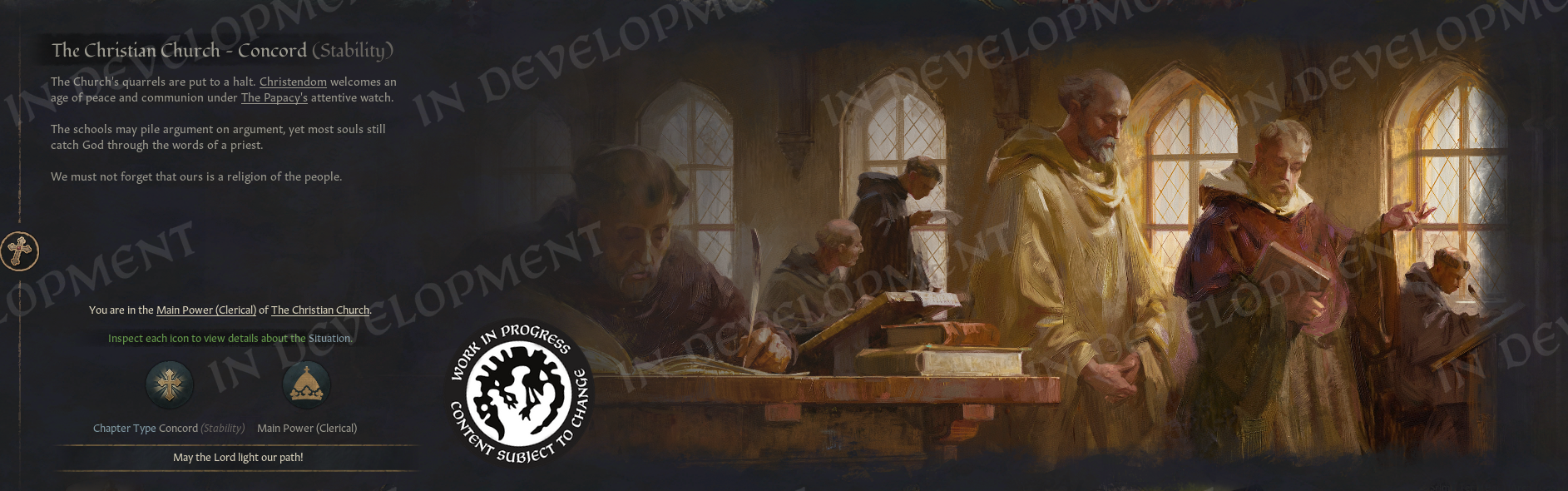

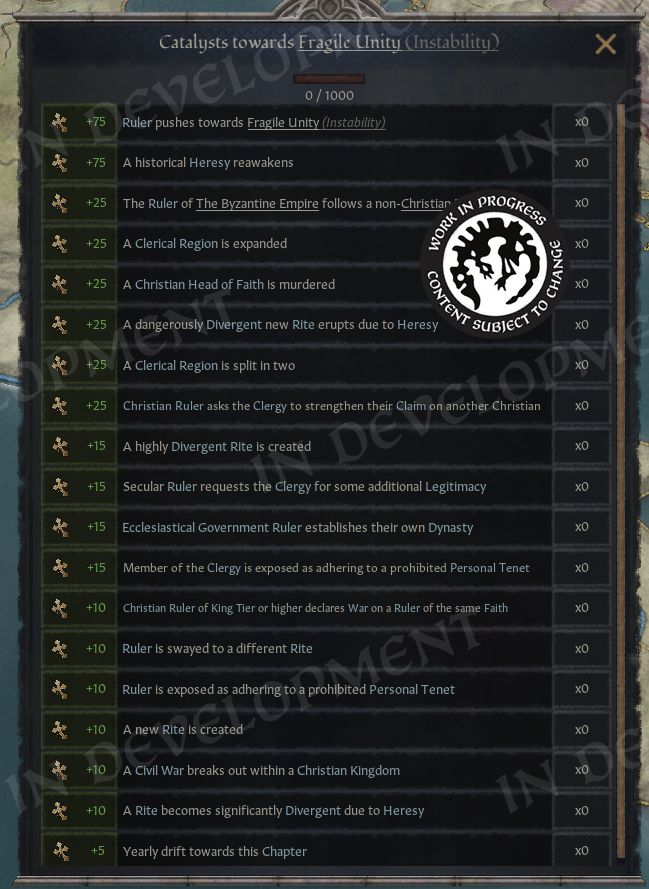

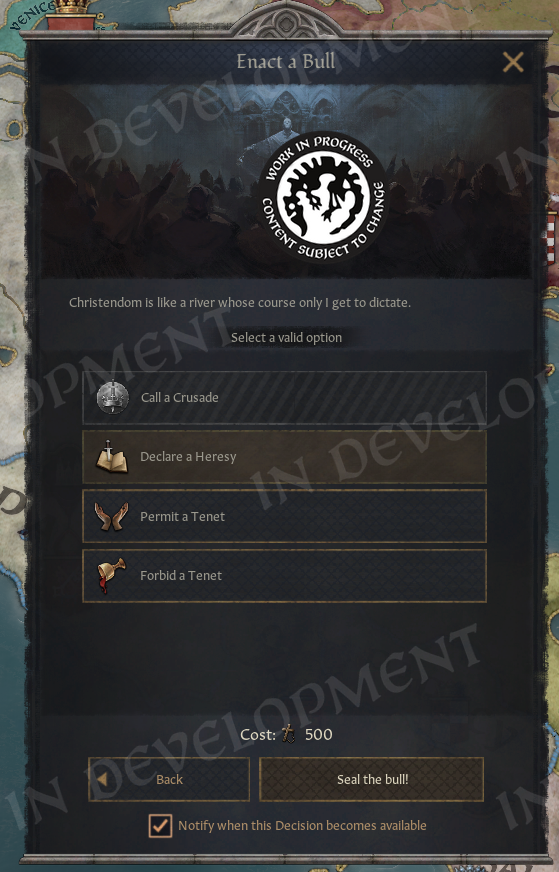
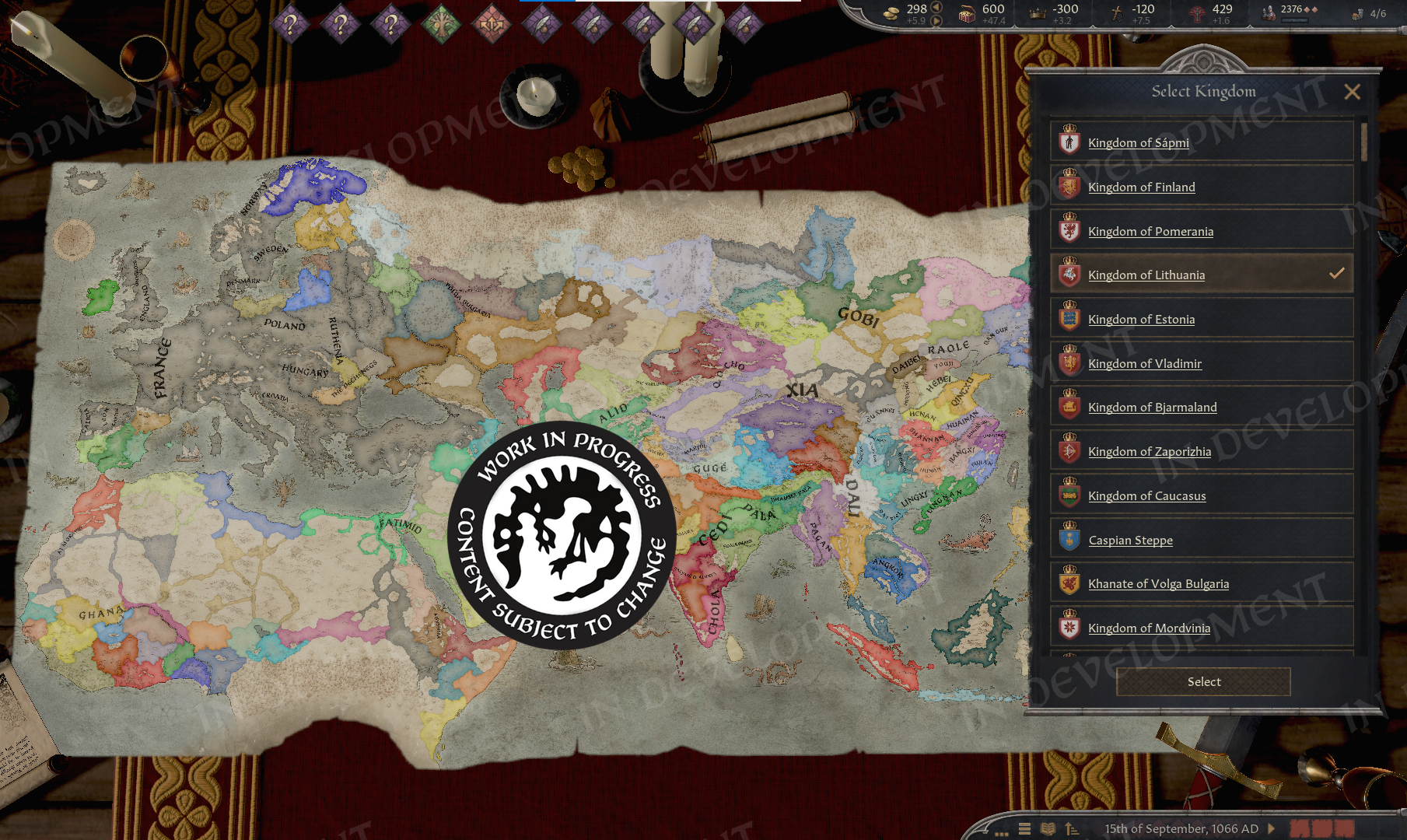 [Any valid hostile kingdom may be selected as a crusade target.]
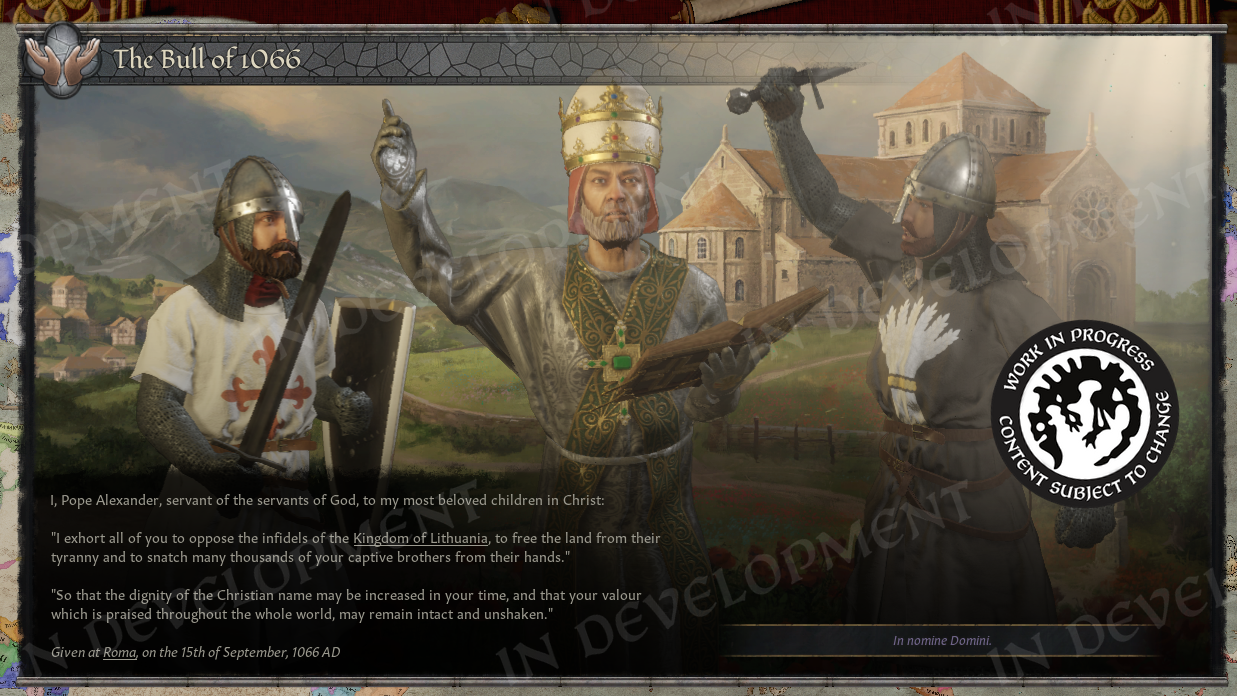 [The Pope calls a crusade for Lithuania.]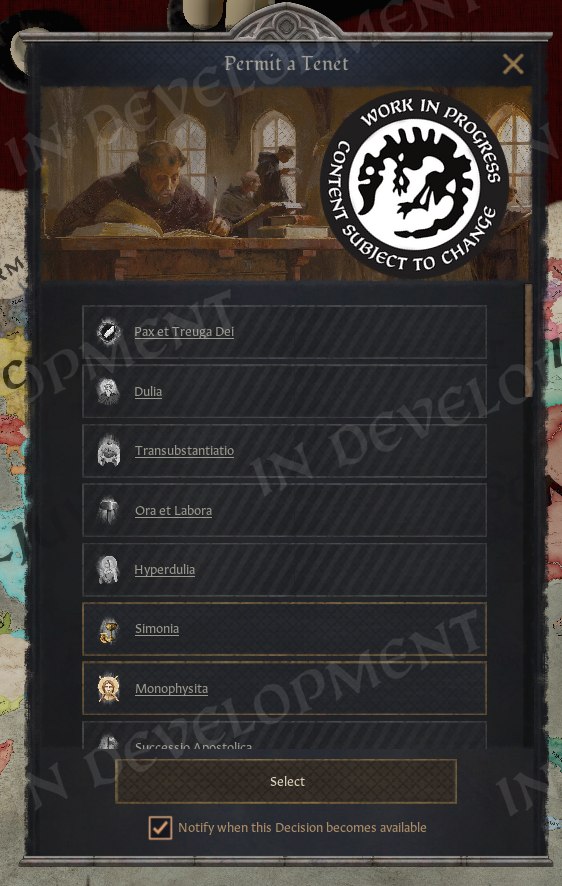













 [Reputable Company Purpose]
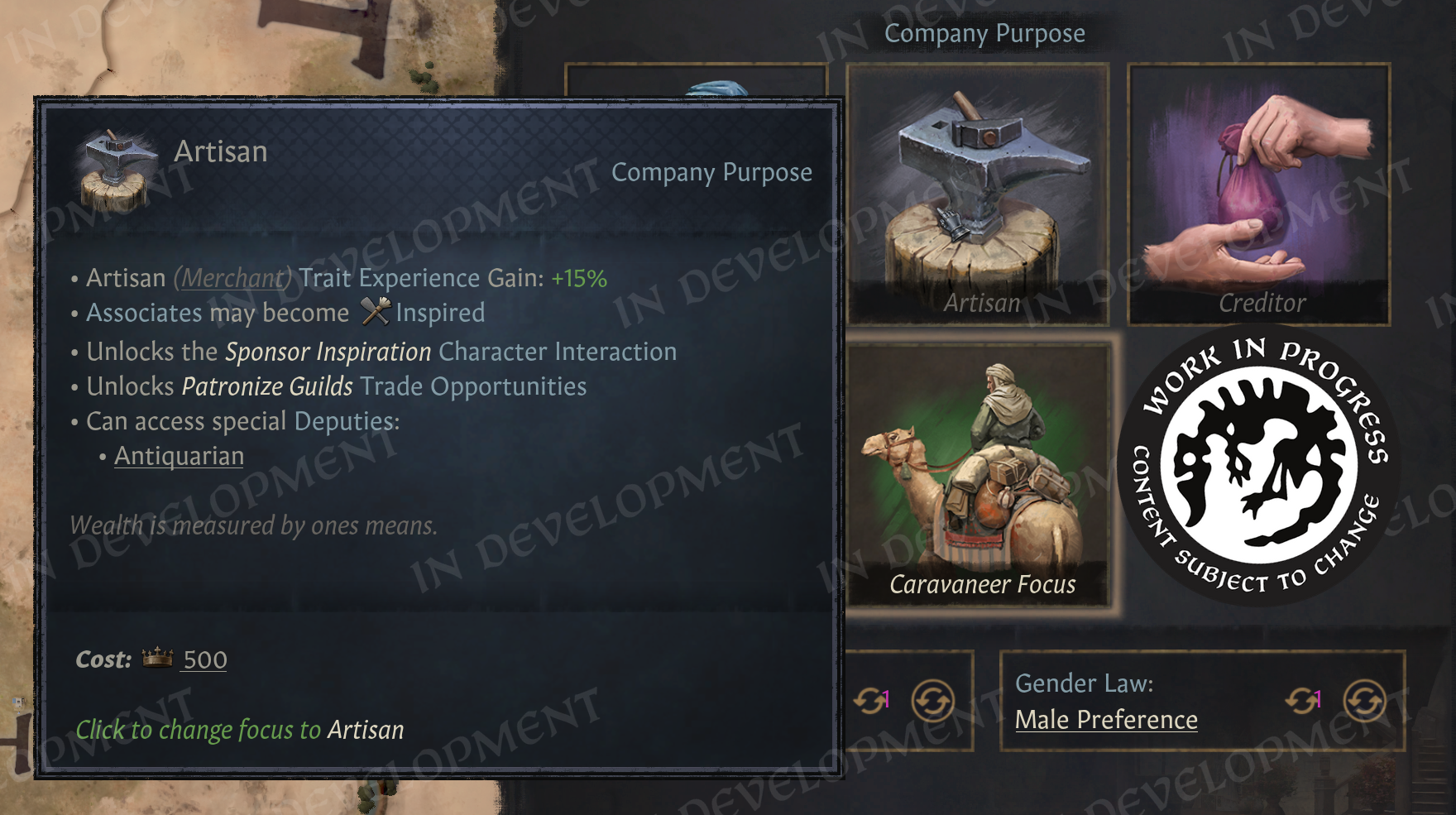 [Artisan Company Purpose]
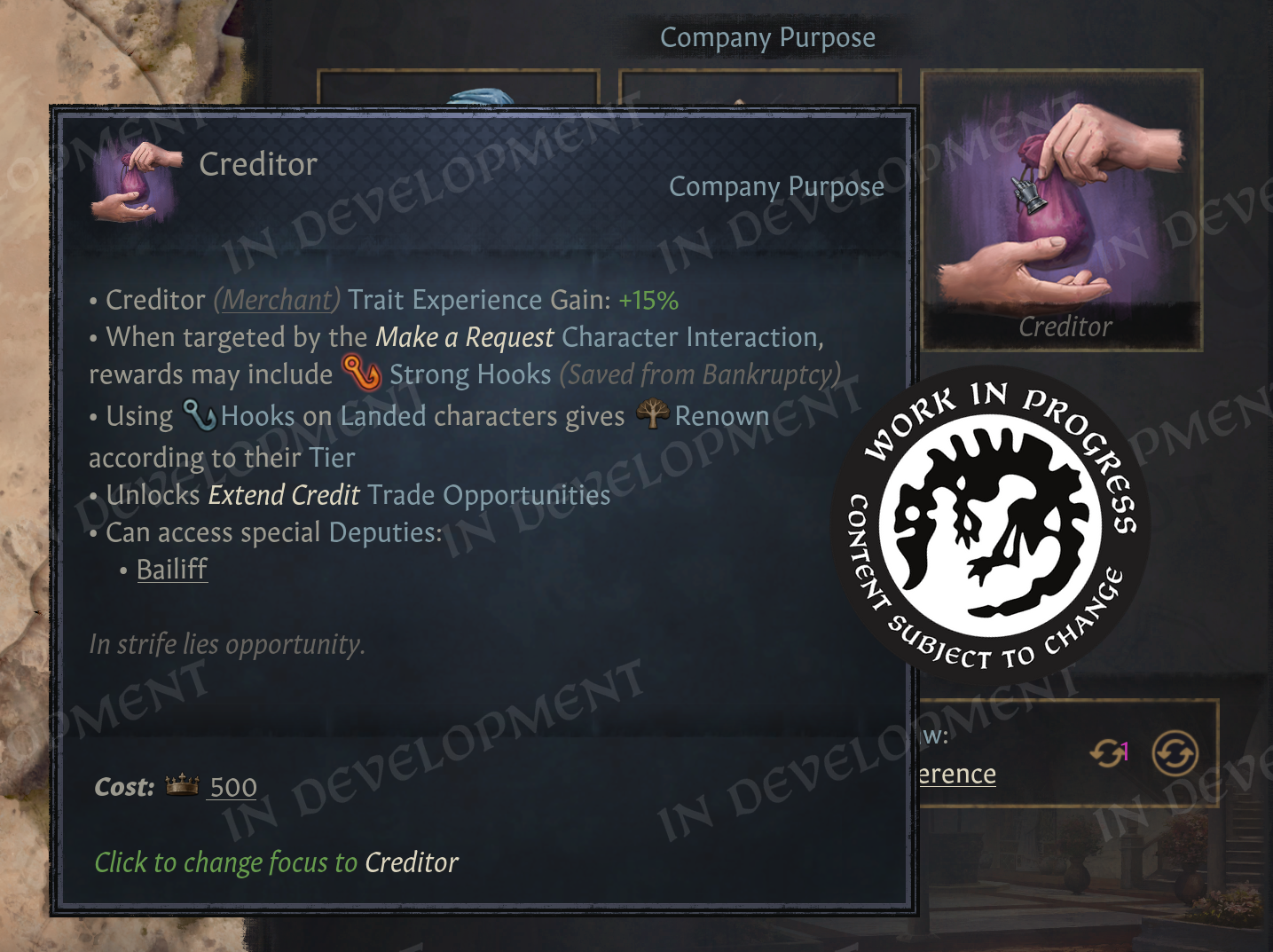 [Creditor Company Purpose]
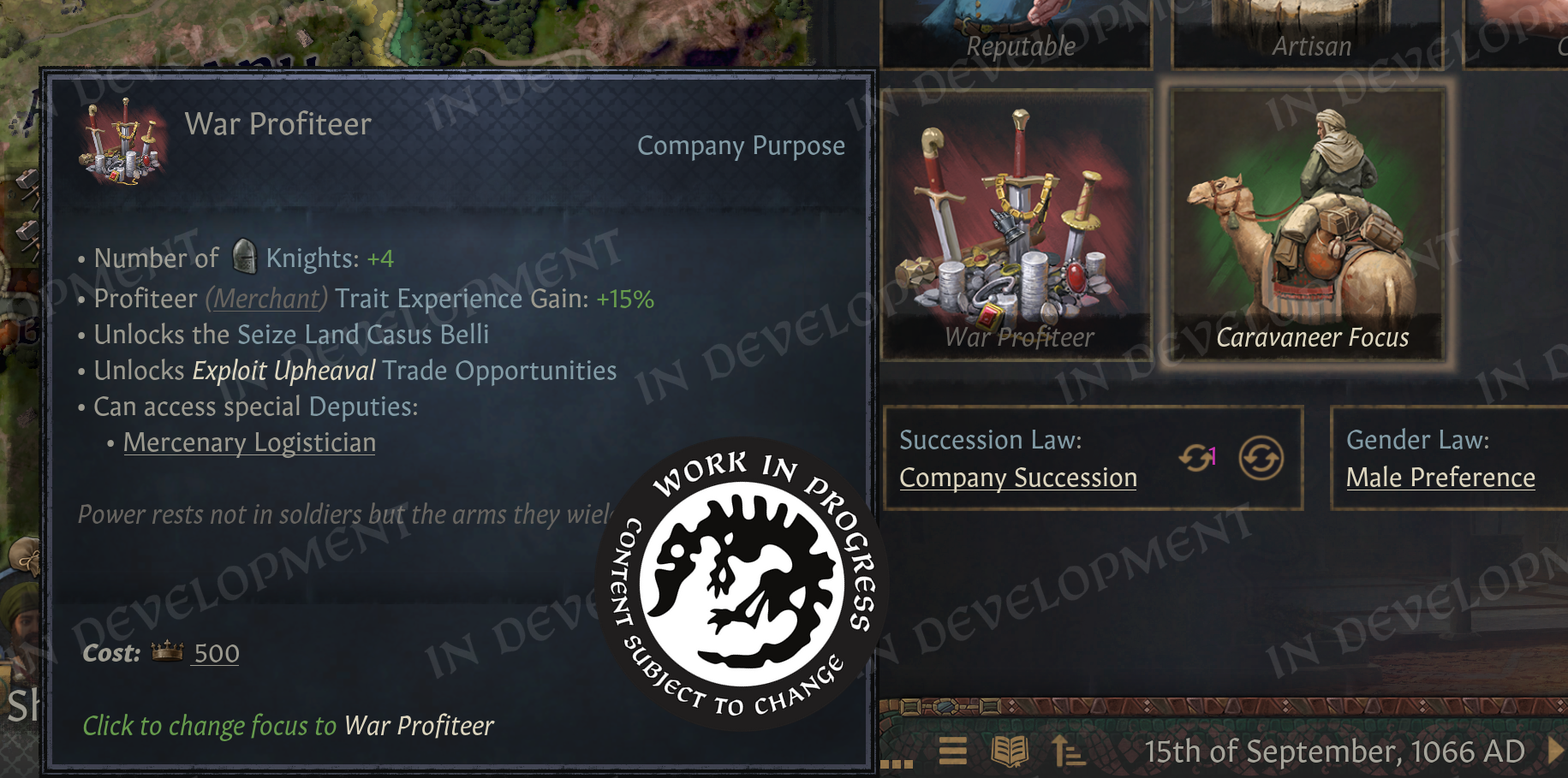 [War Profiteer Company Purpose]
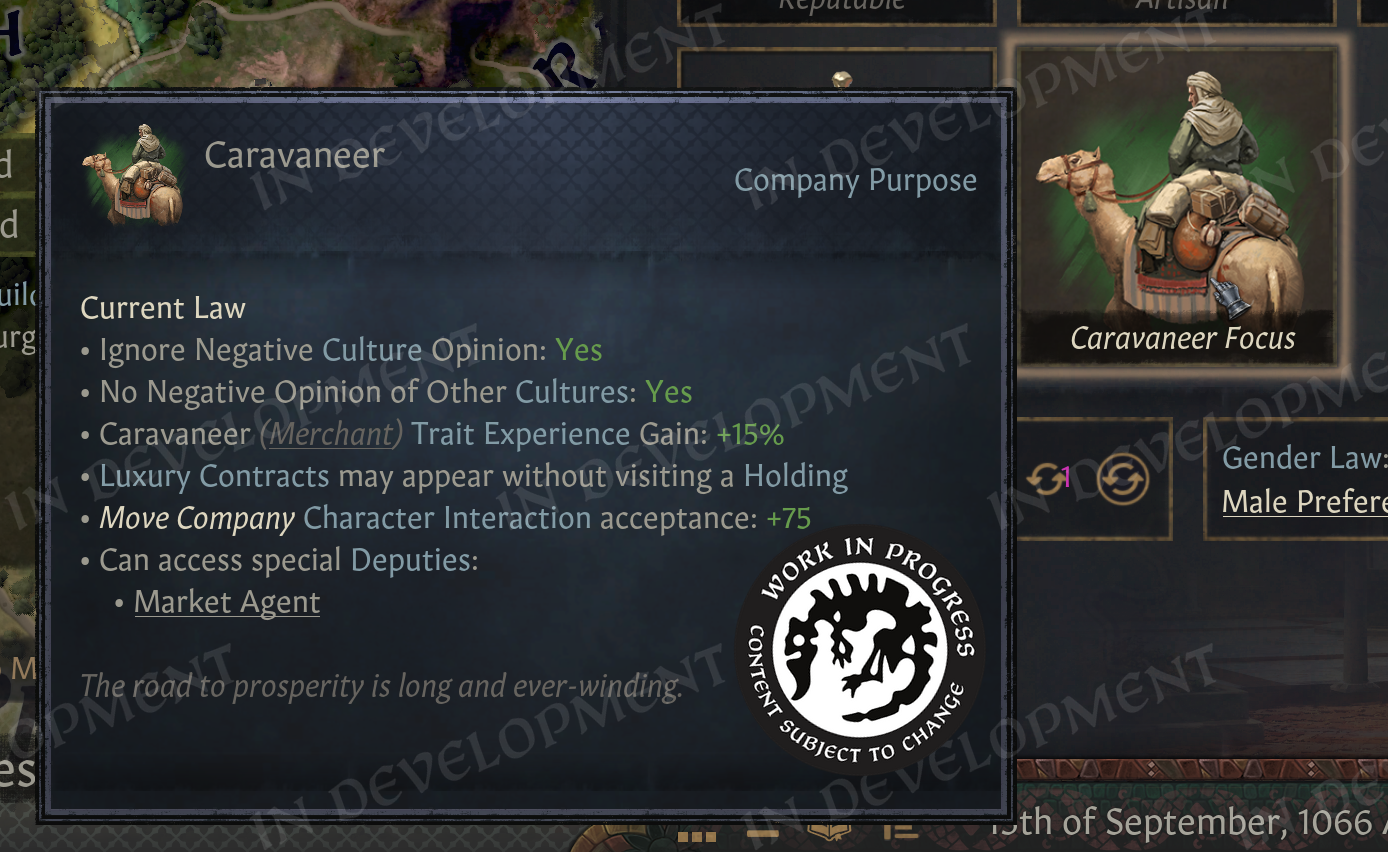 [Caravaneer Company Purpose]
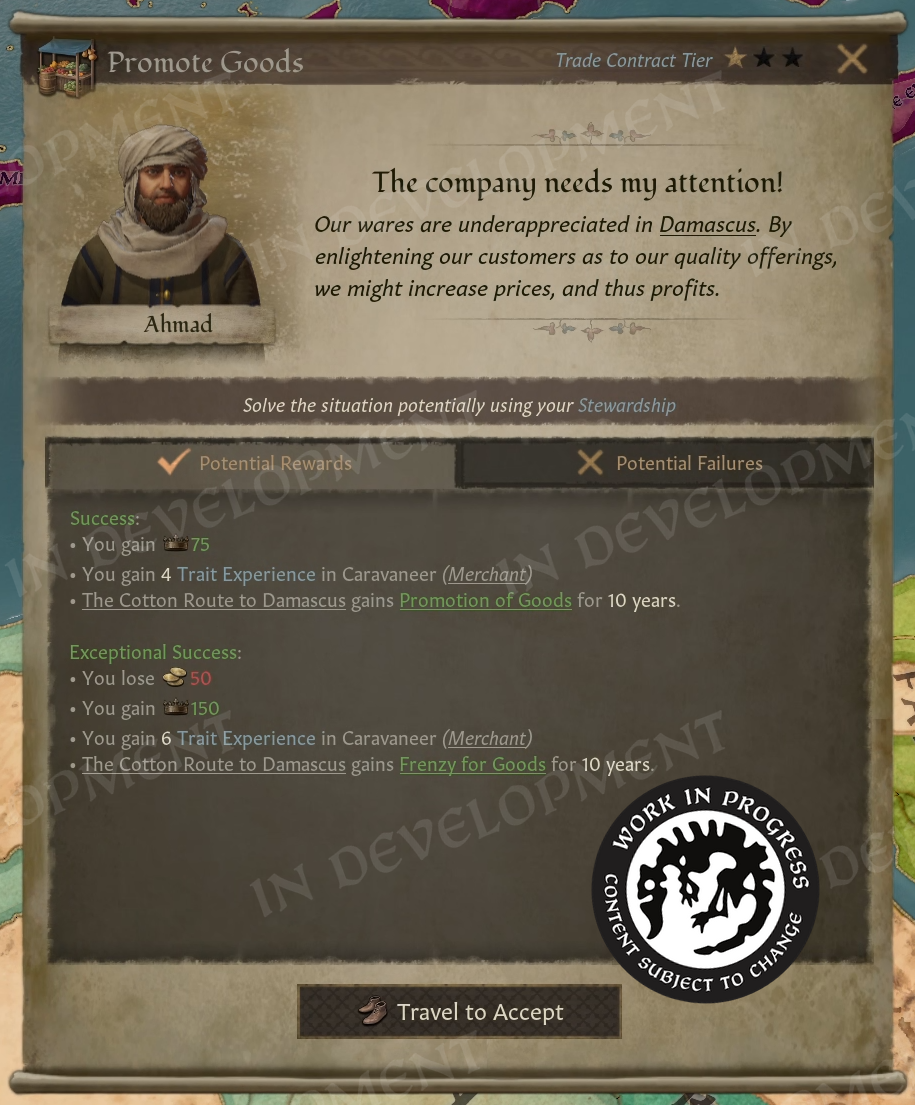 [Promote Goods Trade Opportunity]
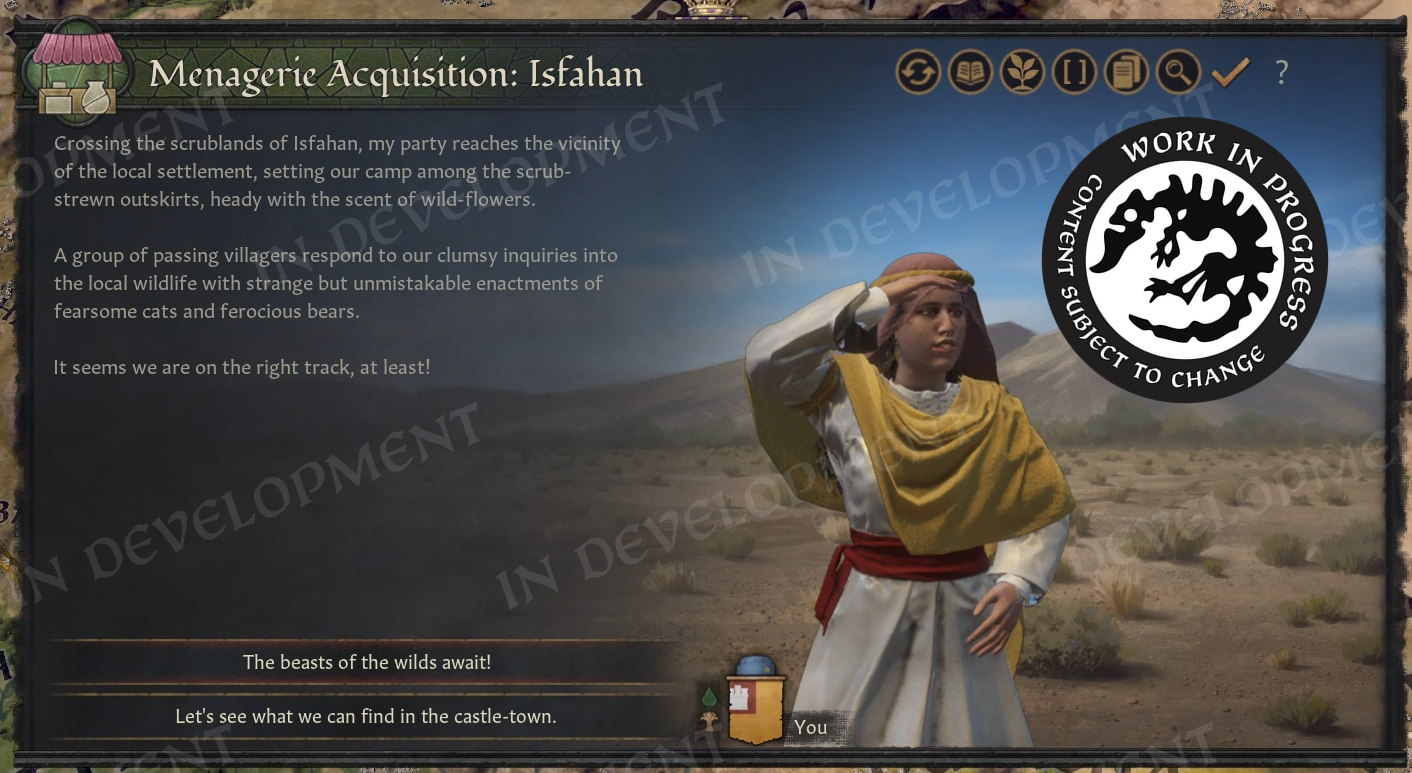 [Luxury Contract Event]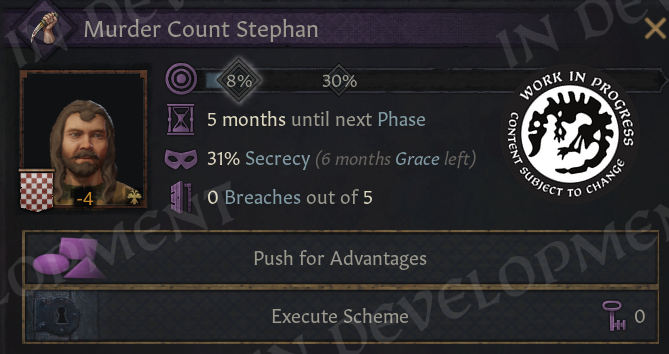
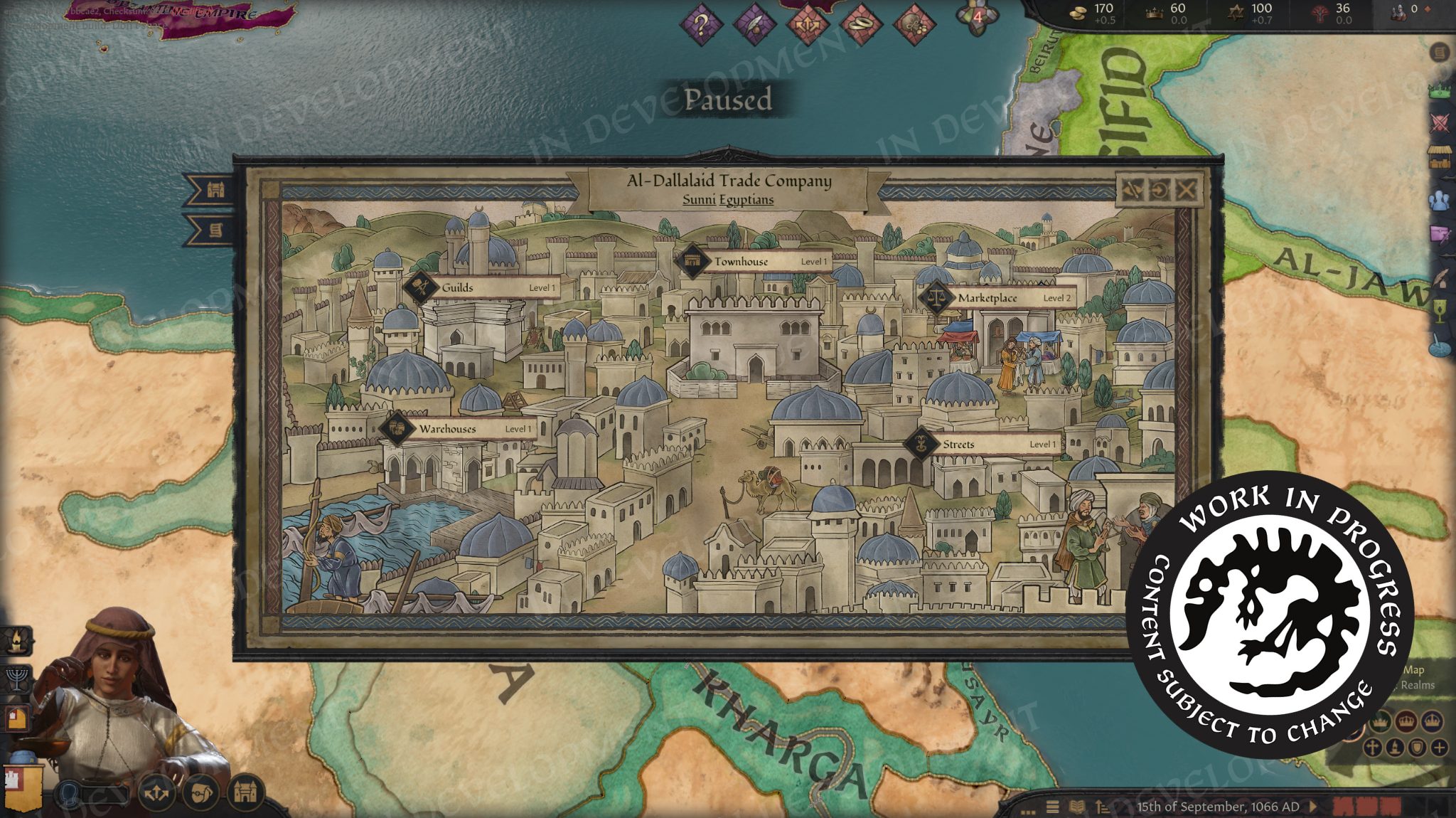 [Wuhsha’s Domicile at Game Start]
 [Domicile Artifacts]
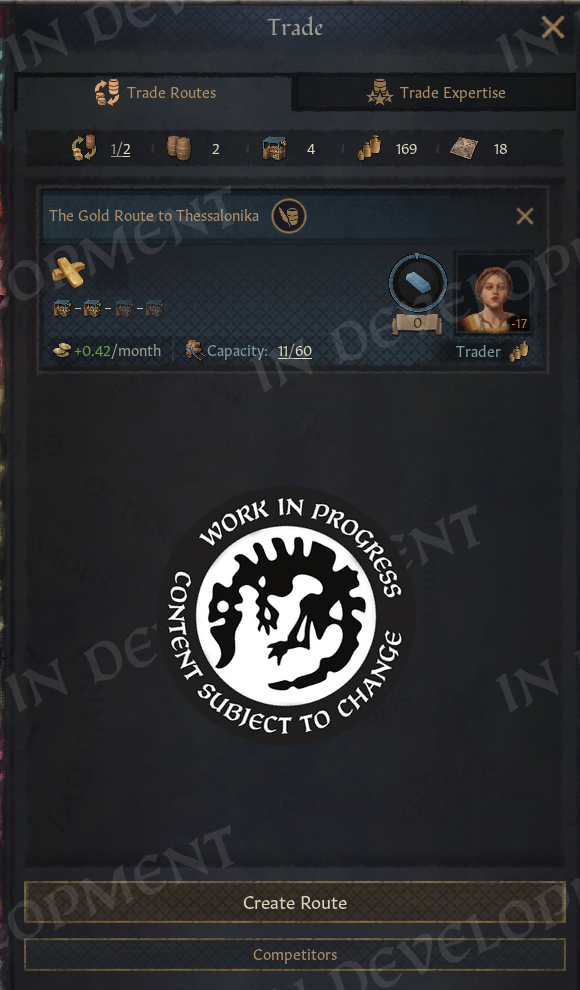
 [Trader assigned to Trade Route]

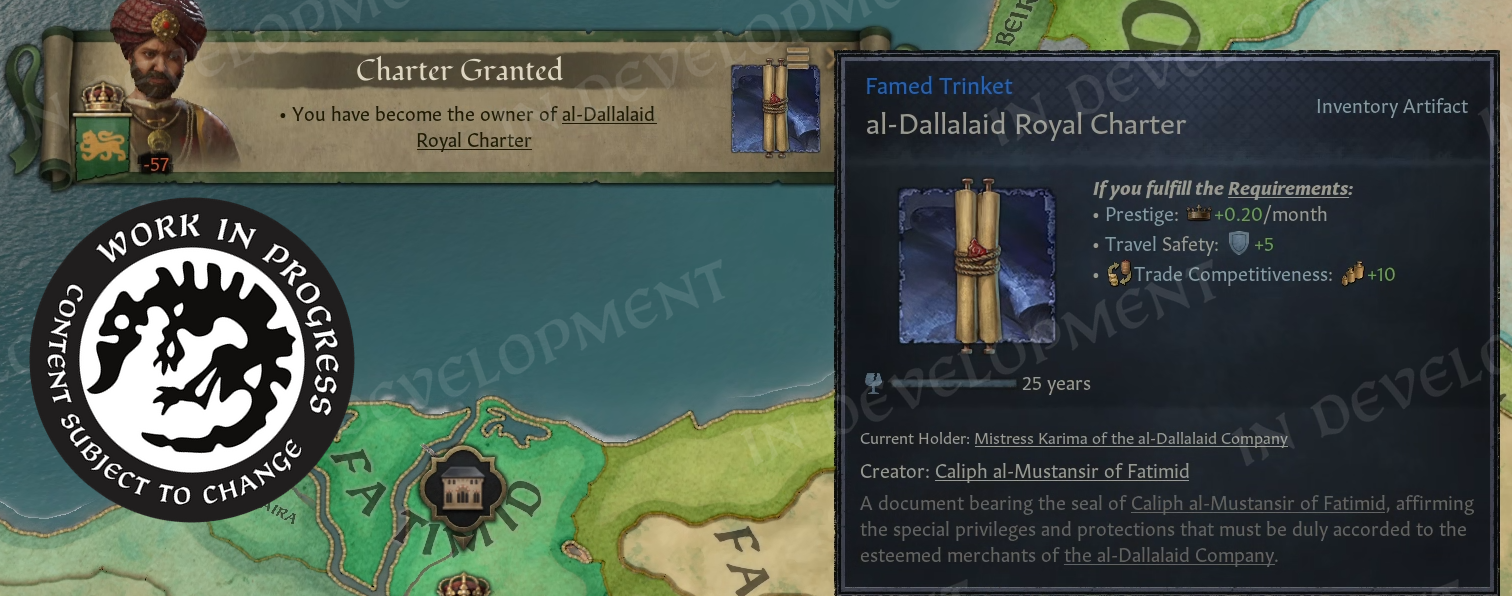 [Charter gained]
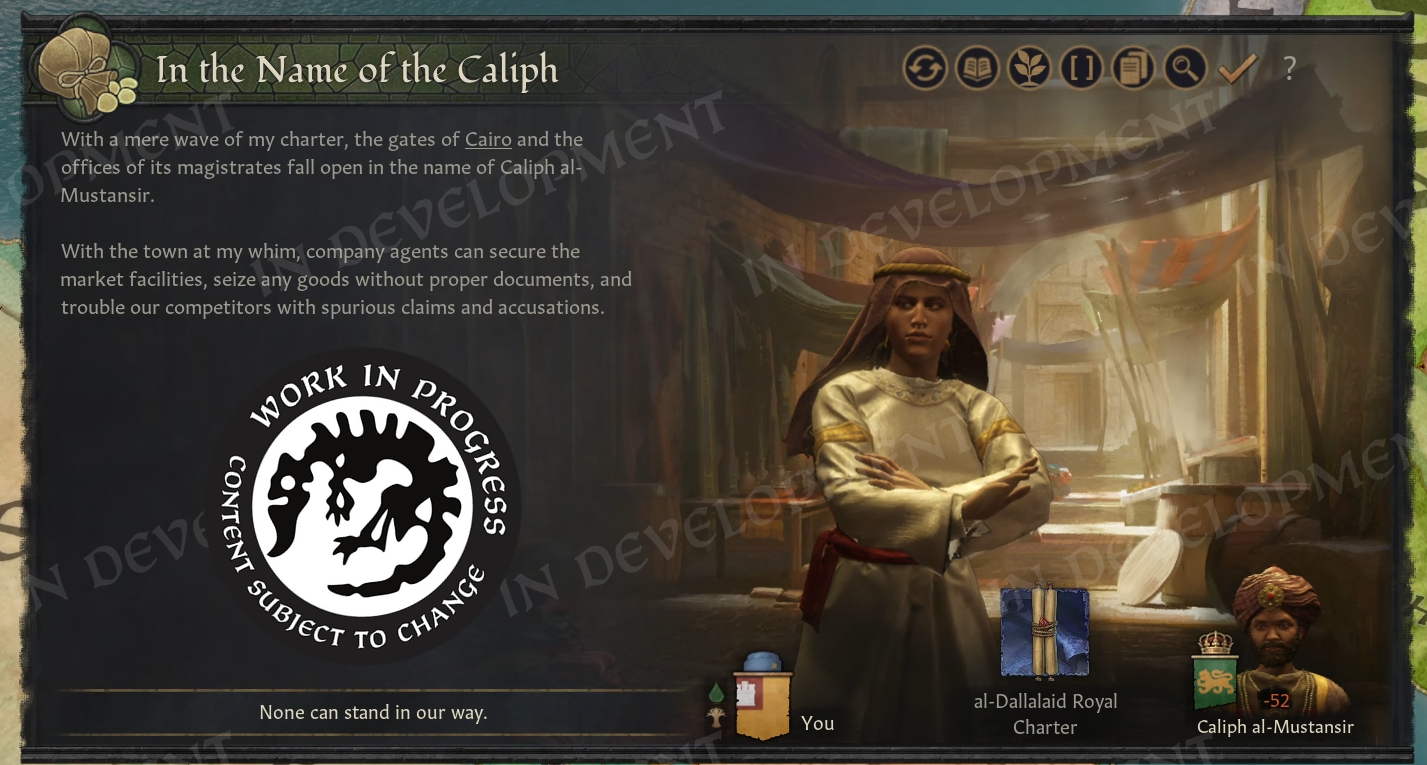 [Abuse Charter Authority Event]



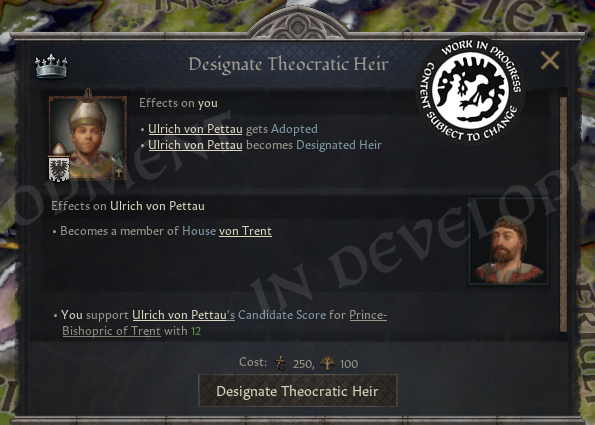


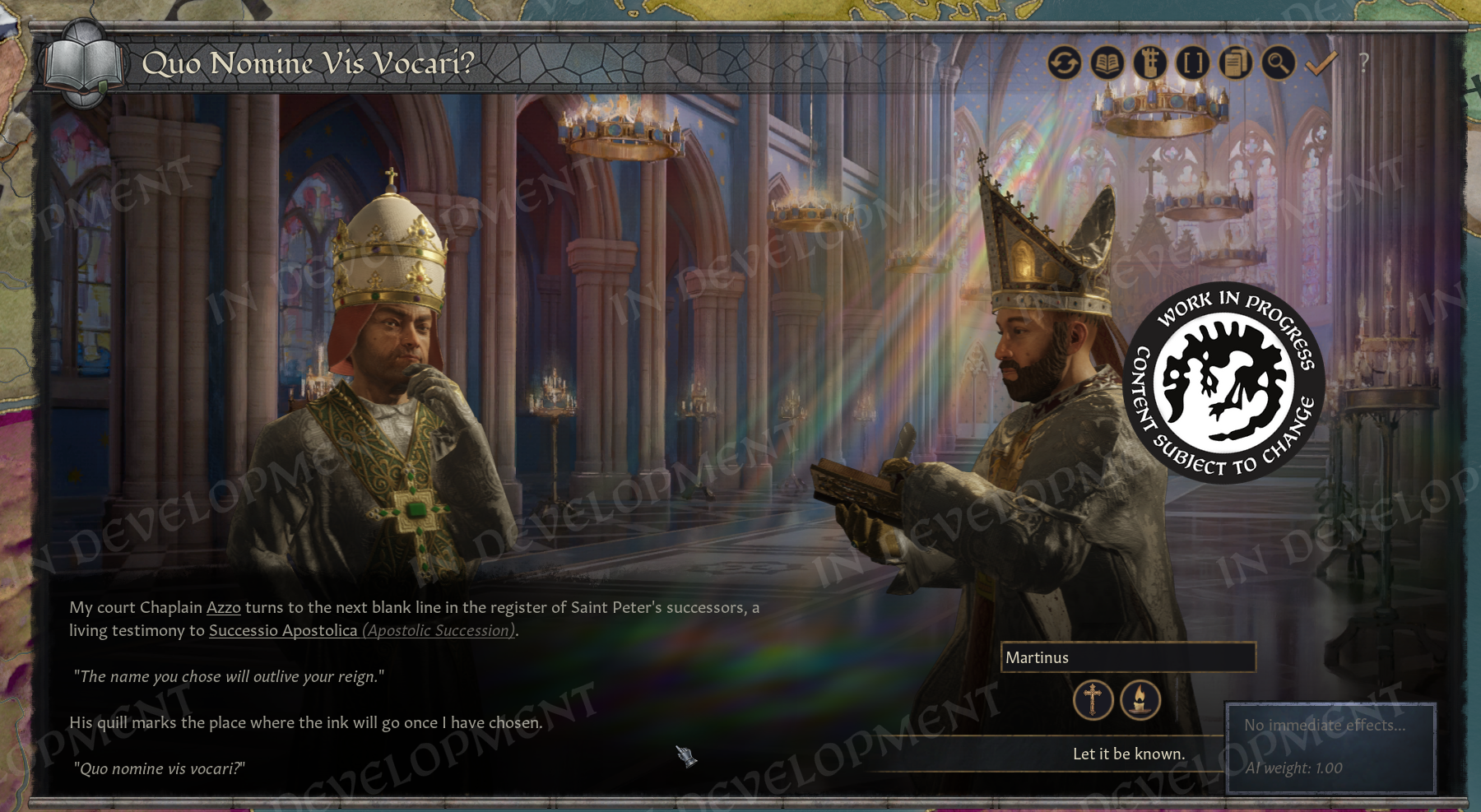 [Screenshot of an event where you get to select your own pontifical name after having been elected Pope]










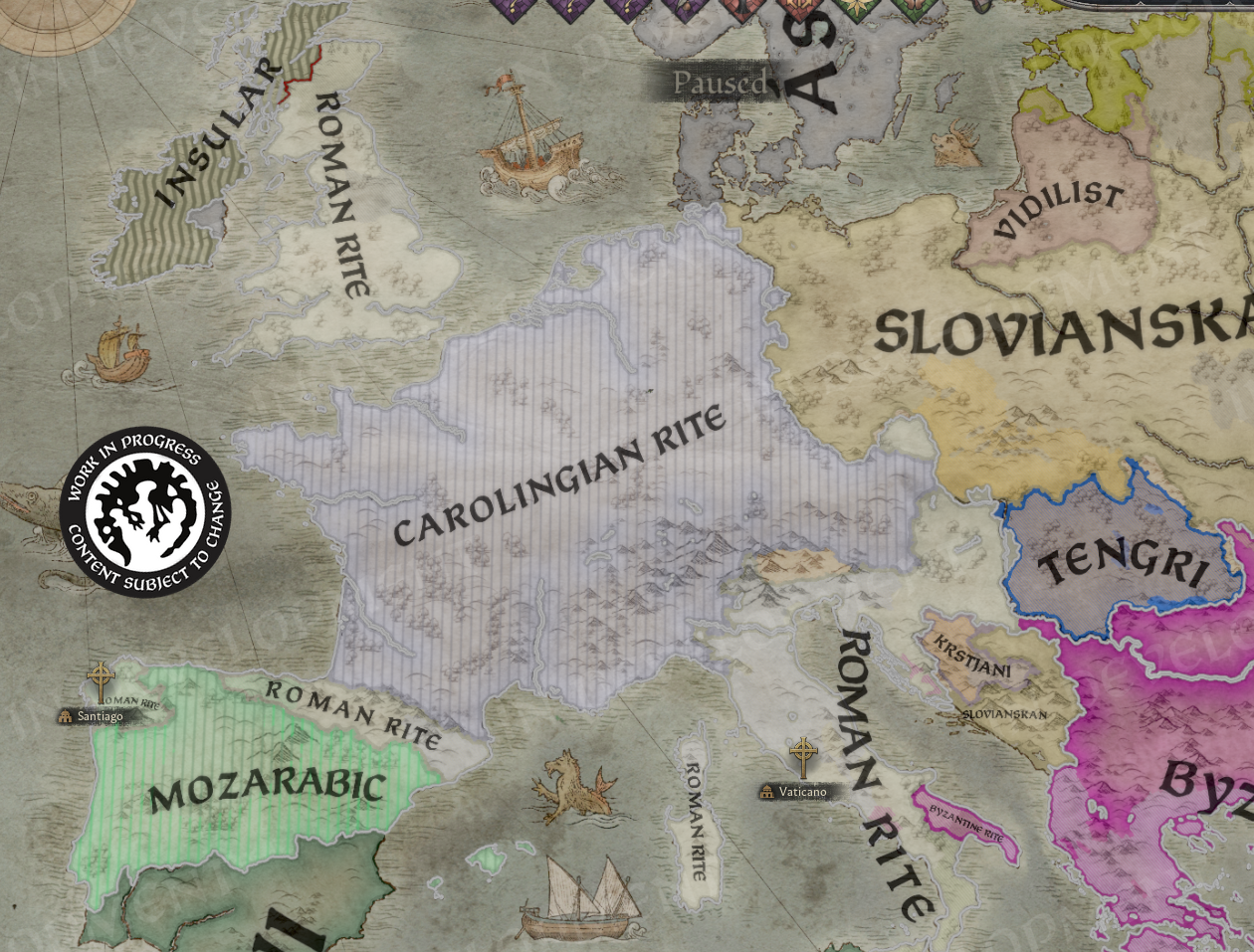



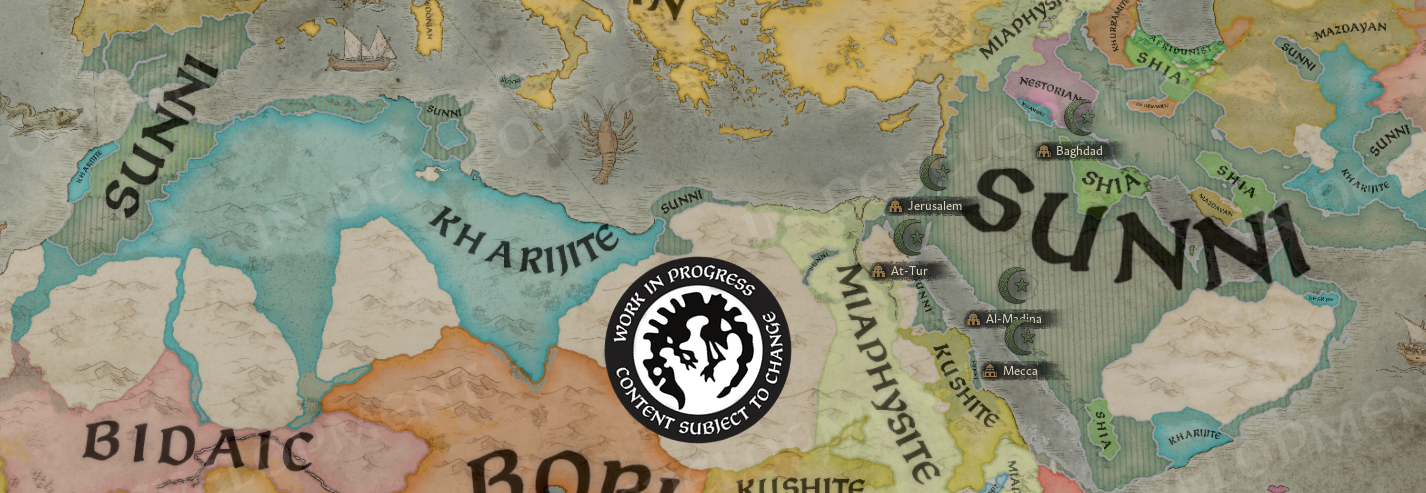
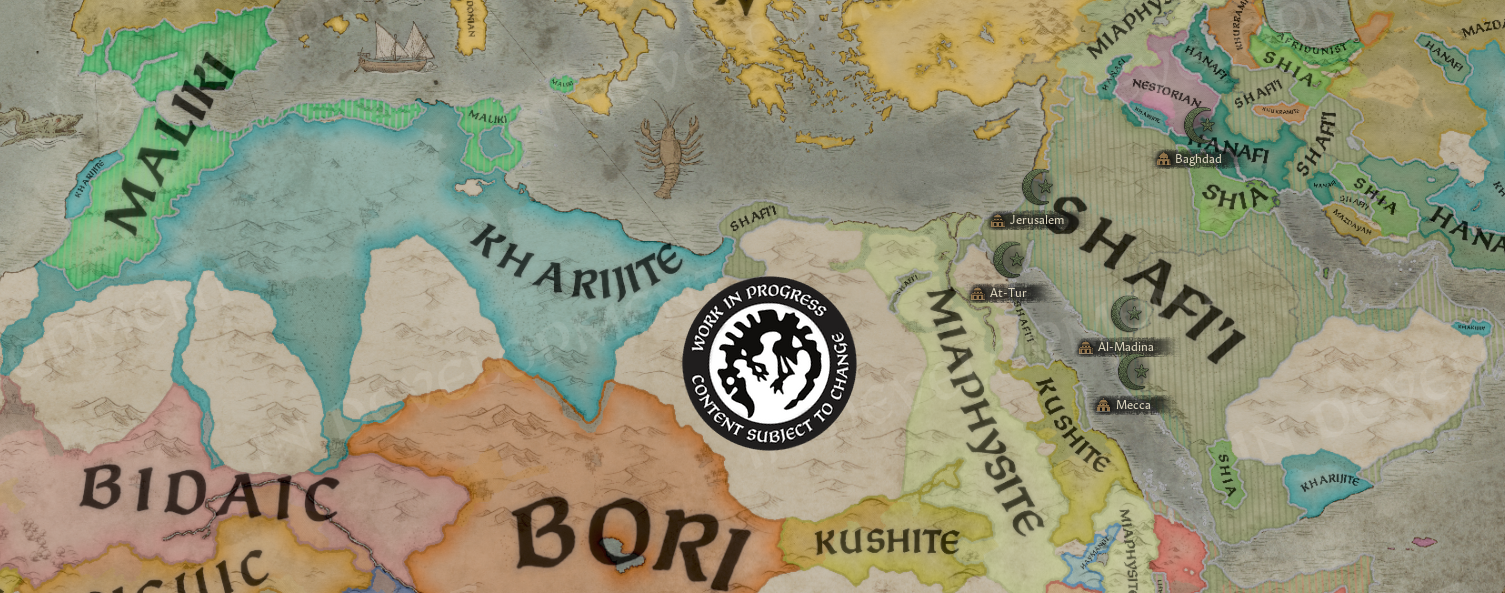 [Screenshot of revised Islamic setup in 867]